Salt & regeneration
How Much Salt Should You Add to a Water Softener—and How Often?
Choose a model-appropriate refill level, record the salt actually added, and estimate your replenishment needs without a universal bags-per-month rule.
Troubleshooting
Understand how model and regeneration stage affect salt-tank water. Record consistent observations and choose the next check for high, low, or hidden water.
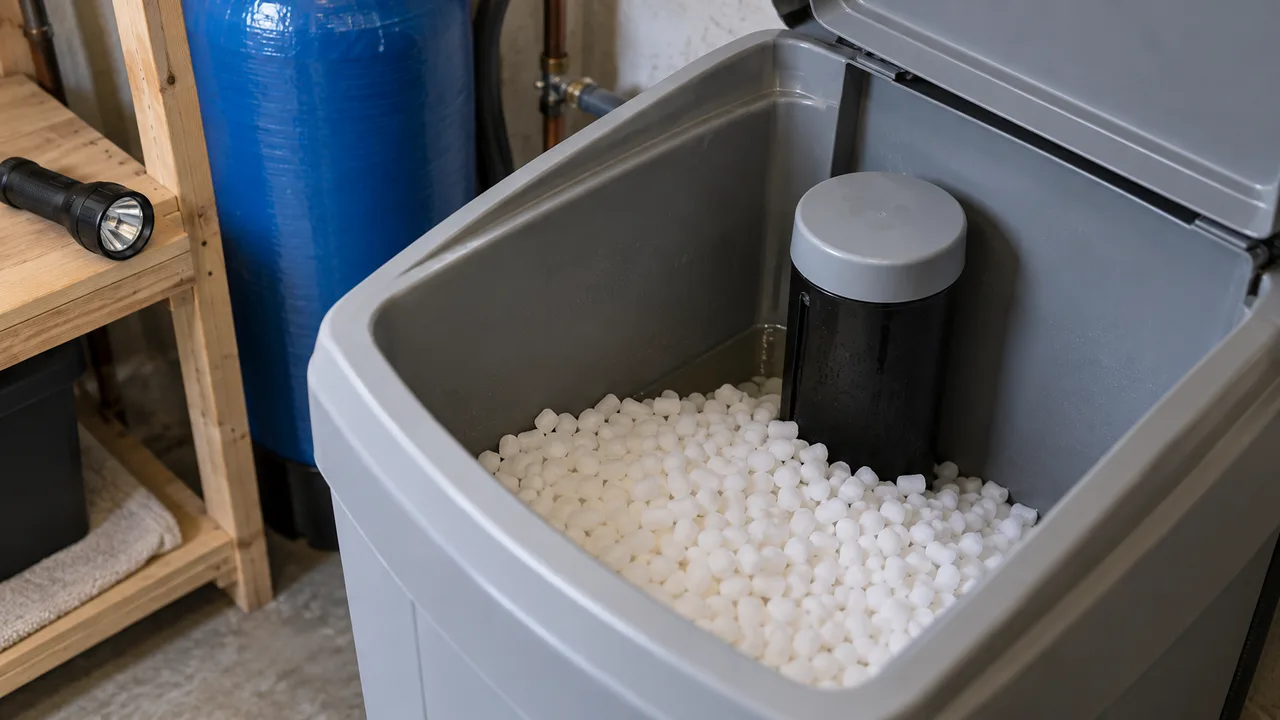
The normal amount of water in a softener's salt tank depends on the complete system, its fill sequence, and the point in the regeneration cycle when you look. A single depth, or a rule that water must always be above or below the salt, cannot diagnose every system. Identify those conditions before adding water, draining the tank, or changing settings.
For example, Rheem's guidance for its covered softeners describes about 0–4 inches at the bottom after the cycle settles, with the level rising and falling during recharge. That is a brand-specific reference, not a target for an unrelated separate-tank system. The useful first record is “this model, at this stage, with this salt level.”
Locate the complete softener model and the manual that matches the installed configuration. If the system was assembled from separate components, the valve name alone may not identify the tank, salt setting, or complete operating instructions.
In Rheem's explanation of salt-tank water levels, the water rises during recharge and returns to the described low level afterward. Its installation water charge is a commissioning instruction; it is not a direction to add that amount at every refill.
Other documented sequences place refill later. The flow diagrams in the Fleck 5600SXT Upflow Service Manual, printed page 22, show a brine-tank fill stage after rinsing and before returning to service. A system using that sequence prepares water for the following cycle. Check the actual installed configuration rather than treating “upflow” or “digital” as a complete description.
| Fill sequence confirmed by your manual | What to compare |
|---|---|
| Fill occurs before brine is drawn in that recharge | Before-cycle observation versus the same point after a completed cycle |
| Refill occurs near the end of the cycle | Post-refill observation versus post-refill observation on another completed cycle |
| Sequence is unknown | Record the display and model; get the sequence identified before judging depth |
The tank can look different at two times without either observation being abnormal. The question is whether it follows the expected sequence and returns to a consistent condition for that equipment.
Salt can hide water at the bottom of the tank. Looking down at the pellet surface and seeing no water is not the same as establishing that the tank is empty.
Rheem's no-water observation guide describes looking into the brinewell with a flashlight, using the access appropriate to the model. If your instructions provide that observation point, use it without dropping salt or objects inside. Replace any cover afterward. If you cannot identify safe access, take an exterior photograph and ask the manufacturer where to look.
Use a fixed reference such as the same visible molding or tank edge. Write down whether you are describing depth from the bottom, distance below the rim, or simply “visible beneath the salt.” Those are different measurements. Do not label a visual impression as an exact number of gallons.
Photograph the salt and water before a refill. Adding salt changes what can be seen and displaces water, so an after-refill photograph is not directly comparable to one taken with little salt remaining. The same issue makes another household's tank photo a poor measurement standard.
If the tank is stable and there is no active leak or overflow, observe its next normally scheduled cycle from the outside when practical. Do not start repeated manual cycles solely to produce a more reassuring photograph. If the display does not identify a stage clearly, record the exact message instead of guessing.
Use the page's Print button for this observation sheet:
| Record field | Your observation |
|---|---|
| System model / manual / installed configuration | ____________________ |
| Date and time | ____________________ |
| Display message or confirmed cycle stage | ____________________ |
| Water reference point and level description | ____________________ |
| Salt level / last refill date | ____________________ |
| Level rising, falling, stable, or unknown | ____________________ |
| Cycle returned to service? | ____________________ |
| Water level after return to service | ____________________ |
| Exterior wetness / visible hose condition | ____________________ |
| Treated-water result / test conditions | ____________________ |
A useful comparison might read: “After two separate completed cycles, the water returned to the same visible reference point.” An incomplete record would be: “It was high yesterday and low today,” with no cycle stage or salt level attached. The first supports a pattern; the second needs another observation.
Do not wait for a full observation record if water is actively escaping. Follow the equipment's documented isolation procedure if you can identify and operate it safely, and arrange prompt help. Avoid handling powered equipment from a wet area. A leak requires action even when the cause of the internal water level is still unknown.
Watch for the later change expected by the manual and record the condition after the cycle finishes. The height during fill is not enough to diagnose excess water. If the level continues rising beyond the expected sequence, the cycle does not complete, or water escapes, move to the appropriate support path rather than waiting for a calendar reminder.
Preserve a photograph before adding salt or removing water. Compare the same stage and reference point with an earlier baseline, if you have one. Note any recent installation work, service, or setting change.
Rheem's excess-water troubleshooting guide considers drain routing, restrictions, and the brine-draw system. For a noninvasive first check, note externally visible kinks, displaced hoses, or changed routing and share them with support. A full diagnosis may require equipment-specific service; this observation guide does not direct you to disconnect pressurized tubing or dismantle an injector.
Record both levels. A low salt inventory can make water visible even without a new rise, while a persistent water-level increase is a separate observation. Neither can be distinguished by hiding the water with another bag. Compare with the permitted salt range and the expected water condition for the current stage, then follow the corresponding refill or troubleshooting instructions.
Check whether the viewing method and cycle stage make water visible at all. If the model provides a brinewell observation point, use that rather than assuming the entire tank is dry from a view of the salt surface. If it is confirmed dry when the instructions say water should be present, report that specific condition. Do not add an arbitrary quantity simply to make it resemble a different system.
A consistent level records only one part of operation. Keep a treated-water hardness result with its sampling location, timing, and unit so the manufacturer has an outcome to investigate. A normal-looking tank photo cannot establish that the water is being softened correctly, just as an unusual-looking photo cannot identify a failed part by itself.
Use the maintenance checklist and printable log to keep the water observations beside salt additions, performance checks, and service history. Include the model, current display, photographs taken at identified stages, and what changed before the symptom appeared.
Ask: “For this configuration, what should happen to the level during this stage, and which observation would distinguish failure to draw from an incorrect refill?” That is more useful than requesting a replacement based on a tank that simply looks fuller than expected. If the answer requires changing a setting, ask what the original value was, why the new value applies, and what result should be checked afterward.
A depth becomes useful when the measurement point, salt inventory, operating stage, and equipment configuration are defined. Until then, quoting a narrow range adds apparent precision without resolving the uncertainty. Even support pages within one brand may describe observations differently; the current instructions for the identified system take precedence over a generalized number.
For future comparisons, preserve the first confirmed normal condition after installation or service. A consistent record of your own equipment gives a technician something to compare when behavior changes. The cover photograph is generic editorial imagery, not a model-specific water-level reference.
There is no universal relationship that diagnoses every softener. Salt inventory and the point in the cycle both change what you see. Compare the water condition with your model's instructions and record whether the salt itself is unusually low. If water remains unexpectedly high after completed cycles, investigate that pattern rather than adding salt just to cover the water from view.
It can be for equipment designed to retain water at that stage. The cited Rheem water-level page describes about 0–4 inches for its covered systems after recharge, but that figure should not be transferred to another tank or configuration. Confirm the sequence, viewing point, and applicable model guidance before deciding whether a particular depth is expected or requires further investigation.
Do not make that a routine step unless the instructions for your equipment require it. An initial installation charge and ordinary salt replenishment are different tasks. If the tank seems dry, first establish whether water is hidden by salt and whether the current stage should contain water. A confirmed unexpected dry condition belongs in the manufacturer's troubleshooting process, not an improvised refill routine.
Removing water does not identify why the tank became overfull or establish that the next cycle will behave correctly. Preserve the level and stage observations, then follow the applicable isolation and troubleshooting instructions. If water is escaping, prioritize stopping damage safely and getting help. Any water removal should be part of the model's documented procedure, with the underlying cause and follow-up check addressed.
Use a photograph to identify visible components, not to set your water depth. Tank dimensions, salt inventory, reference points, and cycle stages can differ even when equipment looks similar. A dated photo of your own system at a known normal stage is more useful. Keep that image with the manual and record any service or setting changes before making a later comparison.
Salt & regeneration
Choose a model-appropriate refill level, record the salt actually added, and estimate your replenishment needs without a universal bags-per-month rule.
Salt & regeneration
Estimate a capacity-based regeneration interval, compare it with real cycle records, and identify the inputs behind a changing schedule.
Maintenance
Build a practical water softener care routine with model-specific checks, a printable maintenance log, and clear guidance on salt, hardness testing, and service.