Troubleshooting
How Much Water Should Be in a Water Softener Salt Tank?
Judge salt-tank water by the system model, fill sequence, and cycle stage. Use an observation sheet to separate normal changes from conditions needing support.
Salt & regeneration
Find a model-appropriate salt refill target, use a printable refill log, and calculate approximate salt use from comparable replenishments.
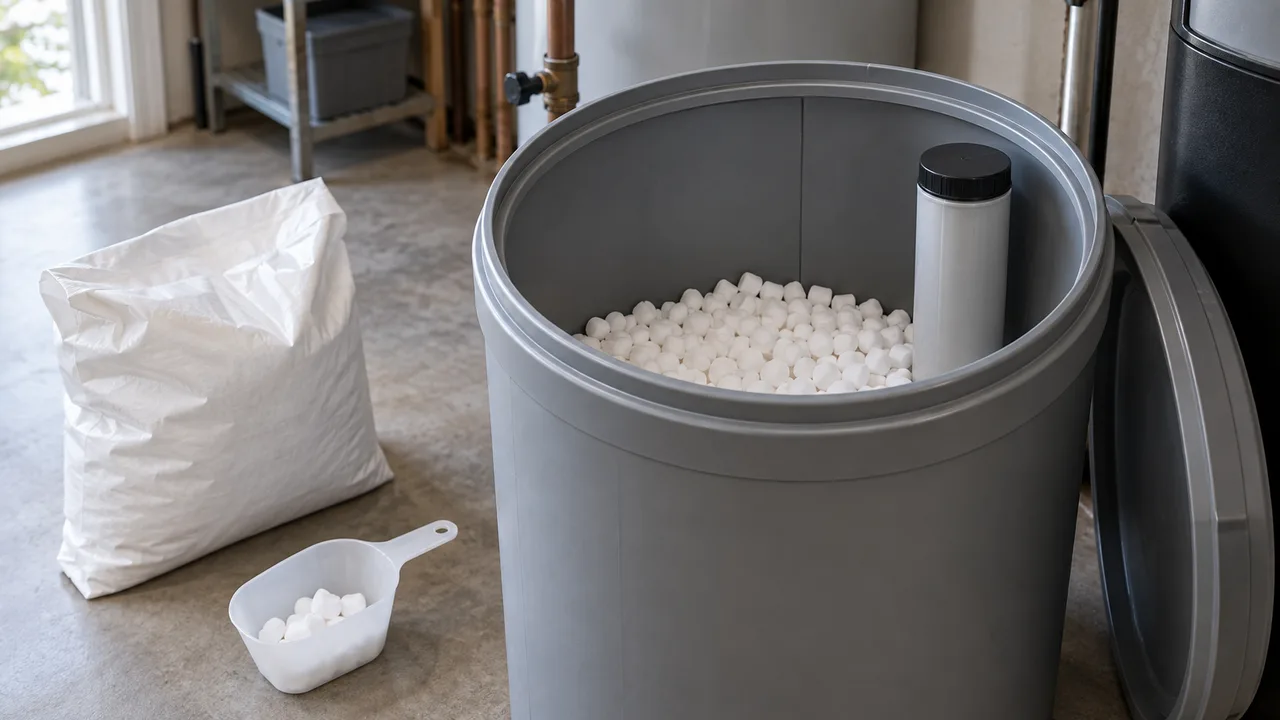
Add enough water-softener salt to reach the refill level specified for your model, stopping below its stated maximum. The amount may be part of a bag or more than one bag; bag count is not a universal refill instruction. How often you add it depends on the salt actually used between checks and how much suitable storage space remains in the tank.
Start with the manual's inspection interval, record the level before and after each refill, and bring the next check forward if the salt is approaching the minimum sooner than expected. A reminder to inspect the tank does not mean you must add salt every time.
Find the complete system model and its salt-storage instructions. Write down the approved salt type, the point at which a refill is needed, and the upper limit. Do not infer those limits from the size of a replacement bag or a picture of another homeowner's tank.
For the units covered by Whirlpool's salt-adding guide, the target uses the numbered brinewell scale: levels 2 through 5. Those numbers identify marks on the equipment. They are not pounds of salt, inches for every tank, or a setting to transfer to another brand. The guide also explains updating the salt-level reminder after a refill.
Other equipment instructions frame the decision differently. The EcoWater ESD2750/2752 owner manual, printed page 17, calls for checking salt every two or three weeks while establishing a routine. It advises keeping the tank below half full in humid locations and replenishing more often. These are examples for the listed systems, not a combined rule for all softeners.
If your manual and a general support article appear to disagree, send the manufacturer your model and both instructions. Record which guidance applies before choosing a new fill level. A precise-looking number from the wrong tank is less useful than an acknowledged unknown.
The large salt-storage compartment and the narrow brinewell are different parts. Rheem's brinewell guidance explains that salt belongs in the main tank; a large amount inside the well can interfere with its float assembly. Keep the well's cover in place while adding salt, as directed for your equipment.
Use the refill as an observation point:
Do not count an entire bag as added when some remains in storage. If the equipment needs investigation, preserve the before-refill observation instead of covering it with more salt. This routine does not call for opening a valve assembly or putting tools down the brinewell.
An inherited softener or a recent change in household use calls for a fresh baseline. Begin with your model's inspection guidance and record what is left at each check. Check earlier when your observations show that the next reminder would fall after the refill point.
Keep inspection date, refill date, and purchase date separate. Buying two bags on sale tells you about inventory, not how quickly the machine consumes salt. Likewise, topping up frequently makes a tank look stable even when significant salt is being used.
Use this sheet with the page's Print button. Add the entries to the full water softener maintenance checklist when you also need to track hardness results, service, or changing operating conditions.
| Refill record | Your entry |
|---|---|
| Date and time | ____________________ |
| System model / applicable manual | ____________________ |
| Salt type and product | ____________________ |
| Salt level before adding | ____________________ |
| Amount actually added, in lb | ____________________ |
| Salt level after adding | ____________________ |
| Cycle underway or idle | ____________________ |
| Manual cycle or service since last entry | ____________________ |
| Guests, travel, or changed water use | ____________________ |
| Clumping, visible water, or other observation | ____________________ |
| Reminder updated / next inspection | ____________________ |
Use the same visible reference point each time. A sloping surface of pellets does not provide the precision of a scale, so describe an uncertain reading honestly. The log should make comparisons easier, not turn a rough visual estimate into an exact mass measurement.
A useful household estimate comes from replenishing the tank to a similar level, using the same product and a clearly recorded elapsed period. When starting and ending inventory are comparable, the amount added is an approximation of consumption over that period.
Suppose, purely as an arithmetic example, that you add 40 lb to return to the same observed level after 42 days. Assume no salt was added, removed, or spilled during that interval and that the two level observations are comparable.
Average daily use ≈ 40 ÷ 42 = 0.95 lb/day
Thirty-day equivalent ≈ 40 ÷ 42 × 30 = 28.6 lb
If the product comes in 40-lb bags, that is approximately 0.71 bag per 30 days for this example period. It is a purchasing estimate, not a direction to pour that fraction into any tank or a claim about normal consumption.
| What happened during your record | What the added amount can tell you |
|---|---|
| Start and end levels are comparable | Approximate replenishment can represent use during the interval |
| You filled much higher at the end | The addition includes an inventory increase, so it overstates consumption |
| You ended at a lower level | Additions alone miss the inventory drawn down during the interval |
| Salt was removed during cleaning | Separate that removal from salt used by regeneration |
| You changed product or mixed records | Keep periods separate until the measurements are meaningfully comparable |
Keep several periods rather than extrapolating one unusual month. A period with guests or extended travel may be real but unrepresentative of the rest of the year. Bring the dated amounts and receipts to the running-cost calculator when estimating a budget. Use its records mode for recorded spending, and avoid counting the same salt again as a per-cycle expense.
If the visible level remains unchanged across repeated checks, first review whether anyone has been topping up and whether softened-water demand has changed. A steady surface alone cannot show what is happening underneath it. If salt is hard or clumped, or treated-water performance has changed, follow the matching manufacturer's inspection path before adding more.
Water visible above the salt also needs context: note the operating stage and whether the salt inventory is unusually low. Adding salt until the water disappears from view can erase a helpful symptom without explaining it.
If the tank actually ran out, use the model's recovery instructions. Restoring the supply of salt and restoring normal treatment are separate things to verify. Record the refill, any required recovery action, and the result rather than assuming that the bag itself proves the system is working again.
Convenience favors fewer refills, but the useful storage level is still limited by the equipment instructions and conditions around it. Humidity guidance may favor smaller replenishments. A household that cannot reliably lift a full bag also needs a manageable way to add the permitted amount without losing track of what was used.
Keep reserve purchases in your inventory record and distinguish them from salt already in the machine. If consumption changes, ask whether demand, settings, service, or the measurement method changed at the same time. That is a stronger basis for revising the refill routine than adopting another household's bags-per-month figure.
Add the amount needed to reach your model's specified refill level, within its maximum. The answer can be less than a full bag, and tank size alone is not enough to decide. Record how much you actually poured in and store the remainder separately. Do not convert another model's numbered scale or a generic photograph into a bag-count rule for your own equipment.
Use the upper level in the applicable manual rather than the tank rim. The manufacturer examples discussed here specify lower operating levels, with additional consideration for humidity. Filling to the top for convenience can also make later observations harder to compare. Establish a consistent permitted target and return to it when needed, while recording the salt added at each refill.
Start with the inspection interval for your model and shorten it if the level approaches the refill point sooner. The cited EcoWater manual gives its listed systems a two- or three-week initial checking interval, but that is not a universal requirement. During the first records, distinguish checks from additions so you can see whether the original reminder is catching depletion in time.
Do not assume that it is. Find out how your model's reminder works and whether it requires a user-entered level after a refill. The cited Whirlpool instructions include that update step for the covered units. Confirm the physical salt level as directed and keep actual pounds added in your own record; a reminder display and a measured inventory are different kinds of information.
Only with clear limits. Purchases may increase stored inventory, and a short period may include unusual household use. For a better consumption estimate, compare replenishments that return the tank to a similar level and record any removals or other additions. A monthly spending figure can support an annualized budget scenario, but it should not be presented as measured annual salt use.
Troubleshooting
Judge salt-tank water by the system model, fill sequence, and cycle stage. Use an observation sheet to separate normal changes from conditions needing support.
Salt & regeneration
Estimate a capacity-based regeneration interval, compare it with real cycle records, and identify the inputs behind a changing schedule.
Maintenance
Build a practical water softener care routine with model-specific checks, a printable maintenance log, and clear guidance on salt, hardness testing, and service.