Maintenance
Water Softener After a Power Outage: What Settings Should You Check?
Check your softener clock, retained programming and interrupted-cycle status after an outage, with model-specific examples and a printable recovery record.
PLANNING TOOL & EXPLANATION
Running cost combines salt, regeneration water, applicable sewer charges, maintenance and known electricity. Enter your own receipts and rates to see annual costs and a monthly average; equipment and installation stay separate.
Use the calculator ↓Use a model-specific estimate or your actual records. All currency amounts are in USD.
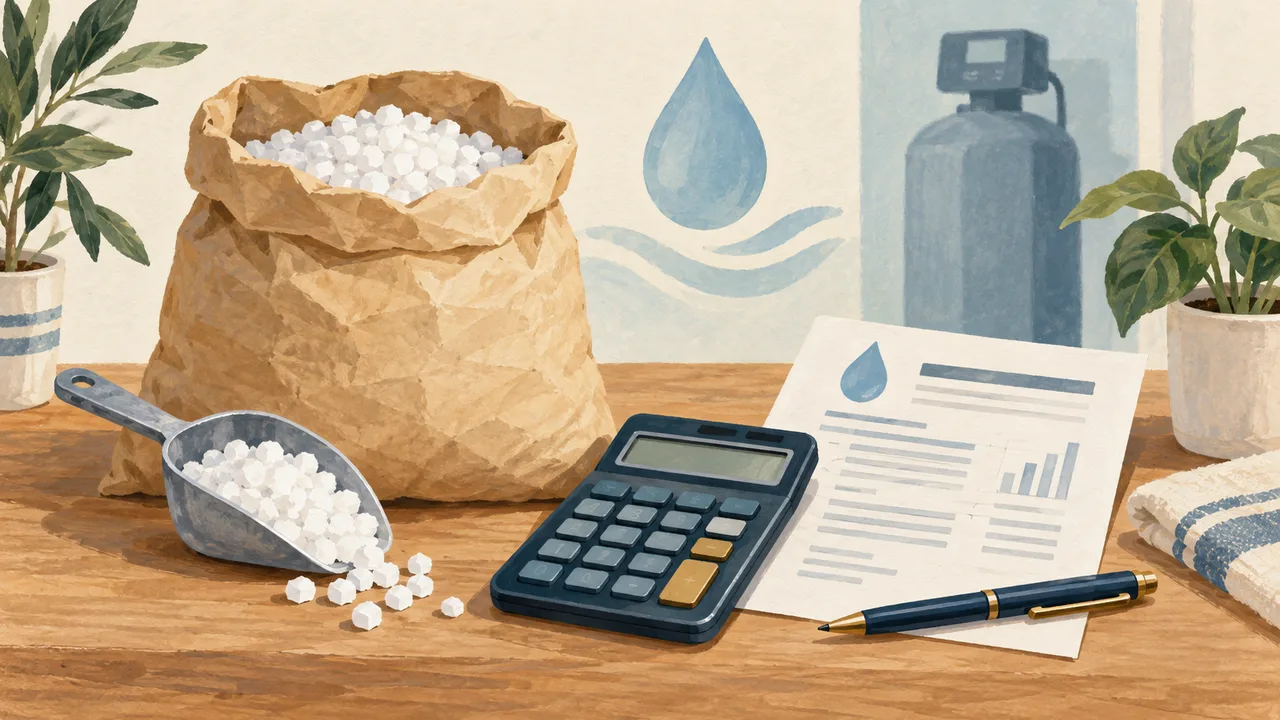
Use dated records from your household. The EPA guide to water bills distinguishes usage charges, fixed charges, tiers and seasonal rates. For additional regeneration water, use the applicable usage rate; dividing the entire bill by gallons can fold unrelated fixed charges into the estimate.
| Line or record | Example | Calculator entry |
|---|---|---|
| Salt receipt: price and net weight | $12 for 40 lb | $12 ÷ 40 = $0.30/lb |
| Meter consumption: CCF / HCF | 8 CCF over 30 days | 8 × 748 ÷ 30 ≈ 199.5 gal/day, before bypassed use |
| Water usage rate | $6 per CCF | $6 × 1,000 ÷ 748 ≈ $8.02 per 1,000 gal |
| Base or meter charge | $20 each bill regardless of volume | Exclude from incremental regeneration cost |
| Sewer usage rate | Separate line or utility rule | Include only if the regeneration water is billed under it |
For tiered rates, use the tier reached by the extra water in your scenario. Record the billing dates and rate effective date. If the billing unit or sewer rule is unclear, ask the utility rather than treating an unknown charge as zero.
Arithmetic scenarios prepared 11 September 2026: assume 6 lb salt and 50 gallons per cycle, $0.30/lb salt and $5 per 1,000 gallons water. Every input here is hypothetical, not a market price or equipment rating. Sewer, maintenance and electricity are excluded from these subtotals.
| Assumed cycles/year | Annual salt | Annual water | Annual subtotal | Monthly average |
|---|---|---|---|---|
| 26 | $46.80 | $6.50 | $53.30 | $4.44 |
| 52 | $93.60 | $13.00 | $106.60 | $8.88 |
| 78 | $140.40 | $19.50 | $159.90 | $13.33 |
A monthly average is the annual scenario divided by 12. It is not a forecast for each month. To use a short spending record, first distinguish salt bought from salt actually added and consumed; buying several bags in one month can distort an annualized budget.
Regeneration mode uses your expected annual cycles, salt dose, water use, and local unit prices. Records mode uses known salt spending and regeneration water over a year or month. The modes are mutually exclusive so you do not count the same salt twice.
If you use one month of records, the calculator multiplies those amounts by twelve. That is an annualized scenario; it does not account for seasonal changes in household use.
| Component | Annual calculation |
|---|---|
| Salt | Regenerations × salt per regeneration (lb) × USD/lb |
| Water | Regenerations × gallons per regeneration ÷ 1,000 × water rate |
| Sewer | Regeneration gallons ÷ 1,000 × applicable sewer rate |
| Other | Add annual maintenance and known electricity expense |
At 52 regenerations, 6 lb of salt per cycle, $0.20/lb, 50 gallons per cycle, and $5 per 1,000 gallons, salt costs $62.40 and water costs $13.00. The subtotal is $75.40/year before applicable sewer, maintenance, or electricity charges.
The default inputs are arithmetic examples, not market-average prices, measured device performance, or recommended settings.
This is an operating-cost calculation. Equipment, installation, removal of an old system, and financing are not included. If you are comparing systems, use each one’s own documented dose and regeneration-water amount rather than assuming their settings are interchangeable.
Need a capacity target first? Work through your household’s sizing calculation. For the measurements to collect, use the getting-started checklist.
Your water softener running cost is the salt you pay for, regeneration water, applicable sewer charges, maintenance, and any known electricity expense. Use your own records and rates to put a number on those items. In the invented example below, they add up to $167.40 per year, or $13.95 per month on average, with electricity still excluded. That is a calculation to replace with your inputs, not a typical US household bill.
The calculator above supports both a regeneration estimate and recorded spending. Before using either mode, decide what the number should represent and check whether the inputs describe the same period and equipment settings.
For a cash budget, salt receipts tell you what you spent. Keep delivery charges and other purchase costs in the total if you want them included. A large purchase can cover several future months, so multiplying that purchase month by twelve may produce a misleading annual budget.
For a consumption estimate, record salt bought, salt added to the tank, and salt remaining in storage separately. Even pounds added are only an approximation of pounds consumed when the tank starts and ends at comparable levels. Salt removed during cleaning needs its own entry. Use the salt refill and inventory record to collect those observations without treating a tank mark as a weight measurement.
Choose Use my spending and water records when you have a useful spending period. Choose Estimate from regeneration details when you have documented per-cycle inputs and a cycle count. Do not add the salt receipts to a second per-cycle salt calculation for the same period.
A specification may describe water per regeneration or water per amount of hardness removed. These are different inputs. The Whirlpool WHES40/WHES44 manual, document 7335139 Rev. L, page 3 gives the following figures specifically for WHES40, model code LL40:
| Specification | Published condition |
|---|---|
| 3.0 gallons per 1,000 grains | Water used during regeneration at the minimum salt dose |
| 37.1 gallons per regeneration | Total water used at the maximum salt dose |
The first figure is not 3 gallons per cycle. The second belongs to a stated maximum-dose condition. The manual also describes a variable salt dose selected by the controller, so neither number establishes what every recharge in your home uses.
Ask the supplier for the salt dose and regeneration-water amount that apply to the proposed operating condition. If those are unavailable, label the inputs as assumptions and compare scenarios; do not present the output as measured operating cost. Keep a laboratory efficiency rating separate from actual household performance.
Find the usage rate and billing unit on your bill. The EPA's guide to understanding water bills explains fixed charges, volume charges, and different rate structures. A base charge you already pay does not become an additional softener expense simply because you divide the whole bill by gallons.
If the rate is per CCF or HCF, one such unit is about 748 US gallons. An assumed $6 per CCF converts to $6 × 1,000 ÷ 748, or about $8.02 per 1,000 gallons, for the calculator. Use the actual applicable tier or seasonal rate. Where extra water crosses tiers, calculate the affected portions separately rather than assigning all of it one convenient rate.
Include sewer only under the rules on your bill. An unknown sewer charge is an unresolved input, not evidence that no charge applies. Likewise, a household water total does not identify regeneration water: showers, irrigation, and leaks can change the total too.
Maintenance comes from your service agreement, receipts, or a labeled allowance for model-required supplies and care. Avoid counting a bundled service twice. In the calculator, maintenance and known electricity are annual amounts even when the records period is one month. The monthly option multiplies only the recorded salt spending and regeneration gallons by twelve.
Leave electricity blank when you do not know its annual cost; the result identifies it as excluded. A confirmed annual amount can be added later. Keep a note of any other omitted expense beside the displayed subtotal so it does not become a supposedly complete budget.
Use Print this page above the calculator. Fill in this record, then replace the example inputs in the calculator with the amounts you can support. Mark each entry as recorded, manufacturer-documented, assumed, or unknown.
| Input to preserve | Your record |
|---|---|
| Complete system model and manual revision | ____________________ |
| Record dates and unusual household use | ____________________ |
| Calculation mode: spending or regeneration estimate | ____________________ |
| Salt receipts, net weight, and stock changes | ____________________ |
| Cycles in the period and how counted | ____________________ |
| Salt per cycle and its operating condition | ____________________ |
| Regeneration gallons and their evidence | ____________________ |
| Water rate, billing unit, and effective date | ____________________ |
| Applicable sewer rate or unresolved question | ____________________ |
| Annual maintenance scope and amount | ____________________ |
| Known annual electricity or “excluded” | ____________________ |
| Other exclusions and the next item to verify | ____________________ |
Save the input record with the result. When the budget changes, it will show whether the cause was a price change, different water use, a service charge, or a revised assumption. A total alone cannot distinguish those explanations.
This hypothetical US-dollar scenario, prepared September 16, 2026, assumes 52 regenerations per year, 6 lb of salt and 50 gallons of water per cycle, a $12 price for a 40-lb bag, water at $5 per 1,000 gallons, applicable sewer at $8 per 1,000 gallons, and $40 of annual maintenance. Every amount is invented for arithmetic. None is a market average, equipment recommendation, or operating specification for the model discussed above.
| Component | Annual scenario |
|---|---|
| Salt: 52 × 6 × ($12 ÷ 40) | $93.60 |
| Water: 52 × 50 ÷ 1,000 × $5 | $13.00 |
| Applicable sewer: 52 × 50 ÷ 1,000 × $8 | $20.80 |
| Annual maintenance allowance | $40.00 |
| Electricity | Unknown; excluded |
| Subtotal of included items | $167.40 |
The scenario uses 312 lb of salt and 2,600 gallons of regeneration water per year. Dividing the subtotal by twelve gives $13.95 per month on average. That smooths out purchases and service visits; it does not say each month's bill will rise by exactly that amount.
If a documented annual electricity expense were $6, this same scenario would become $173.40 per year, or $14.45 per month. That change illustrates adding a newly known cost; $6 is also an assumed amount, not a claim about your softener's power use.
A useful comparison needs the same household demand, rates, service scope, and period on both sides. A lower per-cycle salt dose alone cannot settle it if cycle frequency changes. Nor does a smaller water subtotal establish lower overall cost when a service plan adds recurring charges.
Keep purchase and installation in the separate equipment and installation budget. Then decide how many years you want to compare and which future expenses remain uncertain. A service commitment may be valuable even when it does not reduce the operating subtotal; name that benefit rather than assuming it pays for itself.
Before changing settings or buying equipment, identify the input most likely to change your decision. It might be a verified cycle count, a clarification of sewer billing, or a written service price. Collecting that evidence can narrow the range more usefully than calculating extra decimal places from an uncertain assumption. Any setting change still needs to follow the exact system's instructions and preserve the required treatment performance.
Divide your supported annual operating estimate by twelve to get a monthly average. Include salt, regeneration water, applicable sewer, maintenance, and known electricity, while listing anything excluded. The invented scenario here produces $13.95 per month before electricity. It is an example of the calculation, not a national average or a prediction for your bills. Your records and local rates determine the useful number.
Yes, as an annualized spending scenario. Select the one-month records period and enter that month's salt spending and attributable regeneration water. The calculator multiplies those two amounts by twelve; maintenance and electricity remain annual entries. A month with a bulk salt purchase, guests, or travel may poorly represent the year. Preserve those circumstances with the result and compare a longer period when records become available.
No. Some of the purchase may remain in unopened bags, and some salt added to the tank may still be there at the end of the period. Receipts are useful for cash spending. To estimate consumption, also track additions, remaining inventory, and any removals, using comparable tank observations. Label a rough level-based estimate as approximate rather than presenting it as a precise weight measurement.
Check both the unit and the stated operating condition first. The calculator asks for gallons per regeneration. A value expressed as gallons per 1,000 grains is not that input, and a maximum-dose specification does not describe every automatic recharge. Find applicable per-cycle information for your model and settings, or label the value as an assumption. Keep that qualification with the calculated cost.
Leave electricity blank so the calculator marks it as unknown and excluded. For maintenance, use a documented annual amount or an explicitly labeled planning allowance, recording what it covers. If you enter zero because an expense is unresolved, describe the result as a subtotal that excludes it. Add the actual amount when available and keep purchase and installation outside the operating-cost calculation.
Maintenance
Check your softener clock, retained programming and interrupted-cycle status after an outage, with model-specific examples and a printable recovery record.
Maintenance
Choose a model-appropriate vacation plan, record power and valve positions, separate freezing-weather preparation, and check the return to service.
Salt & regeneration
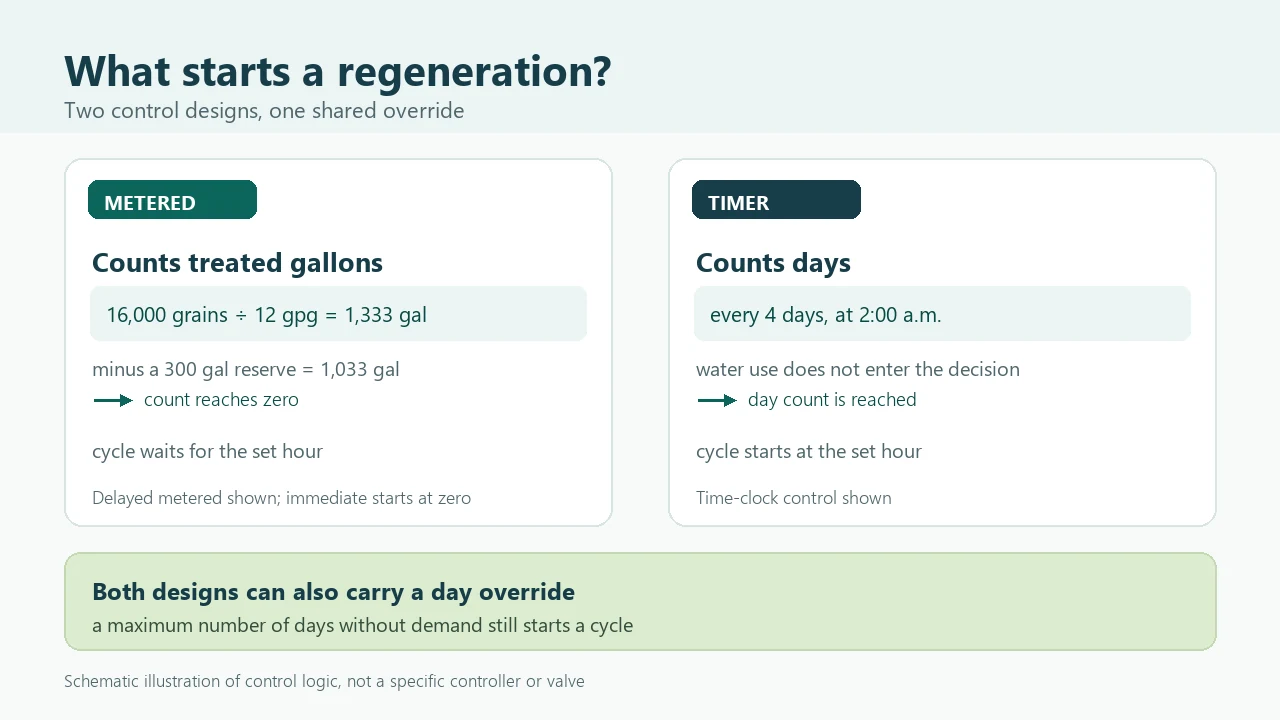
Compare how metered and time-clock softener controls decide when to regenerate, with the immediate and delayed trigger paths, a shared day override, and worked gallons arithmetic for two usage patterns.
Salt & regeneration
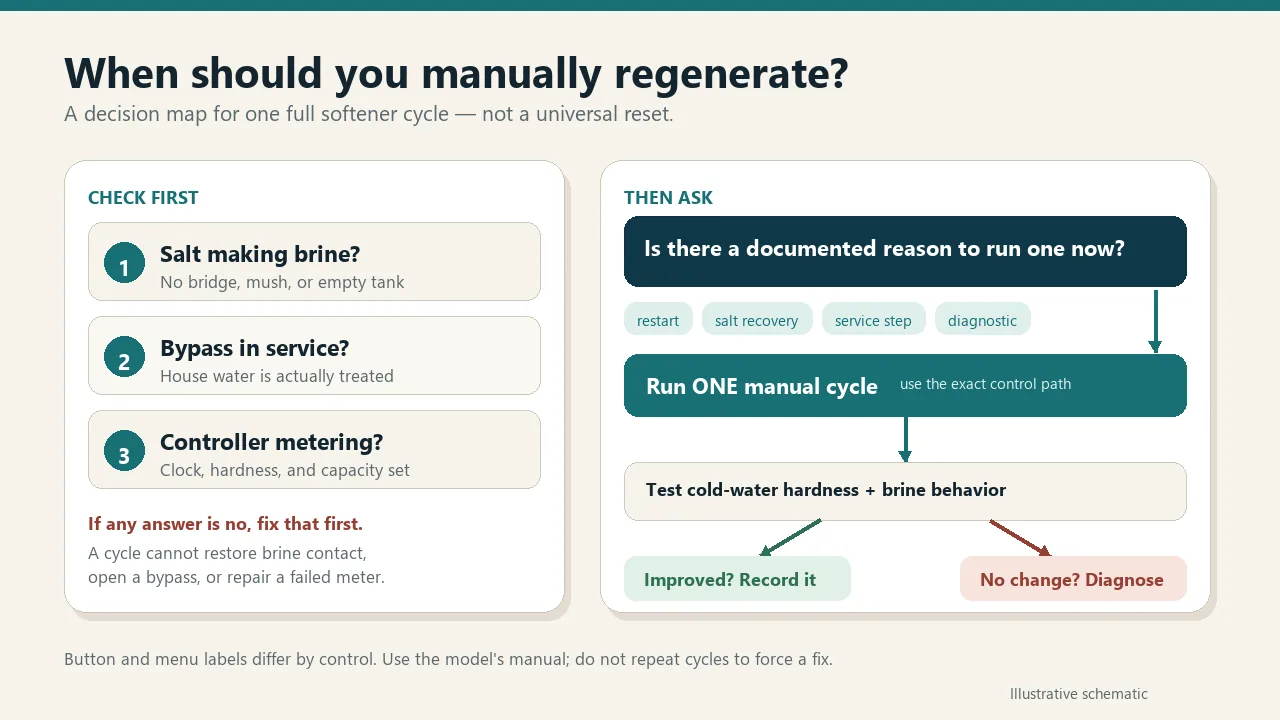
Decide when a manual softener regeneration is justified, compare Whirlpool, EcoWater, and Fleck control paths, and know when to stop and diagnose instead.
Sizing & costs
Estimate simultaneous household flow, compare it with a model-specific service-flow rating and pressure drop, and record the evidence before choosing a water softener.
Troubleshooting
Use an observation-first checklist to find why a water softener is not using salt, then separate salt bridges, metering, bypass, fill, and brine-draw questions.