Maintenance
Water Softener After a Power Outage: What Settings Should You Check?
Check your softener clock, retained programming and interrupted-cycle status after an outage, with model-specific examples and a printable recovery record.
Salt & regeneration
Use a manual regeneration only for a documented restart, salt recovery, service step, or diagnostic, and follow the exact model control path.
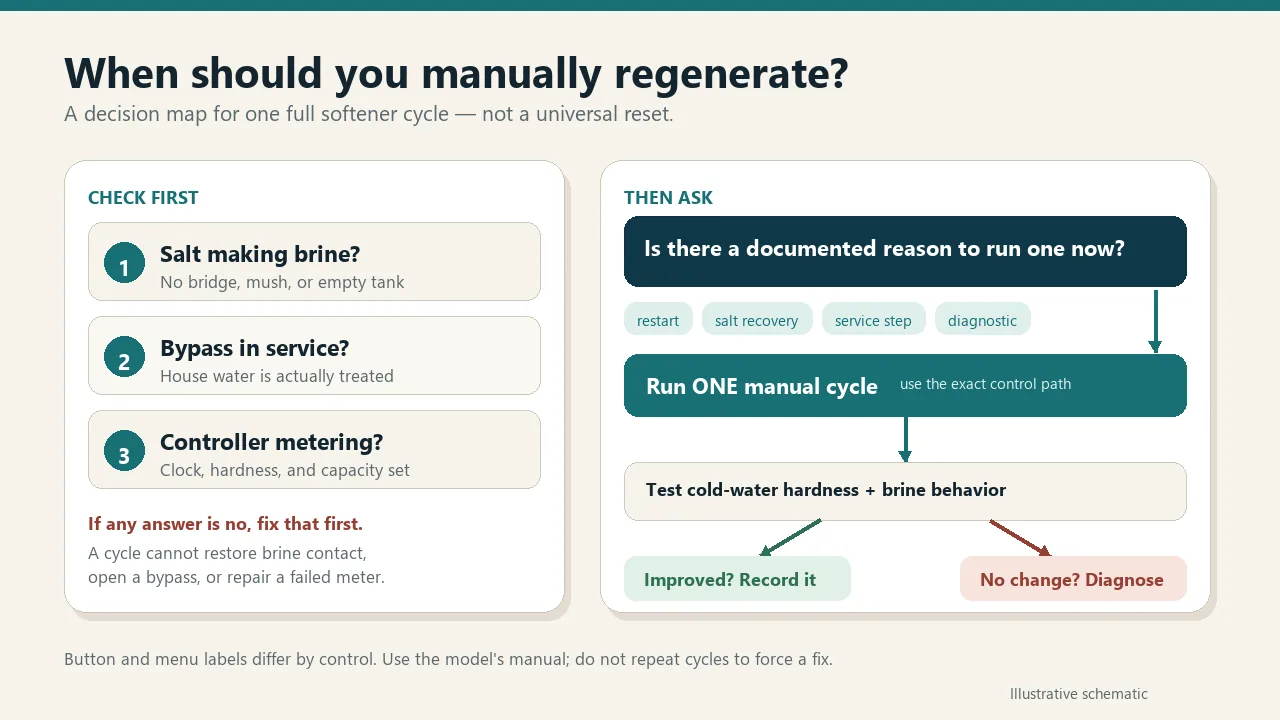
Manual regeneration is worth doing when you have a specific reason to run a full cycle now: a documented restart after the softener was out of service, a manufacturer's recovery step after restoring salt or breaking a bridge, a service procedure that calls for it, or a controlled diagnostic after a repair. It is a poor default for water that merely feels hard, for a tank that was just topped off, or for a problem you have not diagnosed. The exact button or menu path depends on the control, so the model's manual is the authority.
Manufacturers use both regeneration and recharge. They describe the same basic task: the control pulls brine through the resin, rinses it, and refills the brine tank for the next cycle. The sequence, labels, and timing vary by valve and control. A manual cycle is therefore a command to the equipment, not a generic household fix.
Three checks come before the button. If any of them fails, a manual regeneration will either do nothing useful or make the real problem harder to see.
Adding salt is not the same task as regenerating. The salt monitor or salt-level setting tells the controller what is in the tank; the controller then decides when to recharge. If the tank was empty, or a bridge has just been cleared, follow the manufacturer's recovery path rather than assuming that every salt refill needs a manual cycle.
Whirlpool's guidance for a softener that was out of service says to empty and clean the salt tank, check the programming, and then run a manual recharge. On the control it describes, you hold the Recharge button for about three seconds, release it when the motor starts, and watch for the flashing recharge indicator. The cycle takes about two to two and a half hours. That is a restart procedure for a specific condition, not a weekly habit. See Whirlpool's guidance for a softener that was out of service.
EcoWater's 3500/3502 manual gives a conditional troubleshooting instruction: if the display reports no salt or a salt bridge, add salt or break the bridge, then initiate Recharge now. The recharge is the last step after the salt condition is corrected, not a substitute for correcting it. The same manual's control path is Main menu, Recharge, Recharge now, then SELECT twice. See EcoWater's 3500/3502 owner's manual, page 27 for the menu and page 40 for the troubleshooting table.
The same EcoWater manual uses Recharge now to draw sanitizing bleach through the conditioner after service. Some other service procedures use a manual recharge to draw a cleaning solution through the unit as well. These are service procedures tied to a particular product and cleaning step. They are not evidence that every softener should be manually recharged after every cleaning or filter change.
If a repair has just been completed, or you have a hardness test that confirms the water is not being softened, one correctly run cycle can be a useful test. Record the hardness before the cycle, run the cycle once, then test cold water at more than one faucet afterward. The cycle is the controlled action; the before-and-after readings are the evidence. If the reading does not change and the settings and salt are correct, repeating the same cycle is not the next diagnostic step.
The useful part of a manual is not just the word "recharge." It is the exact control path and the state the unit must be in before you use it. These three examples show how much the interface can differ.
| Control family | Documented entry point | What to check first |
|---|---|---|
| Whirlpool electronic control | Hold Recharge about three seconds; release when the motor starts; the display flashes Recharge during a cycle of about two to two and a half hours. | Clock steady, salt tank ready, programming checked. This is the path in the Whirlpool article linked above. |
| EcoWater 3500/3502 | Main menu > Recharge > Recharge now > SELECT twice. The menu also offers Schedule, which waits for the set recharge time. | Use Recharge now only when you want the cycle immediately; use Schedule when you only want the next cycle queued. See the EcoWater manual linked above, page 27. |
| Fleck 5600SXT | Hold Extra Cycle five seconds for immediate regeneration. During a regeneration, the same button advances the valve to the next cycle step. | Do not press it repeatedly as if each press starts another full cycle. See Fleck's 5600SXT service manual, page 5. |
These are examples, not a universal sequence. Another valve may use a different button, a service mode, a touchscreen menu, or an app. Some controls offer an immediate cycle and a scheduled cycle as separate choices. Read the label before you press; if the control offers both, choose the one that matches your reason for being there.
A manual regeneration is a full cycle, not a quick rinse. It uses salt and water, takes hours, and temporarily changes what the equipment is doing. That cost can be justified when it restores a documented condition. It is harder to justify when the owner is using cycles to compensate for a schedule that has not been checked.
Repeated cycles can also hide the cause. If the salt is bridged, the bypass is open, the hardness number is wrong, the meter is stuck, or the brine valve is not drawing, another cycle does not create a new diagnosis. EcoWater's troubleshooting table puts the salt condition first and the recharge after it. A unit that recharges too often can have a leak or a programming problem; check hardness programming, unexpected water flow, and any maximum-days setting before treating the frequency as normal. Those checks are more useful than a stack of manual cycles.
If the schedule itself seems wrong, calculate what the capacity and daily hardness load would predict, then compare that with the controller's actual cycle history. The guide to why there is no universal regeneration interval walks through that comparison. A manual cycle can interrupt the pattern you are trying to measure; use it after the measurement, not instead of it.
A manual cycle is not a repair. It cannot fix a failed meter, a stuck valve, a blocked drain, a leaking connection, or resin that no longer performs. If the first correct cycle does not change the hardness reading or the brine behavior, stop and diagnose the equipment.
Before running a cycle, collect enough information to tell whether it helped:
After the cycle, record the result rather than relying on the display alone:
| Date and time | Why the cycle was run | Salt condition before | Hardness before | Entry point used | Cycle start and finish | Hardness after | Next action |
|---|---|---|---|---|---|---|---|
Print this page or copy the table into the maintenance record you already keep. The value is in the comparison: the same test method, the same tap, and a note about what changed. A cycle that finishes on schedule but leaves the hardness unchanged is a different result from a cycle that restores soft water and then declines again over several days.
Stop after one correctly run cycle if any of these are true:
Those are equipment or setup problems, not reasons to press Recharge again. Use the model's service instructions or contact the manufacturer's support path. Do not disassemble a pressurized valve from a generic web answer; the service procedure and replacement parts are specific to the valve.
The control interface is the part most likely to make a generic answer wrong. A dedicated button, a menu item called Recharge now, a scheduled recharge, and an app command can all produce a regeneration, but they do not mean the same thing at the moment you press them. Some controls let you start immediately; others only queue the next cycle. Some show the current step and remaining time; others show only a flashing indicator. A manual that covers the right model and revision is more useful than a remembered sequence from a different brand.
The decision should stay tied to what you observed. The useful question is not "how many times can I regenerate?" but "what tells me the resin needs a cycle now, and what will I check afterward?" If the answer is a documented restart, a corrected salt condition, a service step, or a controlled diagnostic, one cycle has a clear purpose. If the answer is that the water feels hard and you hope the next cycle fixes it, the more valuable next step is usually a hardness test and a look at the salt, bypass, and programming. The model-specific manual remains the final authority when those checks point to a service procedure.
Usually no, if adding salt was the only issue and the unit is otherwise working. Adding salt restores the supply; set the salt monitor and let the controller schedule the next recharge. Run a manual cycle only when the manufacturer's troubleshooting path calls for one, such as after an empty tank or a bridge has been cleared, or when you are deliberately testing recovery. A cycle cannot make brine contact the resin if the salt is still bridged or the bypass is open.
There is no safe universal frequency. A manual cycle is an override, not a maintenance schedule. Run one when a documented condition calls for it, then judge the result with a hardness test and a look at salt and brine behavior. If you find yourself forcing cycles repeatedly, the schedule, hardness setting, capacity, meter, or valve needs diagnosis. Repeated cycles can use extra salt and water and may hide the real fault.
Only if the hardness is caused by a depleted or bypassed softener that a correct cycle can restore. It will not fix an open bypass, a salt bridge or mush, a failed meter, a brine valve fault, or a hardness setting that is too low. Test cold water before and after one cycle. If hardness is unchanged and the settings and salt are correct, stop repeating the cycle and troubleshoot the equipment.
It depends on the model and the stage. Some systems bypass the softener during part or all of regeneration, so water may be available but unsoftened; others may behave differently. Check the owner's manual before running laundry, filling a tub, or starting a long shower. If the manual does not say, treat the cycle time as a low-demand window and test the water afterward.
Watch the control advance through the cycle, confirm the drain line is flowing as the manual describes, and check for leaks. After the cycle, run a cold-water faucet and test hardness at more than one tap. Also confirm salt is present and the brine tank is not bridged. A completed display or a motor sound is not proof by itself; the hardness reading and the next few days of water use are the useful evidence.
Look for a menu item such as Recharge, Regenerate, or Recharge now. Some controls use a select-and-confirm sequence, and some only let you schedule the next cycle. Check the exact model and revision in the owner's manual or manufacturer support page. Do not assume another brand's button sequence applies. If the control offers only a schedule, choose that and wait rather than repeatedly power-cycling the unit.
Maintenance
Check your softener clock, retained programming and interrupted-cycle status after an outage, with model-specific examples and a printable recovery record.
Maintenance
Choose a model-appropriate vacation plan, record power and valve positions, separate freezing-weather preparation, and check the return to service.
Salt & regeneration
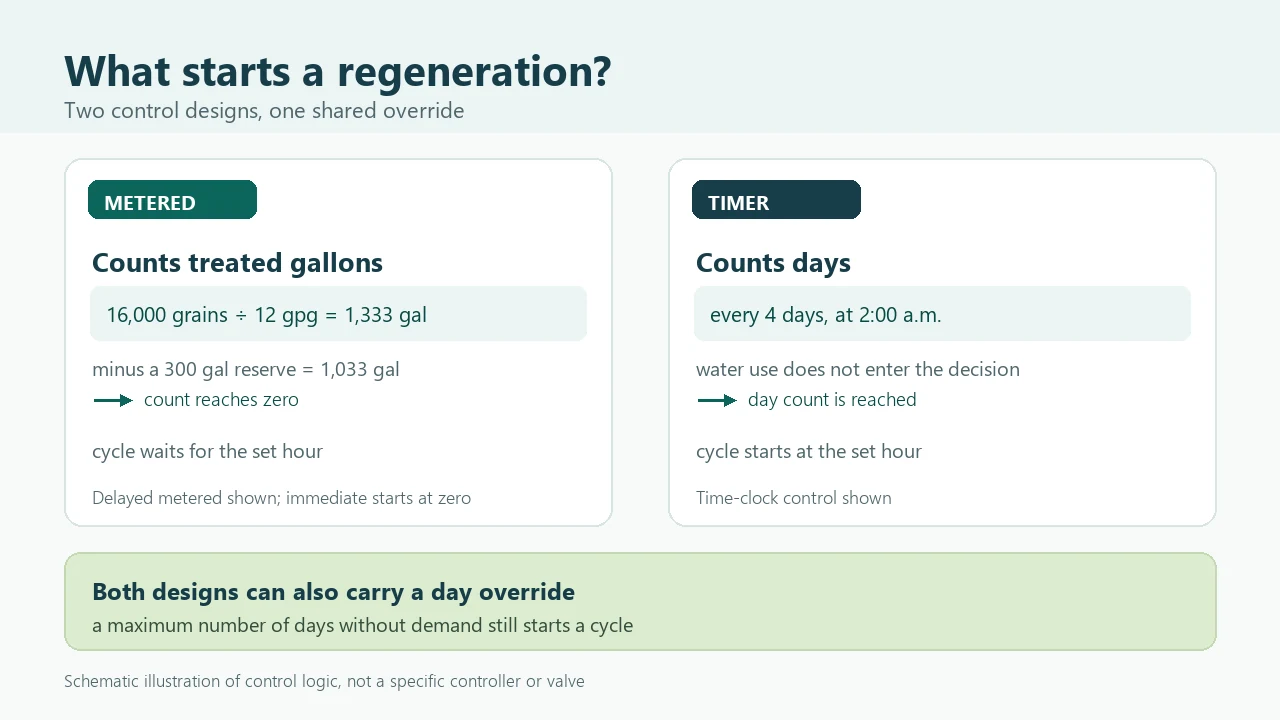
Compare how metered and time-clock softener controls decide when to regenerate, with the immediate and delayed trigger paths, a shared day override, and worked gallons arithmetic for two usage patterns.
Sizing & costs
Estimate simultaneous household flow, compare it with a model-specific service-flow rating and pressure drop, and record the evidence before choosing a water softener.
Troubleshooting
Use an observation-first checklist to find why a water softener is not using salt, then separate salt bridges, metering, bypass, fill, and brine-draw questions.
Salt & regeneration
Distinguish a suspended salt crust from fine salt packed at the tank bottom, then use a model-specific recovery path and printable observation record.