Maintenance
Should You Turn Off Your Water Softener When You Go on Vacation?
Choose a model-appropriate vacation plan, record power and valve positions, separate freezing-weather preparation, and check the return to service.
Maintenance
Check the clock, saved hardness and recharge settings, interrupted cycles, and follow-up hardness after a power outage. Includes a printable recovery log.
After a power outage, check your water softener's current time, its saved hardness and regeneration settings, and whether it is still in a cycle. Correct the clock using the instructions for your model, but do not assume the outage erased every setting. A clock correction, a manual regeneration, and a factory reset are separate actions.
This checklist covers household salt-based softeners with electronic controls. The controller examples below explain why the same outage can produce different displays. Use the manual for your complete system before operating buttons or moving a bypass valve. If the control or power connection is wet or damaged, stop the routine checks and arrange appropriate service.
Photograph the screen and find the complete model number. Note whether it shows the time, a recharge stage, a setup prompt, or an error. Write down the approximate outage and restoration times; mark them as estimates if you do not know.
Compare the displayed time with a reliable clock, including AM/PM or the selected 24-hour format. Then check the saved regeneration start time against your previous record. A correct-looking start time can still occur at the wrong hour if the controller's current time is wrong.
Review the hardness value against your existing water-test and setup record. Record other accessible options your manual identifies, such as a day override or reserve setting. Do not replace an unfamiliar value with a default simply because you have no earlier photo. Ask the system supplier to confirm undocumented programming, especially if the screen requests initial setup or a model code.
Whirlpool WHES40 and WHES44: The WHES40/44 manual's power-outage section says to reset the present time if the restored display is flashing. It says hardness and recharge time remain set unless you want to change them. An interrupted recharge finishes when power returns. These instructions come from revision E, dated April 14, 2021; check the manual supplied for your unit rather than applying them to every Whirlpool control.
Pentair 5600SXT systems: The 5600SXT system manual, revision B AP22, distinguishes time backup from permanent configuration storage. Its sections give conflicting clock-backup durations, so use the actual displayed time and ask your system supplier which instructions apply to your control. Flashing time signals an outage; it does not establish that all programming was lost. The controller does not monitor water use without power. It resumes an interrupted regeneration and queues a missed scheduled cycle for the next programmed regeneration time.
That last distinction matters: stored settings do not necessarily mean the controller accounted for water used during the interruption. A retained hardness value and a retained remaining-volume display answer different questions. Do not alter capacity or reserve settings to compensate by guesswork.
Use Print this page to keep this sheet with the manual. Enter observations before changes, then record only the action the matching instructions support. Write "unknown" where a value was not documented.
| Check | Your record |
|---|---|
| Equipment | Complete model, controller, manual revision: ______ |
| Interruption | Estimated power-off and restoration times: ______ |
| Display before changes | Time, flashing message, stage or error; photo saved: ______ |
| Clock check | Actual time; displayed time; AM/PM or format; correction: ______ |
| Saved programming | Hardness and units; recharge time; other documented options: ______ |
| Cycle status | Idle, resumed, scheduled, completed or uncertain; observation time: ______ |
| External observations | Visible leak, drain flow, salt condition; bypass position if known: ______ |
| Follow-up | Cycle completion time; sampling point, hardness result and units; service advice: ______ |
Keep a change separate from an observation. For example, "clock showed afternoon in the morning; corrected using the manual" is a useful record. "Settings fixed" does not show what changed or whether the equipment returned to service.
Regeneration, also called recharge, restores the resin's ability to remove hardness. Check the display for a resumed stage before requesting another cycle. Let the documented sequence finish; do not press cycle-advance buttons just to reach a normal-looking screen. Record when it actually returns to service rather than treating a motor sound as proof of completion.
If water continues to drain, look up the outage-during-recharge instructions for your model. GE's power-outage guidance describes continued drain flow during an interrupted recharge on the systems it covers and identifies bypass as a way to stop that flow. That is a model-specific response: use the matching valve directions and record any bypass change. Bypassed water is not softened by the unit. Ask for service if the documented recovery does not occur or you cannot identify the valve safely.
Check the result after the cycle has completed, using a hardness test and a confirmed treated cold-water outlet. Follow the system's flushing directions and the test kit's sampling instructions. A change in how soap feels is not a measurement.
Use the hard-water-after-regeneration sample log to compare outlets and record the units. It helps separate an overall softening problem from water at one branch or water already stored in a heater. Bring that record, the outage timeline, and any error photo to the manufacturer instead of repeatedly starting cycles.
Confirm that household power has returned and record whether the softener's accessible power connection appears disconnected. Follow the manual's power-supply and error-code checks. Do not open the control, substitute an unknown transformer, or perform a factory reset as an experiment. A display that remains blank needs a power or equipment diagnosis; editing hardness settings cannot resolve an unreadable screen.
Recurring interruptions raise a different question from a one-time clock correction: how will this particular system handle demand and delayed regeneration while power is unavailable? Keep a record of outage length, household water use if known, and the next observed cycle. Ask the supplier whether the existing reserve and scheduling setup accounts for that pattern, and which changes require professional programming.
The EPA's WaterSense softener guide recommends checking programming after power returns and avoiding unnecessary regeneration because it wastes salt and water. A useful recovery plan should explain what observation calls for a cycle, what successful recovery looks like, and when to seek service. An extra cycle after every brief interruption is not a substitute for those answers.
Check what your exact controller retained before changing anything. Some models preserve hardness and recharge time while asking you to correct the current time. Compare the display with your previous setup record and the matching manual. If the controller instead presents an initial setup prompt or an unknown model code, ask the supplier for the correct configuration rather than accepting defaults or performing a factory reset.
The meaning depends on the controller. The Whirlpool WHES40/44 manual uses a flashing restored display as the cue to set the present time, while retaining hardness and recharge time. The cited 5600SXT manual describes flashing time as an outage indication. Read the displayed value and the manufacturer's explanation together. Record the original screen so that clearing an alert does not erase your only account of what happened.
Check whether a cycle has already resumed or is scheduled, then follow your model's recovery instructions. An outage alone does not establish that another cycle is needed. Consider the observed cycle status and any documented water use or hardness result. If the system needs a manual recharge, use its instructions after correcting the clock and resolving any error or bypass condition that would prevent normal operation.
It may be completing an interrupted regeneration, but ongoing drain flow needs to be compared with the actual stage and your model's recovery directions. GE specifically describes continued drainage during an interrupted recharge on the systems covered by its support page. Record the stage, restoration time, and whether flow stops as documented. Use bypass only with the correct valve instructions; seek service when the behavior remains unexplained.
Wait for the documented cycle to finish and test a cold-water outlet confirmed to receive softened water. Follow the system's flushing directions and the hardness test's sampling method, keeping the result and units. Compare other outlets if one result seems inconsistent. Water already held in a heater can complicate a hot-water check, so do not judge the entire system from a single hot tap or from soap feel.
Record the condition and follow the model's power-supply troubleshooting instructions. Check accessible observations such as a visibly disconnected power connection, without opening the controller or handling wet or damaged equipment. If the screen remains blank, contact the supplier or an appropriate service provider with the model number and outage timeline. A factory reset or guessed replacement transformer can complicate diagnosis without establishing why the control lost power.
Maintenance
Choose a model-appropriate vacation plan, record power and valve positions, separate freezing-weather preparation, and check the return to service.
Salt & regeneration
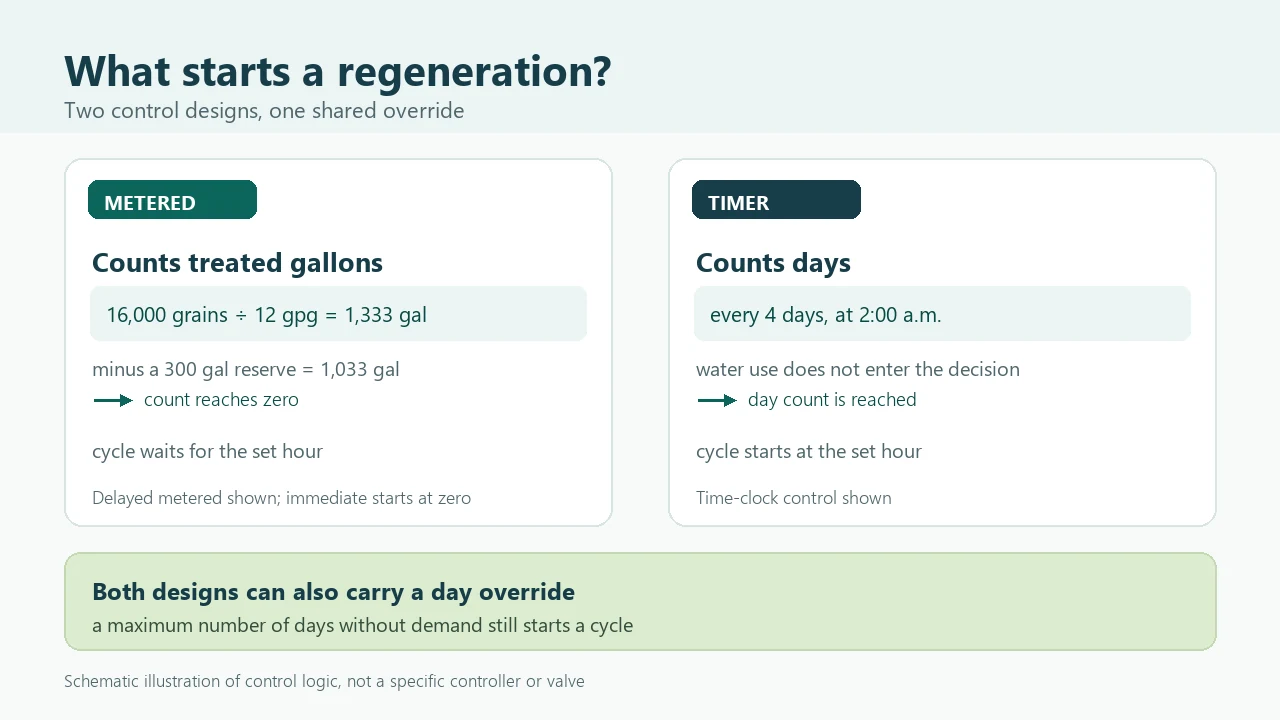
Compare how metered and time-clock softener controls decide when to regenerate, with the immediate and delayed trigger paths, a shared day override, and worked gallons arithmetic for two usage patterns.
Salt & regeneration
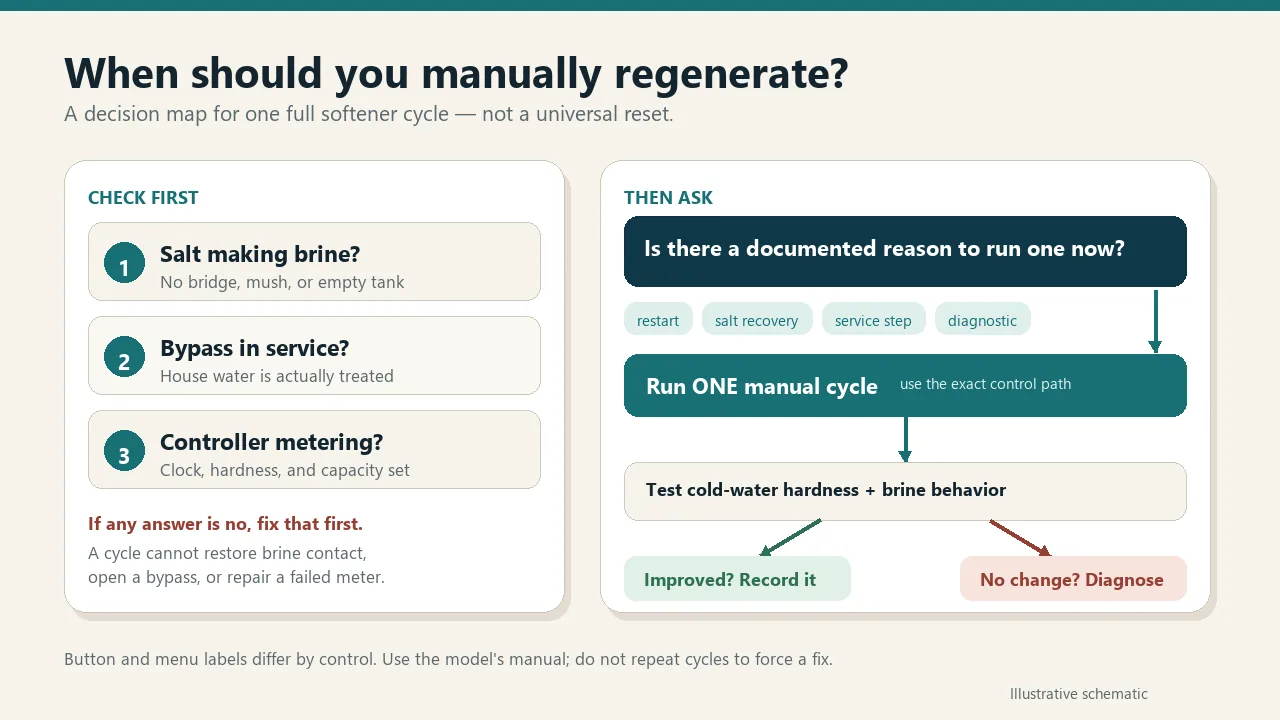
Decide when a manual softener regeneration is justified, compare Whirlpool, EcoWater, and Fleck control paths, and know when to stop and diagnose instead.
Sizing & costs
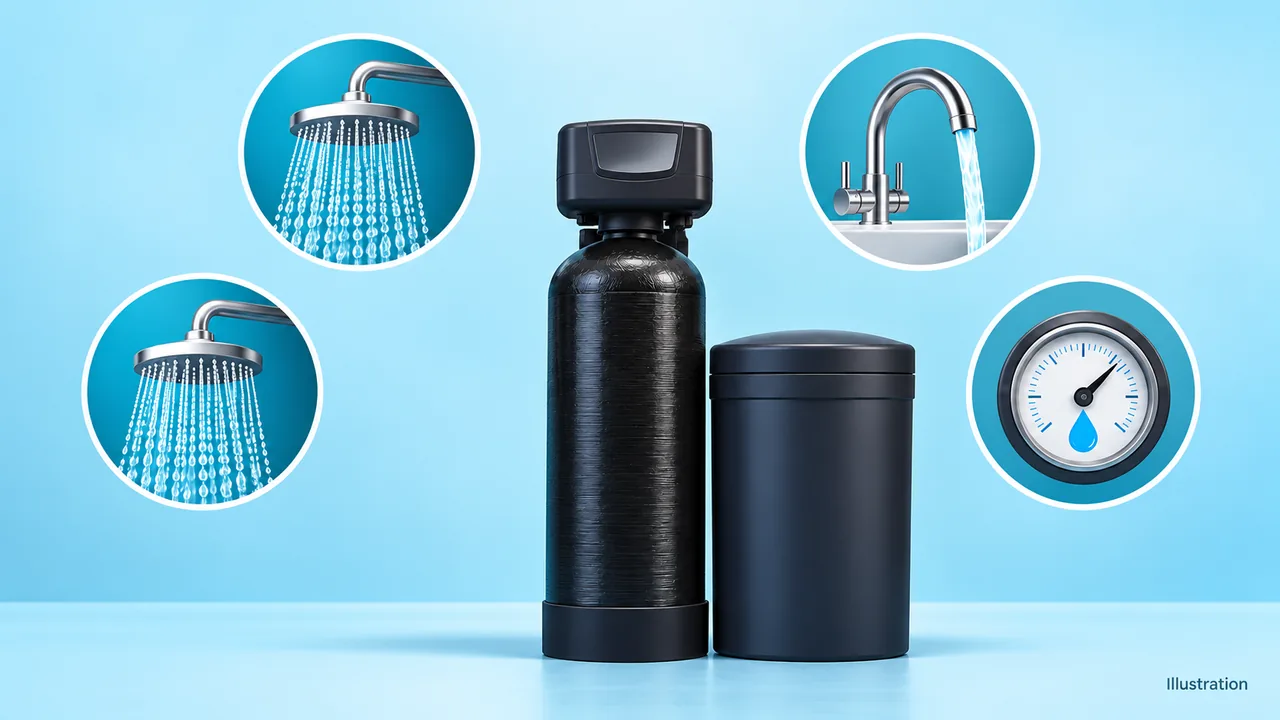
Estimate simultaneous household flow, compare it with a model-specific service-flow rating and pressure drop, and record the evidence before choosing a water softener.
Troubleshooting
Use an observation-first checklist to find why a water softener is not using salt, then separate salt bridges, metering, bypass, fill, and brine-draw questions.
Salt & regeneration
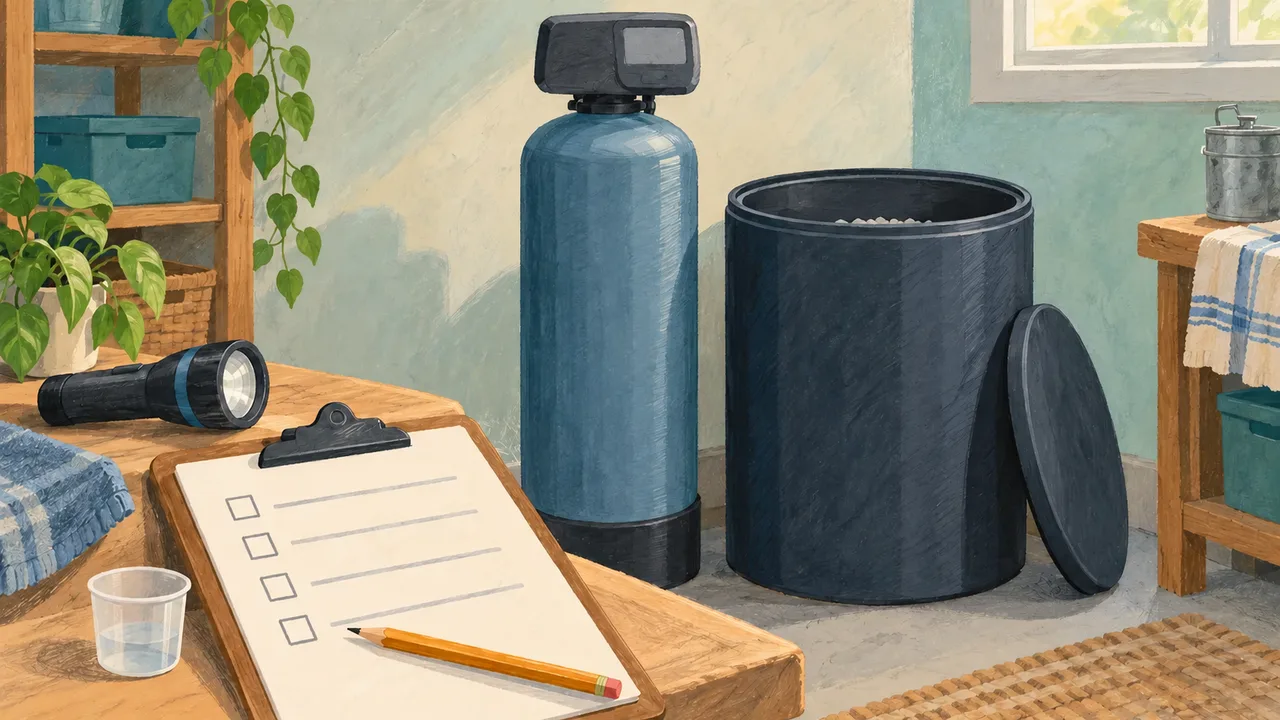
Distinguish a suspended salt crust from fine salt packed at the tank bottom, then use a model-specific recovery path and printable observation record.