Maintenance
Water Softener After a Power Outage: What Settings Should You Check?
Check your softener clock, retained programming and interrupted-cycle status after an outage, with model-specific examples and a printable recovery record.
Sizing & costs
Estimate peak household flow, compare service flow and pressure drop, and check the exact softener manual before you buy.
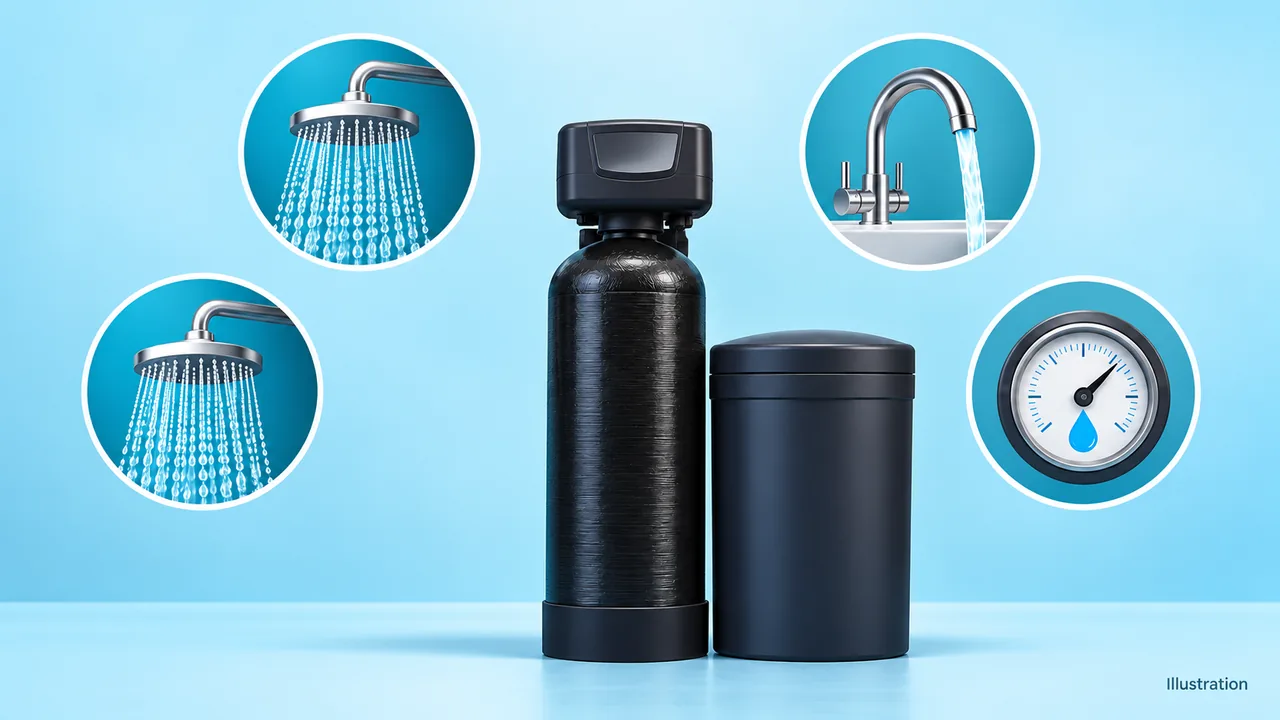
Start with the water your home can use at the same time, then compare that estimate with the exact softener model’s rated service flow and its pressure drop at that flow. A softener with a larger grain-capacity label is not automatically a higher-flow unit. If your estimate is close to the rating, ask for the model’s current manual and pressure-loss data before buying; the inlet pressure, pipe size, filters, and other restrictions still determine what a fixture feels.
This guide concerns salt-regenerated ion-exchange softeners. The cover is a conceptual illustration of household demand and equipment, not an installation diagram or a product test.
Write down the fixtures that could realistically run together during your busiest routine. Use the fixture label or manual when it gives a flow rate. If it does not, measure one outlet at a time: catch the flow for 15 seconds in a container, multiply the gallons collected by four, and record the result as an estimate. Do not call a short test a certified plumbing measurement.
For a simple planning scenario, suppose two conventional showerheads are each 2.5 gallons per minute (gpm), and a bathroom faucet is 1.5 gpm. The assumed simultaneous demand is:
2.5 + 2.5 + 1.5 = 6.5 gpm
The EPA says standard showerheads use 2.5 gpm and WaterSense showerheads use no more than 2.0 gpm. A label on your own fixtures is better evidence than a generic example. The EPA showerhead guidance explains those product limits and the conditions behind the label.
Use a worksheet like this before you compare equipment:
| Outlet and evidence to record | Flow included in this scenario |
|---|---|
| Shower 1: label or measurement ____; runs together? yes / no | ____ gpm |
| Shower 2: label or measurement ____; runs together? yes / no | ____ gpm |
| Kitchen or laundry: label or measurement ____; runs together? yes / no | ____ gpm |
| Other outlet: label or measurement ____; runs together? yes / no | ____ gpm |
| Peak estimate for the selected outlets | ____ gpm |
The total is a planning scenario, not a promise that every fixture will run at its label flow at once. If your household has a large tub filler, body sprays, irrigation, or a fixture with an unknown rate, record that uncertainty instead of hiding it in a precise-looking number.
Look for these entries in the model-specific manual or data sheet:
Rated service flow is the model's documented service-flow rating. It does not establish the pressure available at every fixture in your home.
Pressure drop at rated service flow is the pressure lost through the unit at that test point. It excludes losses in the rest of the plumbing, filters, meter, and fixtures.
Intermittent flow is a separate value when the manufacturer provides one. Do not substitute it for the service-flow rating used to determine capacity and efficiency.
Minimum supply flow is an inlet requirement for the model's operation. It is not a recommended target for your household's peak use.
For example, printed page 3 of the Whirlpool WHES40/WHES44 manual, 7345469 Rev. B dated March 30, 2015, lists rated service flow of 8.5 and 9.0 gpm and pressure drops of 11.0 and 9.4 psig at those rated flows. That page also gives a minimum supply flow of 3 gpm and warns that sustained flow above the service rating can affect capacity and efficiency. Printed page 3 of the Whirlpool WHES30/WHES33 manual, 7392301 Rev. C dated September 13, 2023, lists 7.3 and 7.2 gpm, with pressure drops of 14.8 and 14.9 psig, and separates its intermittent-flow value from the rated service-flow test. These are examples from those revisions, not current ratings for every unit sold under the same model name. Copy the figures from the manual that matches the complete unit you are evaluating.
Keep the grain-capacity guide beside your flow worksheet. Its specification audit card treats service flow, capacity, salt dose, and pressure drop as separate fields. The household capacity calculator answers a hardness-and-use question; it does not replace a service-flow check.
Check the symptom before changing the softener setting. Note whether low flow affects the whole house or one fixture, whether it occurs only when several outlets run, and whether a filter or pressure-reducing valve was recently changed. If the softener has a bypass, a brief comparison can show whether the restriction is associated with the treatment path; follow the model manual and avoid opening pressurized equipment. A licensed plumber or the manufacturer is the right next step when pressure is unsafe, a valve leaks, or the result points to the main supply.
A proposed extra shower or a change in which fixtures receive softened water can change your simultaneous-use scenario. Keep that planned demand beside the routine you actually have today. Ask the supplier to explain how the proposed system would serve both, including the available pressure and the documented service-flow rating. An unexplained allowance can hide the assumption that matters most.
Capacity still needs its own record: how much hardness the resin can remove between regenerations at a stated salt dose and other conditions. A larger grain label cannot settle an unanswered flow question. Before agreeing to a proposal, keep the fixture scenario, capacity-and-dose figures, pressure assumptions, and matching manual revision together so a later change has a clear point of comparison.
There is no universal house-wide answer. Add the fixtures you realistically expect to run together, using their labels or a timed measurement, then compare that scenario with the exact softener’s rated service flow. Also read the pressure-drop figure and your available inlet pressure. A home with one shower and a faucet may have a different peak scenario from a home with two showers, a tub filler, and laundry running together.
No. Grain capacity describes hardness removal under stated salt and test conditions. Service flow describes water passage under a documented flow test. A model can have a large capacity label and still have a service-flow rating that does not suit your simultaneous fixtures. Keep capacity, salt dose, service flow, pressure drop, and model revision in separate worksheet fields.
Treat it as a short-duration reference only when the manufacturer labels it that way. It is not the same as the rated service flow used for capacity or efficiency claims. For continuous household demand, compare your scenario with the rated service-flow entry. If a supplier uses an intermittent number in a quote, ask them to explain the duration, pressure condition, and why it applies to your use.
Catch the outlet in a container for 15 seconds, measure the gallons, and multiply by four. Repeat once and record the pressure or operating conditions if known. The result is a household estimate, not a laboratory rating. Do not infer the softener’s service flow from a faucet test; fixture aerators, valves, pipes, and supply pressure affect what you collect.
Request the current model manual, pressure drop at rated flow, assumed inlet pressure, and expected outlet pressure. Include filters and other treatment devices in the discussion. A close comparison is a reason to resolve the assumptions in writing, not a reason to add an arbitrary percentage or choose the largest grain label.
It can contribute pressure loss, but a symptom does not identify the cause. Compare the affected fixture with the softener in service and in the model-approved bypass position, while observing safe pressure conditions. A clogged screen, filter, partially closed valve, undersized pipe, pressure-reducing valve, or municipal supply issue can create the same symptom. Use the manual and qualified service help before disassembling the unit.
Maintenance
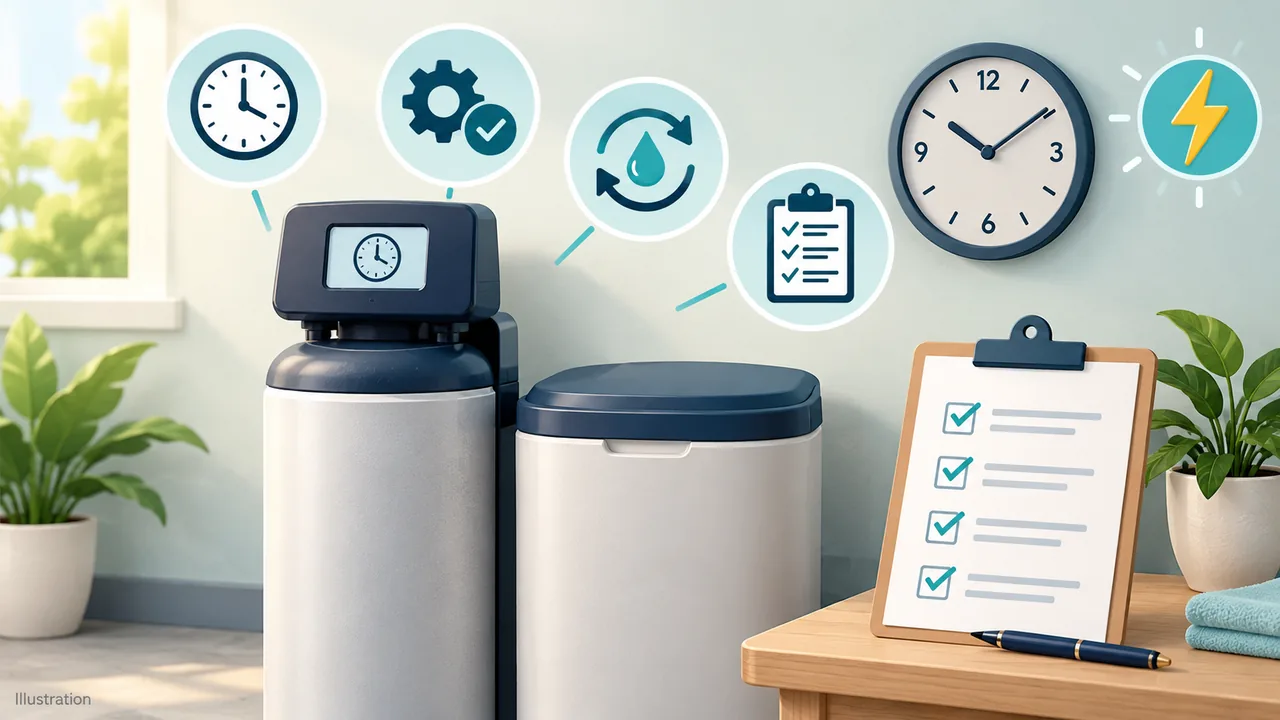
Check your softener clock, retained programming and interrupted-cycle status after an outage, with model-specific examples and a printable recovery record.
Maintenance
Choose a model-appropriate vacation plan, record power and valve positions, separate freezing-weather preparation, and check the return to service.
Salt & regeneration
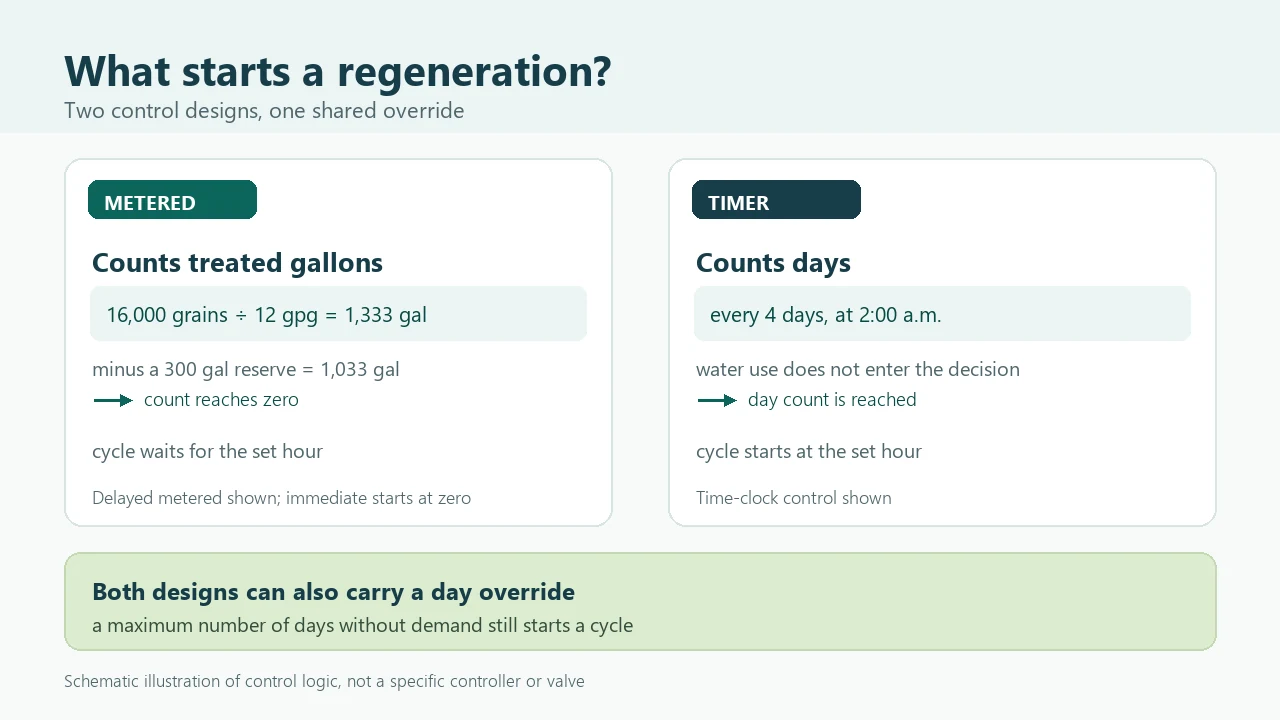
Compare how metered and time-clock softener controls decide when to regenerate, with the immediate and delayed trigger paths, a shared day override, and worked gallons arithmetic for two usage patterns.
Salt & regeneration
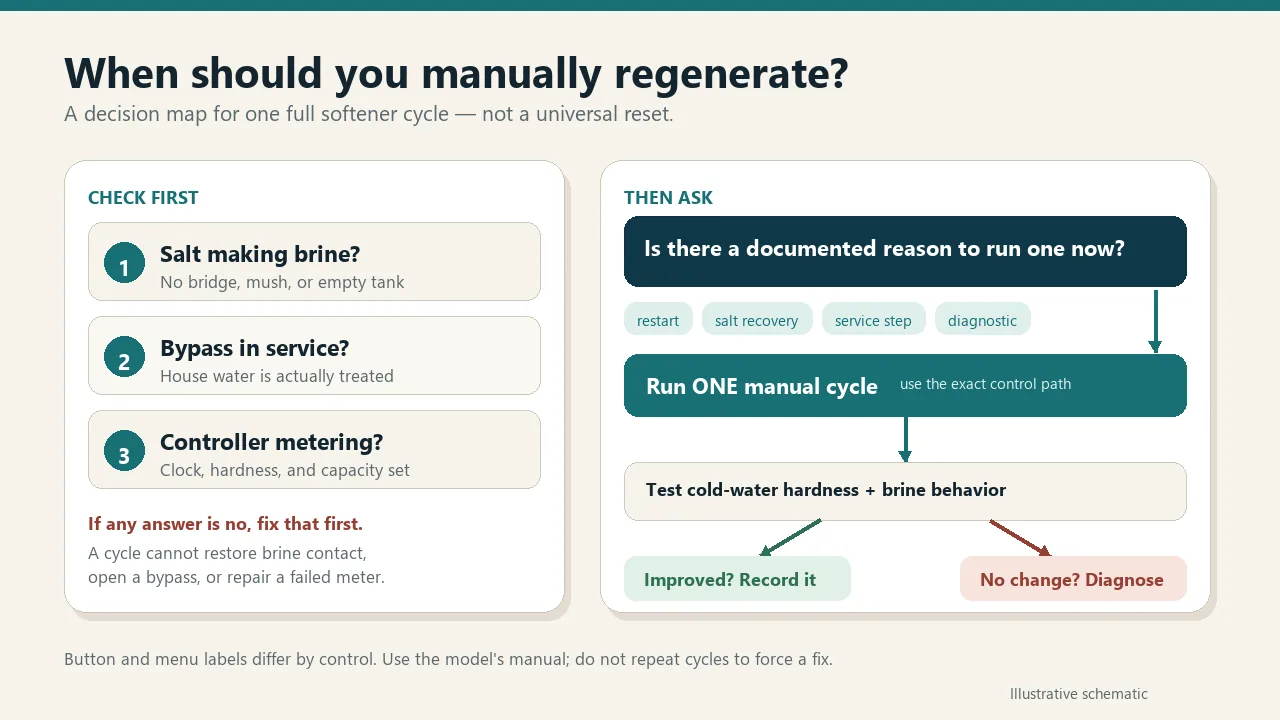
Decide when a manual softener regeneration is justified, compare Whirlpool, EcoWater, and Fleck control paths, and know when to stop and diagnose instead.
Troubleshooting
Use an observation-first checklist to find why a water softener is not using salt, then separate salt bridges, metering, bypass, fill, and brine-draw questions.
Salt & regeneration
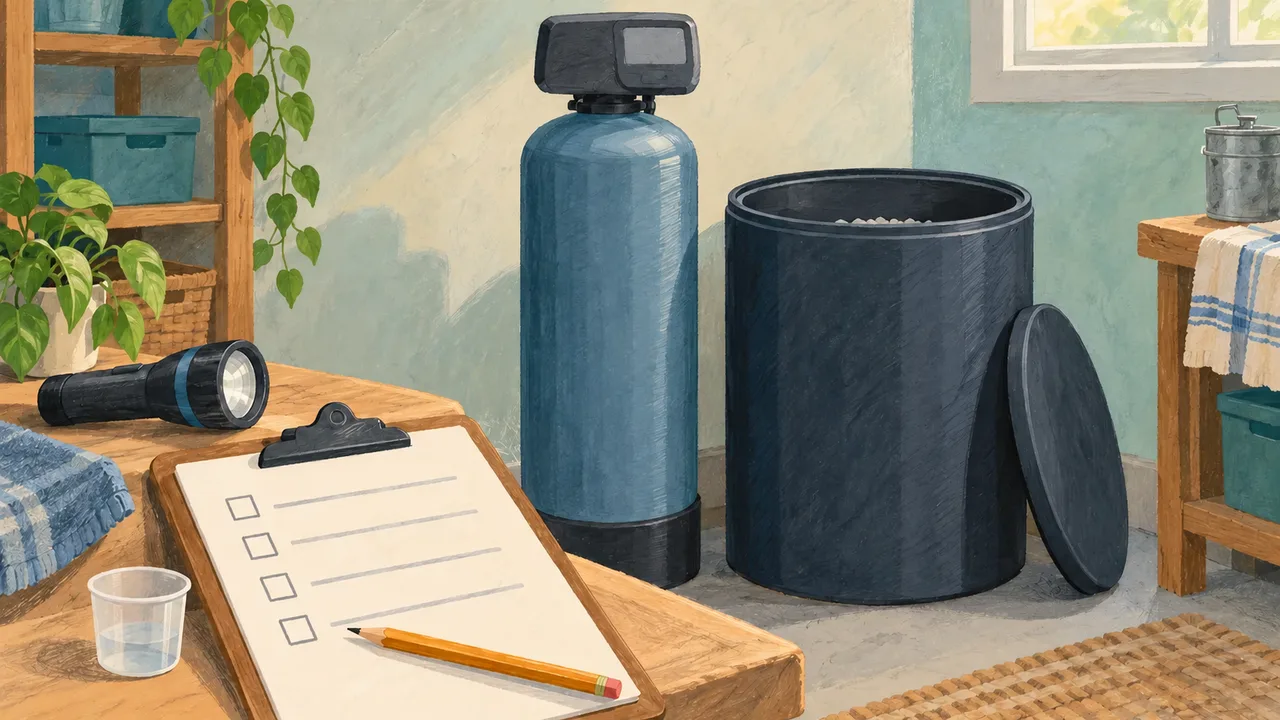
Distinguish a suspended salt crust from fine salt packed at the tank bottom, then use a model-specific recovery path and printable observation record.