Maintenance
Water Softener After a Power Outage: What Settings Should You Check?
Check your softener clock, retained programming and interrupted-cycle status after an outage, with model-specific examples and a printable recovery record.
Salt & regeneration
Compare salt bridges and salt mushing using observable clues, model-specific manual examples, and a printable check-and-recovery record.

The difference is where the salt has collected: a salt bridge is a crust suspended over a gap, while salt mushing is fine salt packed into a mass at the bottom of the tank. Identify that physical finding before selecting a recovery procedure. Salt that looks plentiful from above, or seems to stop going down, is a reason to investigate—not a diagnosis of either condition.
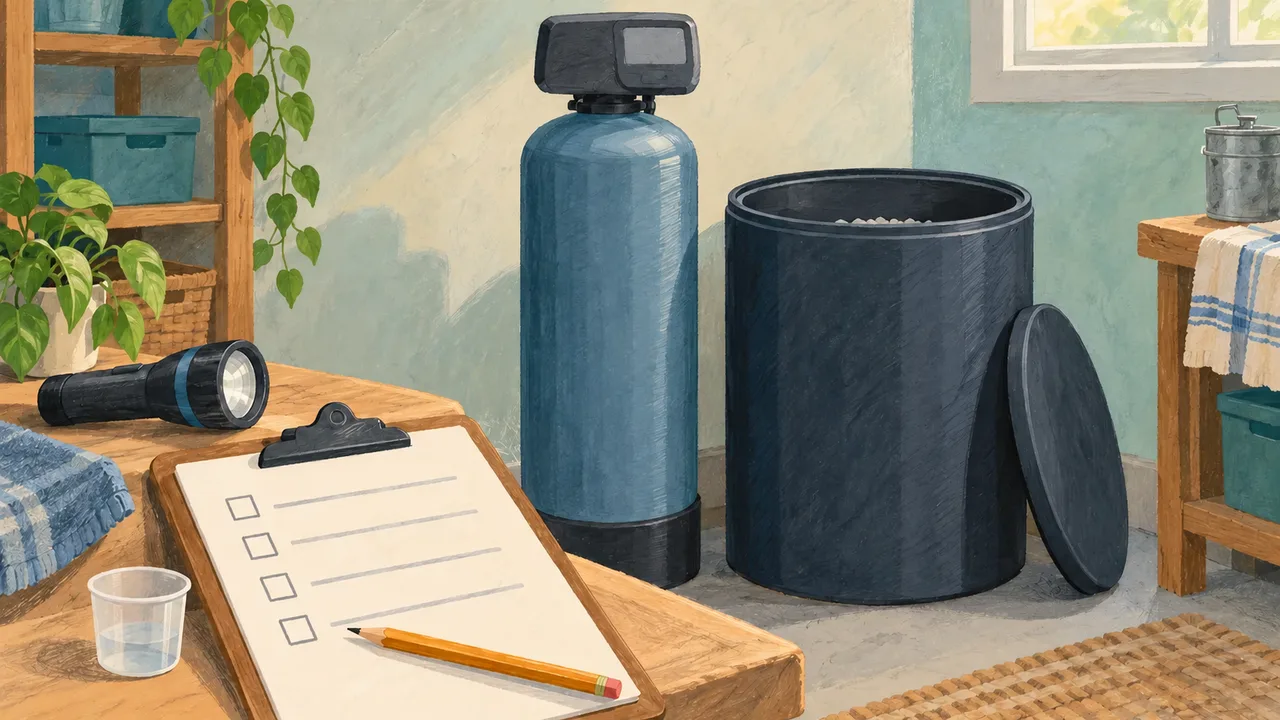
These checks apply to household salt-regenerating water softeners. The cover is an AI-generated illustration, with simplified tanks to show the distinction. It does not specify your equipment’s construction, normal water level, or maintenance steps.
A bridge separates salt from water. A hard layer supports salt over an empty space, and loose pieces can hide that layer from view. The Whirlpool WHESFC manual, Rev. D dated October 20, 2023, shows the crust and gap in its salt-bridge section on printed page 19. This is why simply looking through the lid may miss the problem.
Mushing leaves a deposit at the bottom. Diamond Crystal’s mushing explanation describes loosely compacted pellets or cubes breaking down into fine crystals that can bond into a thick mass and disrupt brine production. Brine is the salty solution used to regenerate the softener. The deposit, rather than a suspended crust, is the relevant finding.
The distinction changes the next task. Cargill’s salt FAQ describes carefully breaking a bridge so salt can reach the water, but removing the mushed material from the bottom. Those are broad descriptions; the equipment manufacturer must supply the access, isolation, and restart instructions. Cargill also identifies insoluble matter from salt or source water as a possible cause of dark residue. Color alone cannot tell you which material is present.
Start with the complete system model and the manual section that covers its salt tank. Keep the valve model as additional information if it differs. Photograph the original salt condition and the product label before changing anything, and write down what prompted the check.
“The water is harder than before” and “the salt level appears unchanged” are different observations. If you have a hardness reading, retain its sampling point, test method, date, and units. If your concern is salt use, retain the refill date and the cycles you actually observed. A label such as “bridge suspected” keeps the observation separate from a confirmed finding.
Read the checking method before inserting a tool or removing a part. The WHESFC example uses gentle checking with a blunt handle and warns that pointed tools or pounding can damage the tank. Use only the method that matches your equipment. If a hard object could be a support or another component, stop and ask for identification rather than treating resistance as permission to push harder.
A crust and gap are identified: follow the matching salt-bridge procedure. Record what you found and which instructions you used. Clearing the visible obstruction completes only that part of the job; carry out the prescribed recovery steps before deciding whether the original problem is resolved.
Fine salt has accumulated on the tank floor: find the applicable removal or cleanout procedure. Decide how salt and residue will be removed, which material the instructions permit you to reuse, and how the tank will be reassembled and refilled. The salt-tank and brinewell cleaning guide supplies a preparation and restart record for this next step. The brinewell is the narrow compartment containing the brine valve and float; its fittings must be handled according to the equipment instructions.
No clear salt obstruction is found, or access is uncertain: keep the cause open. The WHESFC troubleshooting table, for example, lists bypass as another explanation for hard water with salt that is not dropping. Give support the model and observations so the next check addresses the remaining symptom. Do not copy a bypass-handle direction from a different unit.
Avoid guessing a refill quantity or pouring in a household chemical to settle an uncertain diagnosis. Any water addition, cleaning product, or manual regeneration should come from the applicable procedure. An unknown restart instruction is a reason to obtain it before beginning the work.
Use Print this page to keep a short record beside the equipment. The fields below capture the information needed to compare the condition before and after an approved recovery. They are a paper log, not a substitute for the manual.
| Field | Fill in your finding |
|---|---|
| Equipment | Full system model; valve model if different: ______ |
| Starting problem | Symptom, date, and cycle/service state: ______ |
| Salt history | Product, last refill, and observed level: ______ |
| Physical finding | Crust/gap, fine bottom salt, other residue, or unknown: ______ |
| Instructions | Manual section and approved work: ______ |
| Restart | Specified reassembly, refill, and service steps: ______ |
| Follow-up | Dated salt observation; hardness result if relevant: ______ |
| Unresolved item | Remaining symptom or question for support: ______ |
Judge the follow-up against the starting problem. If you investigated a hardness change, compare documented readings under the same sampling conditions after the prescribed restart is complete. If you investigated salt use, keep a dated observation for the next comparison. A looser top layer is an observation about the salt; it does not establish that softening performance has recovered.
Recurring material raises a choice between changing a refill habit and asking for a closer equipment check. Keep enough of a record to distinguish a new deposit from one that was never fully removed. Compare photographs, the product used, the amount added, idle periods, and the outcome of the last procedure.
The WHESFC manual suggests lower salt storage with more frequent refilling in humid areas. Whether a similar adjustment suits your system depends on its instructions and the attention you can give to refills. A smaller stored supply also means you need a workable monitoring routine; do not invent a minimum level for an unfamiliar tank.
Before changing products or repeating a cleanout, ask the supplier which finding would justify that choice. Material returning with the original performance problem unresolved deserves a different conversation from a stable system with an occasional documented crust. The useful next decision depends on what changed between observations, not on the name you first gave the problem.
Yes. The WHESFC manual describes a bridge beneath loose salt, so a normal-looking surface cannot rule one out. Consult your equipment’s checking instructions before probing below that surface. Keep the observation marked as suspected until the condition is identified. If the obstruction could be a component or the approved check is unclear, give the manufacturer a description and photograph instead of applying more force.
No. Mushing describes fine salt gathered into a mass, while other material can also accumulate in the compartment. Cargill identifies water-insoluble matter from salt or the water supply as one possibility for dark residue. Record the appearance and location without assuming color proves its identity. Use the matching inspection or cleaning instructions, and ask for help when you cannot identify the material through permitted access.
Use a water addition only when your equipment’s recovery procedure calls for it. The physical difference between a crust and a bottom deposit does not establish a universal refill amount, temperature, or sequence. Read the complete instructions, including the restart, before adding anything. If the finding remains uncertain, preserve the photographs and observation record so support can advise on the next step without relying on a guessed remedy.
Check the salt requirements for the complete system before switching. Diamond Crystal’s explanation concerns loosely compacted pellets or cubes; it does not establish that every pellet will mush or that crystals will prevent every problem. Keep the product and refill history with your record. Ask whether a different approved product or storage routine fits the condition you actually found, rather than making a universal choice from salt shape alone.
Return to the original performance question. Record the approved work completed, restart steps, and a dated hardness result with its sampling conditions. A change in salt texture does not confirm the whole system is working. Give those details and the full model to support, then ask which check will distinguish the remaining possibilities. Repeating the same cleanup without new observations may leave the cause unresolved.
Maintenance
Check your softener clock, retained programming and interrupted-cycle status after an outage, with model-specific examples and a printable recovery record.
Maintenance
Choose a model-appropriate vacation plan, record power and valve positions, separate freezing-weather preparation, and check the return to service.
Salt & regeneration
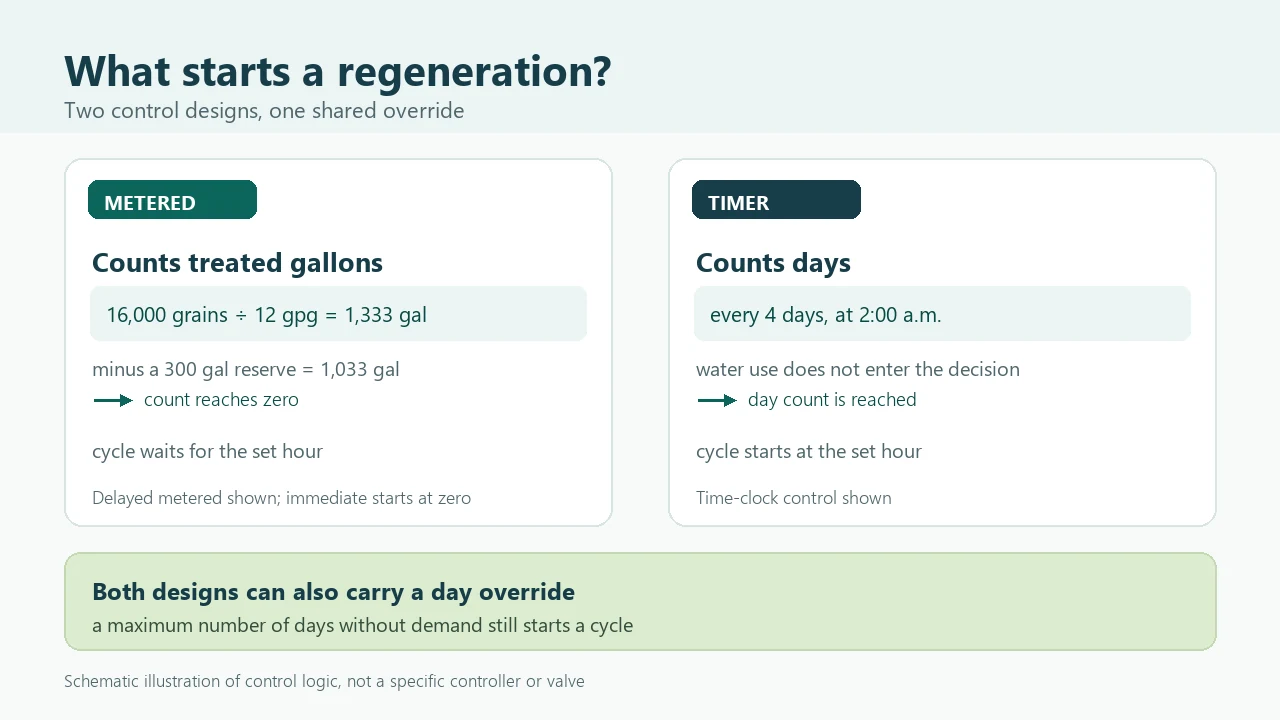
Compare how metered and time-clock softener controls decide when to regenerate, with the immediate and delayed trigger paths, a shared day override, and worked gallons arithmetic for two usage patterns.
Salt & regeneration
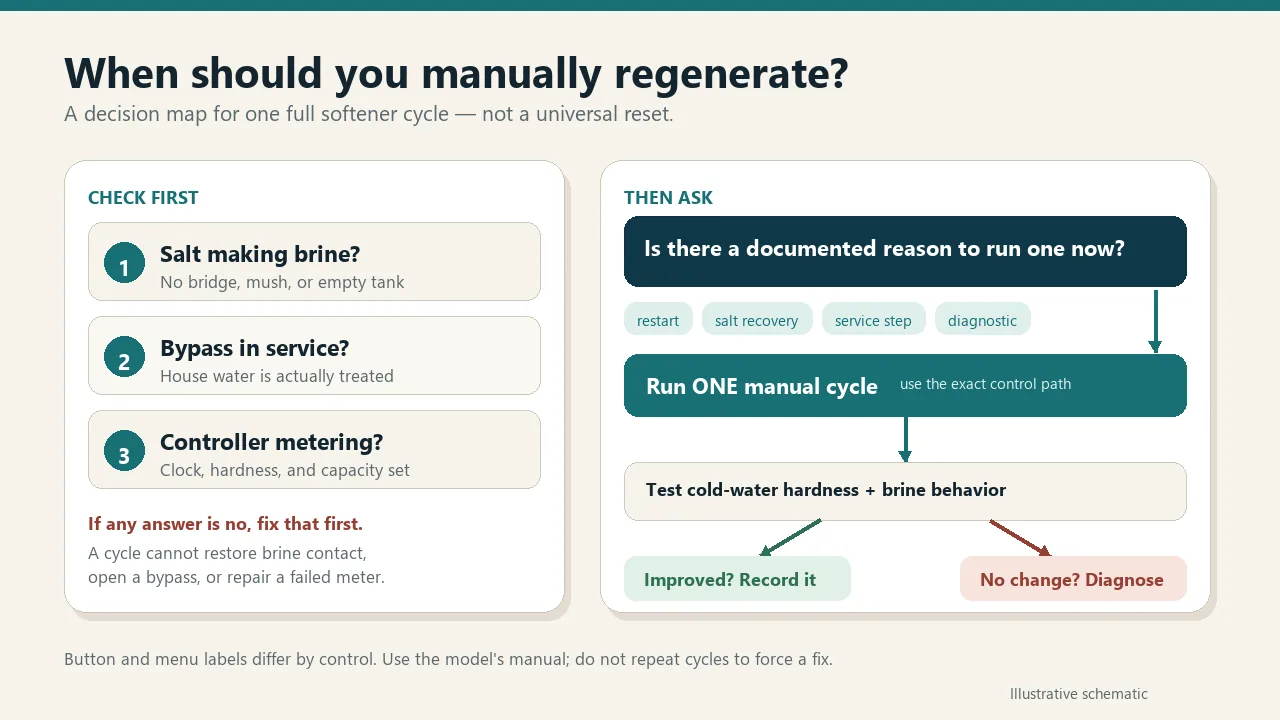
Decide when a manual softener regeneration is justified, compare Whirlpool, EcoWater, and Fleck control paths, and know when to stop and diagnose instead.
Sizing & costs
Estimate simultaneous household flow, compare it with a model-specific service-flow rating and pressure drop, and record the evidence before choosing a water softener.
Troubleshooting
Use an observation-first checklist to find why a water softener is not using salt, then separate salt bridges, metering, bypass, fill, and brine-draw questions.