Maintenance
Water Softener After a Power Outage: What Settings Should You Check?
Check your softener clock, retained programming and interrupted-cycle status after an outage, with model-specific examples and a printable recovery record.
Salt & regeneration
See how metered and time-clock softener controls trigger regeneration, including immediate vs. delayed metering, the day override, and worked gallons arithmetic.
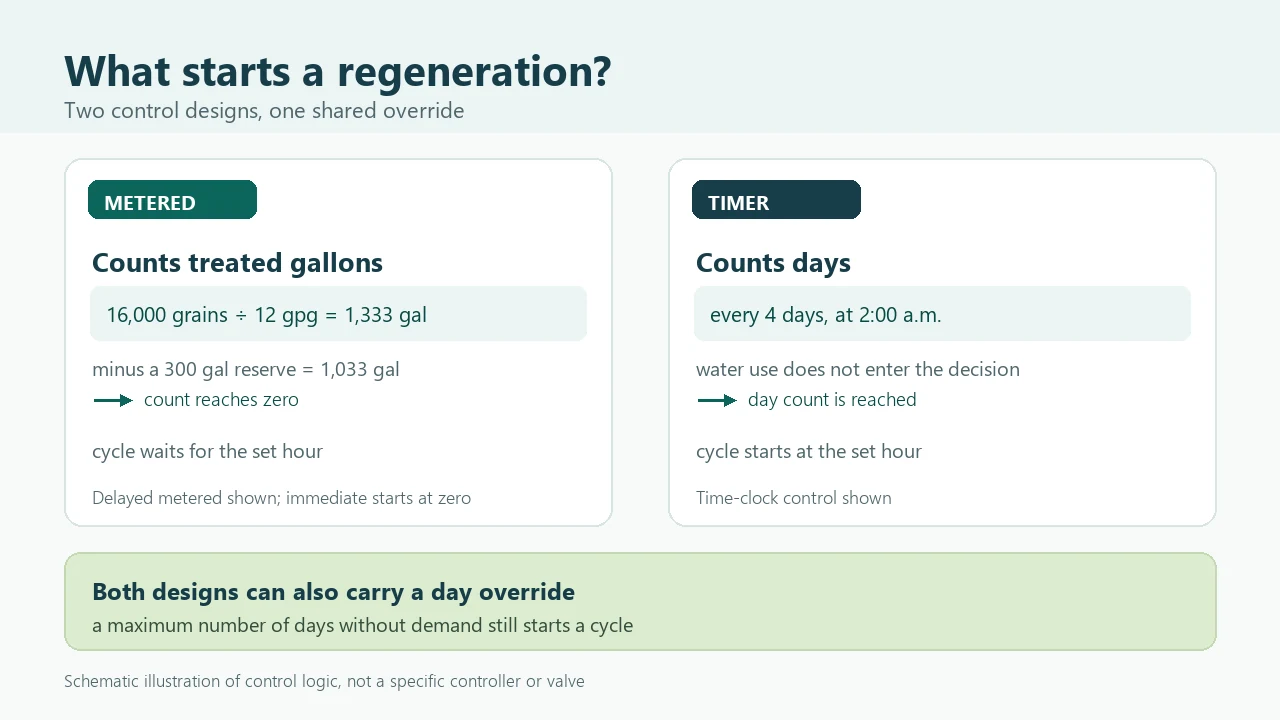
A metered water softener decides when to regenerate by counting the gallons it has treated and comparing that count with its capacity divided by your water hardness. A timer, or time-clock, softener ignores consumption and regenerates after a set number of days at a programmed hour. Both designs can look identical from the outside: same cabinet, same salt tank, often the same style of display. What separates them is the trigger, and that trigger explains most "why did it regenerate now?" questions a homeowner asks.
Two conditions are worth stating up front. Metered controls come in immediate and delayed variants that behave differently at the end of a capacity cycle, and metered controls in the Pentair and Fleck documentation also carry a maximum-days override that fires a regeneration even when water use has been light. The sections below explain how each trigger behaves, run one household through both control types, and end with a way to identify your own control and a log for watching it over a month.
Three quantities get mixed up constantly, so it helps to separate them before comparing controls.
Grains capacity is the amount of hardness a resin bed can remove before it needs to recharge, measured in grains. Feed-water hardness is the concentration in your incoming water, measured in grains per gallon (gpg). Gallons of treated water are what you actually consume. A metered control bridges the first two to predict the third: capacity divided by hardness gives the gallons a full bed can treat. A 16,000-grain working capacity against 12 gpg water covers about 1,333 gallons.
That division is also where reserve capacity enters. A delayed metered control does not regenerate the instant the count reaches zero; it waits for its programmed hour. The reserve is the buffer that keeps soft water flowing between the moment capacity is depleted and the moment the cycle actually starts. Immediate metered controls generally run without a reserve, because the cycle starts at depletion. Twin-tank systems are the documented exception, where the reserve is sized to the water used during regeneration.
Pentair's service manual for the Fleck 5600SXT names the control types precisely, and that distinction is what you need when reading a display. The manual describes a meter immediate control as one that measures water usage and regenerates as soon as the calculated capacity is depleted. A meter delayed control measures usage but regenerates at the programmed time after depletion. A time clock delayed control regenerates on a timed interval, at the programmed hour, once the days since the last regeneration equal the day setting.
| Control type | What actually starts the cycle |
|---|---|
| Meter immediate | Capacity count reaches zero, cycle starts then |
| Meter delayed | Capacity count reaches zero, cycle waits for the set hour |
| Time clock | A set number of days passes, whatever the usage |
| Day of week | A chosen weekday arrives, at the set hour |
The same definitions appear under Timer Operation in the Fleck 5600SXT downflow service manual. It is written for installers, which is why the wording is blunt about what each mode does and does not measure.
Whirlpool's buying guide frames the split in plain terms: timer regeneration "can be set to regenerate at a regular schedule, like every four days, regardless of water usage," while demand-initiated regeneration "is triggered by the amount of water used." The same buying guide notes that a softener runs most efficiently when it regenerates about once every three to ten days, which gives you a band to compare your own records against.
Metered does not mean "only when the meter says so." In the Fleck documentation, both meter variants also start a cycle at the programmed time once a set number of days passes without the usage count depleting capacity. The setting is usually called a day override, or maximum days between regenerations.
That answers a common confusion. A metered unit that regenerates on a quiet week, when nobody was home and the count never got near zero, is usually obeying its override rather than malfunctioning. The override also caps how long the bed can go without a cycle, which matters in a house that sits empty for stretches. If you want to know why a specific cycle happened, the override value is one of two numbers you need, along with the capacity count.
Arithmetic makes the difference concrete. Use your own numbers when you run this; the ones below are a stated example, not a recommendation.
Assumptions: 16,000 grains of working capacity at the salt dose in use, 12 gpg feed-water hardness, a 300-gallon reserve on the delayed metered setting, and a timer programmed for every four days at 2:00 a.m. Two usage patterns: a typical week at 180 gallons per day, and a guest week at 420 gallons per day.
Capacity in gallons is 16,000 divided by 12, or 1,333 gallons. Subtract the 300-gallon reserve and a delayed metered control triggers after roughly 1,033 gallons of treated water.
| Pattern | Delayed metered | Timer, every four days |
|---|---|---|
| Typical week, 180 gal/day | 1,033 / 180 = about 6 days | Fixed cycle, 720 gal used |
| Guest week, 420 gal/day | 1,033 / 420 = about 2.5 days | Fixed cycle, 1,680 gal used |
Read the second row against capacity and the timer's weakness shows up as arithmetic rather than opinion. Four days at 420 gallons is 1,680 gallons, and 1,680 multiplied by 12 gpg is 20,160 grains of demand against a 16,000-grain bed. The cycle arrives roughly 4,160 grains too late, which is about 350 gallons drawn after the bed was exhausted. In the first row the same timer regenerates after 720 gallons, or 8,640 grains, so about 7,360 grains, or 46 percent, of the capacity that cycle restored was still unused.
Six days is a plausible interval for a household this size. If your own arithmetic lands at a day and a half, or at three weeks, one of the four inputs is probably wrong. The guide to expected regeneration intervals takes the same inputs and goes further into comparing an estimate with a real cycle log.
Start with the display, because the cabinet tells you nothing. Three readings point in different directions.
If the screen counts down gallons remaining, or shows a capacity figure that falls as water runs, you have a metered control. If it shows only the time of day and a days-until-regeneration count, you are looking at a time clock. If it shows a count that rises while a tap is open, the unit is metering flow at that moment, which is a narrower question than whether the regeneration logic is demand-based.
That last check is worth doing properly, because a metered control with a failed meter behaves like a timer that never fires. Whirlpool's article on checking whether your softener is working walks through it on their controls: hold Program/Select until zeros appear, open a hot-water faucet, and watch whether the numbers climb. If they do not climb, the unit is not metering and will not recharge on consumption.
A few entries, written down once a week for a month, will tell you more than any label on the lid. The table prints well if you keep it next to the unit.
| What to record | Why it answers the question |
|---|---|
| Display reading at the same time each week | Shows whether the unit tracks gallons or days |
| Date and time of each regeneration | Reveals a fixed interval or an irregular one |
| Days since the previous regeneration | Separates override cycles from demand cycles |
| Gallons used in between, if shown | Tests capacity divided by hardness against reality |
| Anything unusual that week | Guests, vacation, irrigation, a new appliance |
After three or four weeks the pattern is usually obvious. A regeneration every four days to the hour is a timer. Cycles that drift with occupancy and cluster after heavy laundry days are metered. Cycles that appear at a fixed maximum interval only when the house was quiet are override-driven, which is still metered behavior.
The log tells you what the control is doing; it does not tell you to change settings. Capacity, hardness, reserve, and the override are installer-level values, and a wrong guess about any of them produces either hard water or wasted salt. Change one value at a time, after confirming what your model's manual says that value means.
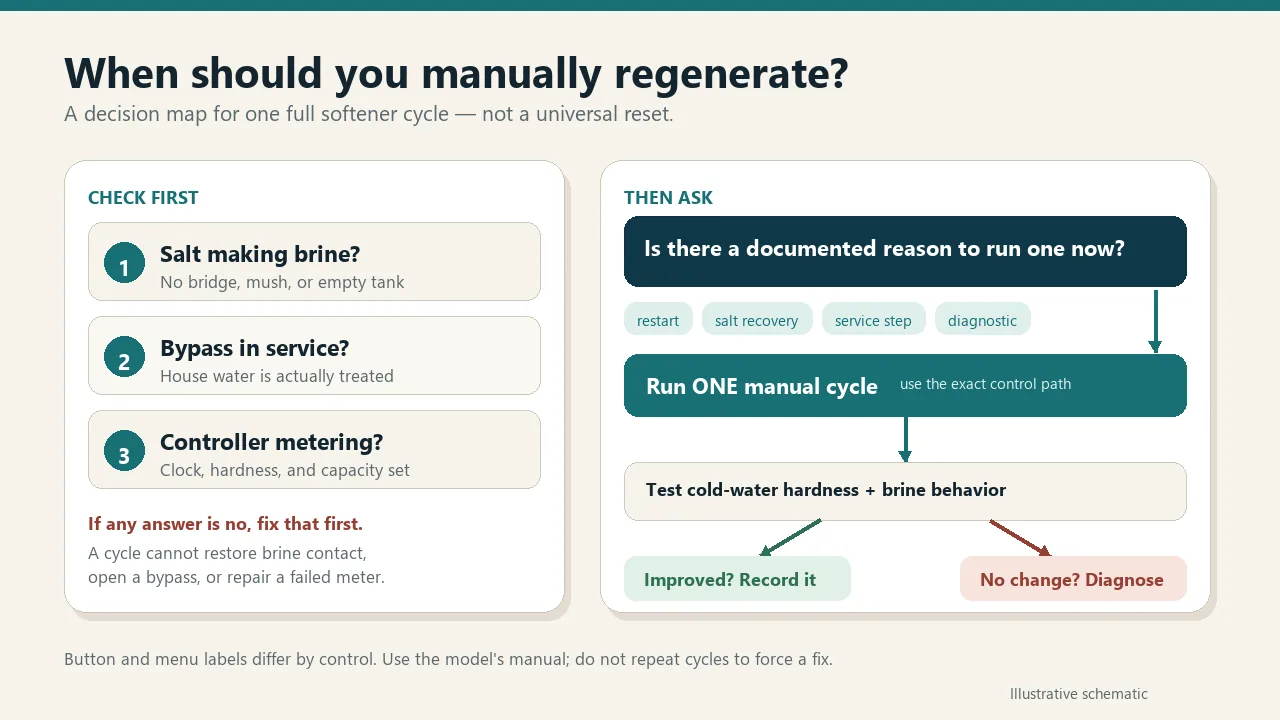
There is one deliberate override available to you: a manual regeneration. It is the right move after a documented restart, a long vacancy, or a service step, and the wrong move as a habit. The guide to when a manual regeneration is justified covers the entry points for several control families and the point at which repeating the cycle stops being diagnostic.
The metered-versus-timer question gets blurrier at the top of the market. Controllers now advertise adaptive or learning behavior, variable reserve, and twin-tank configurations that regenerate one tank from the other's treated water. Those features change the reserve arithmetic in ways a single-capacity example cannot capture.
What has not changed is the diagnostic order. Identify the trigger, record the interval, compare it with the gallons that capacity should cover, and only then decide whether the schedule is wrong. Two units from the same brand can run different logic depending on the valve and the programming, so the manual for your exact model outranks any general comparison, including this one. The open question for most households is not which design is newer, but whether the numbers their control is using still match the water and the people in the house.
Yes. Metered controls usually include a maximum-days setting, often called a day override. When that many days pass without water use depleting the capacity count, the control starts a cycle at its programmed time anyway. In the Fleck documentation this applies to both immediate and delayed metered modes. A metered unit can therefore look scheduled during quiet periods while still responding to demand during busy ones.
Watch the display rather than the cabinet. A count of gallons remaining, or a capacity number that falls as water runs, indicates metering. A screen showing only the time of day plus days until regeneration indicates a time clock. To confirm the meter itself works, open a hot-water tap and watch whether the count changes. A metered control that is not counting will not recharge on consumption.
Not automatically. Metered control adapts to how much water you actually use, which is why manufacturers describe it as the more salt-efficient design, but it depends on correct capacity, hardness, and reserve values. A timer is predictable and simple, and it suits a household with steady occupancy and steady use. Either design performs badly when its programmed numbers do not match your water.
Heavy use is the usual reason. Two days of laundry, guests, or irrigation can consume a capacity count that normally lasts six. Check whether the cycle followed an unusual demand day, then whether the day override could have fired, then whether anyone pressed a manual regeneration button. A pattern of short intervals without unusual use points to a capacity or hardness setting that is too low.
Reserve is the buffer that keeps soft water flowing after the capacity count reaches zero but before the delayed cycle starts. Without it, a delayed metered unit would deliver hard water overnight until its programmed hour arrived. Immediate metered controls generally run without a reserve because the cycle starts at depletion. Twin-tank systems are the documented exception, where the reserve is sized to the water used during regeneration.
Sometimes, and the answer lives in your model's manual. Some control families offer metered and time-clock modes as programming choices on the same powerhead, while others need a meter assembly or a different control before metering is possible. A digital display does not by itself mean the conversion is available. Confirm the valve model, then check what the manual lists for that configuration.
Maintenance
Check your softener clock, retained programming and interrupted-cycle status after an outage, with model-specific examples and a printable recovery record.
Maintenance
Choose a model-appropriate vacation plan, record power and valve positions, separate freezing-weather preparation, and check the return to service.
Salt & regeneration
Decide when a manual softener regeneration is justified, compare Whirlpool, EcoWater, and Fleck control paths, and know when to stop and diagnose instead.
Sizing & costs
Estimate simultaneous household flow, compare it with a model-specific service-flow rating and pressure drop, and record the evidence before choosing a water softener.
Troubleshooting
Use an observation-first checklist to find why a water softener is not using salt, then separate salt bridges, metering, bypass, fill, and brine-draw questions.
Salt & regeneration
Distinguish a suspended salt crust from fine salt packed at the tank bottom, then use a model-specific recovery path and printable observation record.