Maintenance
Water Softener After a Power Outage: What Settings Should You Check?
Check your softener clock, retained programming and interrupted-cycle status after an outage, with model-specific examples and a printable recovery record.
Maintenance
Check model-specific vacation instructions, distinguish power from bypass and house supply, and print a departure and return checklist with a separate freeze branch.

You do not automatically need to turn off your water softener for a vacation. Follow the instructions for your exact system: some manufacturers allow normal operation during an absence, while others recommend bypassing and disconnecting power for an extended trip. If the equipment could freeze, use its winterizing procedure instead of treating it as an ordinary vacation shutdown.
Before changing anything, identify what you mean by "off." Stopping the controller, routing water around the softener, and shutting off the house water supply are different actions. Your departure plan should say which of those you need and how you will restore service.
Unplugging an electric controller stops its powered operation; it does not close a plumbing valve. A softener bypass routes incoming water around the treatment equipment, so the house may still receive unsoftened water. The main shutoff controls the home's supply. None of those actions, by itself, removes all water retained inside the softener.
A setting labeled Vacation or similar is another possibility, but use it only if your own manual describes it. Do not assume that a blank display means the equipment is isolated, or that a bypass handle shuts off water throughout the house. If you cannot identify a valve, leave it alone until the installer or manufacturer identifies it.
GE's vacation guidance says its SmartWater demand-based softeners generally need no special preparation when no water is being used. It identifies the timed GXSS17 as an exception that can continue regenerating during an absence. This is a useful example of why a brand name alone is insufficient: the control type matters too.
Whirlpool's extended-absence instructions recommend bypassing the unit, disconnecting power, and recording its settings. Its return instructions call for restoring power and programming as needed, returning the unit to service, and running a manual recharge. Apply that sequence to the equipment covered by those instructions, rather than borrowing its handle directions for another valve.
Even a demand-controlled softener may have a calendar override. Whirlpool's maximum-days explanation describes an optional feature on select models that forces a recharge if the selected interval is reached. Check whether your system has such a setting before assuming zero household use guarantees zero cycles. Record the setting and its purpose; do not disable an established service setting simply to suppress a cycle while traveling.
Use the manual's vacation or extended-storage section to choose the operating state. If it does not address your situation, ask the manufacturer what to do with both the controller and water supply. Say whether the home will remain heated and whether anyone or anything will still use water.
Before leaving:
Print this page and complete the record below. Keep a baseline observation or test result with the water softener maintenance checklist if you want to compare performance after the trip.
| Trip record | Your entry |
|---|---|
| System model and manual section | ____________________ |
| Departure / expected return | ____________________ |
| Freeze exposure / heat plan | ____________________ |
| Remaining water demand | ____________________ |
| Controller time and settings photo | ____________________ |
| Power state selected | ____________________ |
| Softener bypass position | ____________________ |
| House supply decision | ____________________ |
| Return instructions / contact | ____________________ |
| Return inspection and test result | ____________________ |
This is a planning record, not a valve-operation diagram. Write "unknown" where you still need an answer instead of guessing a setting or handle direction.
An unheated cabin, garage, or other exposed location changes the decision. Turning off power does not protect water left inside the tanks or valve from freezing. Leaving the unit bypassed does not drain those components either.
Whirlpool's winterizing procedure includes depressurizing, disconnecting, and draining work. It illustrates how different winterization is from an electrical shutdown. Use the procedure for your complete system and installation; arrange qualified help if you cannot confidently identify the required steps. Do not pull retaining clips, disconnect pressurized fittings, or tip a different model simply to copy an illustration.
Plan the home's other water-dependent equipment separately. A softener vacation instruction does not establish that closing the main supply or shutting off heat is appropriate for the rest of the property.
Compare the equipment with your departure record before restoring anything. Look for visible damage, wetness, disconnected hoses, and an unfamiliar display message. If freezing damage or a leak is suspected, arrange inspection before putting the softener back into service.
Restore the supply, bypass position, and power in the order specified by your manual. Verify the displayed time and any settings that may need attention after a power interruption. Use the recorded values as a reference, not a reason to overwrite a setting whose purpose is unclear.
Follow the manufacturer's return procedure for recharge, flushing, or cleaning. Whirlpool's vacation guidance, for example, also raises cleansing after a prolonged idle period. It does not establish one chemical recipe or a universal number of idle days for every softener. Use the approved procedure for the model and the condition you find.
Finish with an observation of normal operation and, when checking softening performance, a recorded hardness result using the test's instructions. Note the tap, timing, and unit so the result can be compared with a prior reading. If performance remains unexpected, give support the model, trip record, settings, and result before making several changes together.
An empty house is not always a house with no water use. A person checking the property, scheduled equipment, or a fixture still drawing water changes the assumption behind a no-demand plan. Identify which uses actually pass through the softener rather than treating every household water use as softened water.
For a seasonal home, ask the manufacturer how the expected idle period, water conditions, and winter protection plan affect both storage and restart. If the inherited settings are unexplained, ask what the existing override is intended to address and which return checks demonstrate that the system is ready. Those answers are more useful than choosing a shutdown method solely by the length of the trip.
A weekend alone is not a universal reason to unplug it. Check the exact model's instructions and whether the equipment will stay in a heated space with a normal water supply. Some systems can remain operating during an absence. If you choose an approved shutdown, record the starting settings and the steps needed on return rather than assuming every controller preserves the same information.
Check the model's shutdown instructions before deciding what to do with power. Closing the house supply and stopping the controller address different parts of the system. Your plan needs to account for both, including any scheduled regeneration. Record which valve was closed and which controller action was taken, then follow the matching return sequence when the supply is restored.
A normal softener bypass sends water around the treatment equipment, so it can leave the rest of the house supplied with water. It should not be treated as the home's main shutoff. Identify the actual plumbing arrangement and make a separate house-supply decision. If a valve's purpose or position is unclear, ask the installer to identify it before you leave.
Use your manufacturer's instructions rather than adding a recharge to every trip. GE's vacation page says a pre-trip regeneration is optional for the demand-based systems it describes. Other shutdown and restart instructions can differ. Check whether a cycle is already underway and follow the manual for any interruption; the departure checklist is not a procedure for stopping a valve midway through regeneration.
No. Disconnecting power does not remove the water retained inside the equipment. A bypass also leaves winterization work unresolved. If the installation could freeze, use the complete system's documented draining and storage procedure or arrange appropriate service. Protecting the softener is only one part of the property's cold-weather plan; the same decision must account for the rest of the plumbing and equipment.
Inspect the visible condition and compare power, valve positions, and controller settings with your departure record. Follow the manufacturer's restart instructions for any recharge, flushing, or cleaning, without choosing a chemical dose from another model. Record an actual performance check afterward. If you find damage, a leak, an error, or a persistent unexpected result, obtain model-specific help before repeated adjustments.
Maintenance
Check your softener clock, retained programming and interrupted-cycle status after an outage, with model-specific examples and a printable recovery record.
Salt & regeneration
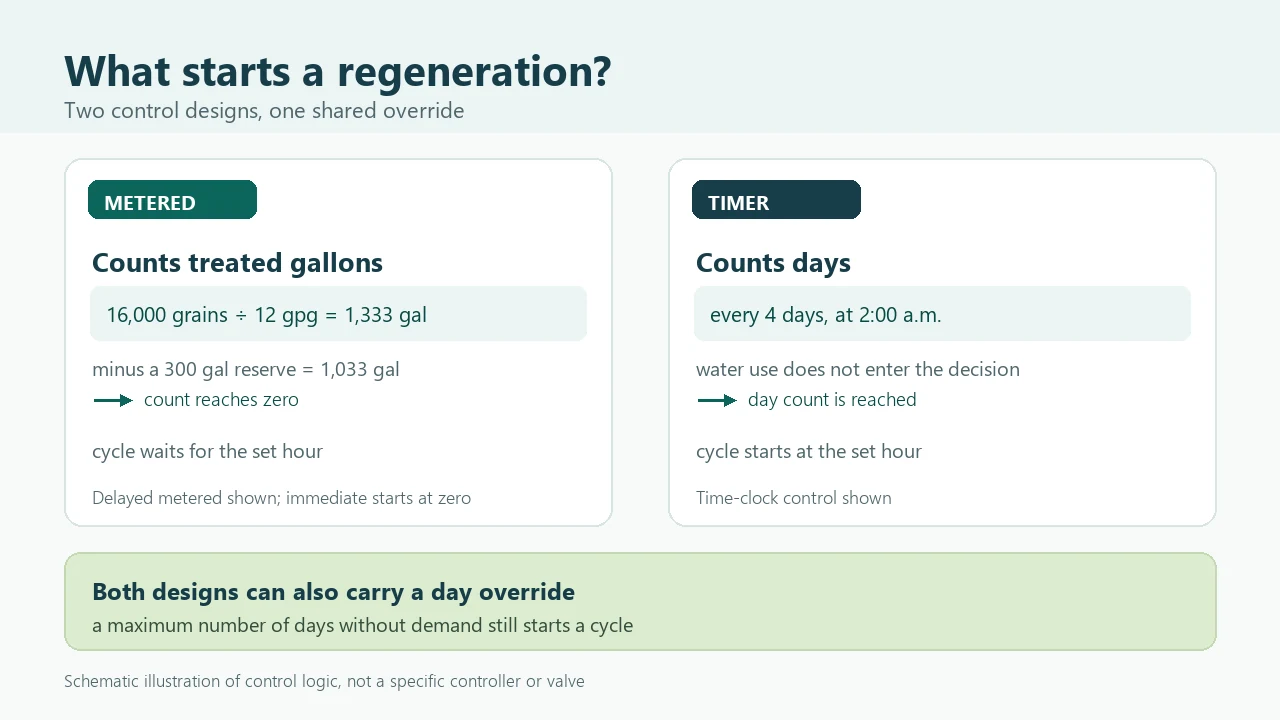
Compare how metered and time-clock softener controls decide when to regenerate, with the immediate and delayed trigger paths, a shared day override, and worked gallons arithmetic for two usage patterns.
Salt & regeneration
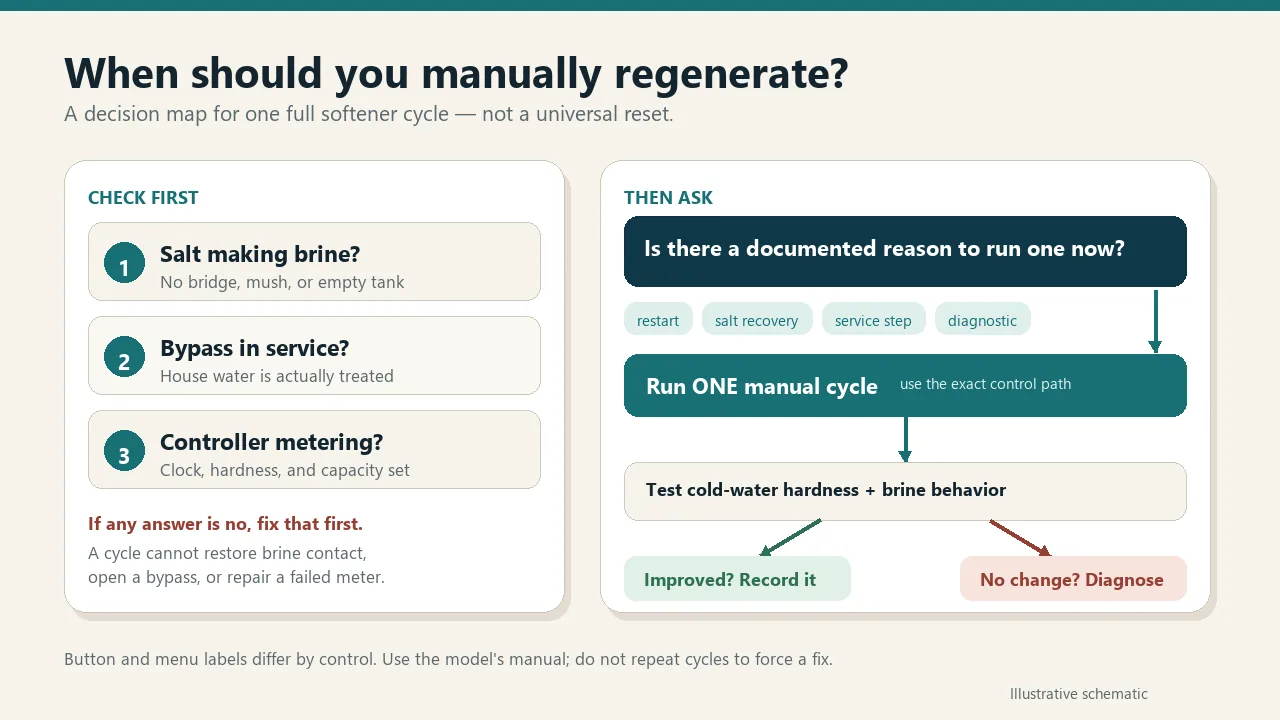
Decide when a manual softener regeneration is justified, compare Whirlpool, EcoWater, and Fleck control paths, and know when to stop and diagnose instead.
Sizing & costs
Estimate simultaneous household flow, compare it with a model-specific service-flow rating and pressure drop, and record the evidence before choosing a water softener.
Troubleshooting
Use an observation-first checklist to find why a water softener is not using salt, then separate salt bridges, metering, bypass, fill, and brine-draw questions.
Salt & regeneration
Distinguish a suspended salt crust from fine salt packed at the tank bottom, then use a model-specific recovery path and printable observation record.