Maintenance
Water Softener After a Power Outage: What Settings Should You Check?
Check your softener clock, retained programming and interrupted-cycle status after an outage, with model-specific examples and a printable recovery record.
Troubleshooting
Use a printable sample log to diagnose hard water after regeneration. Compare treated cold taps, hot water, bypass, salt, and the timing of hardness return.
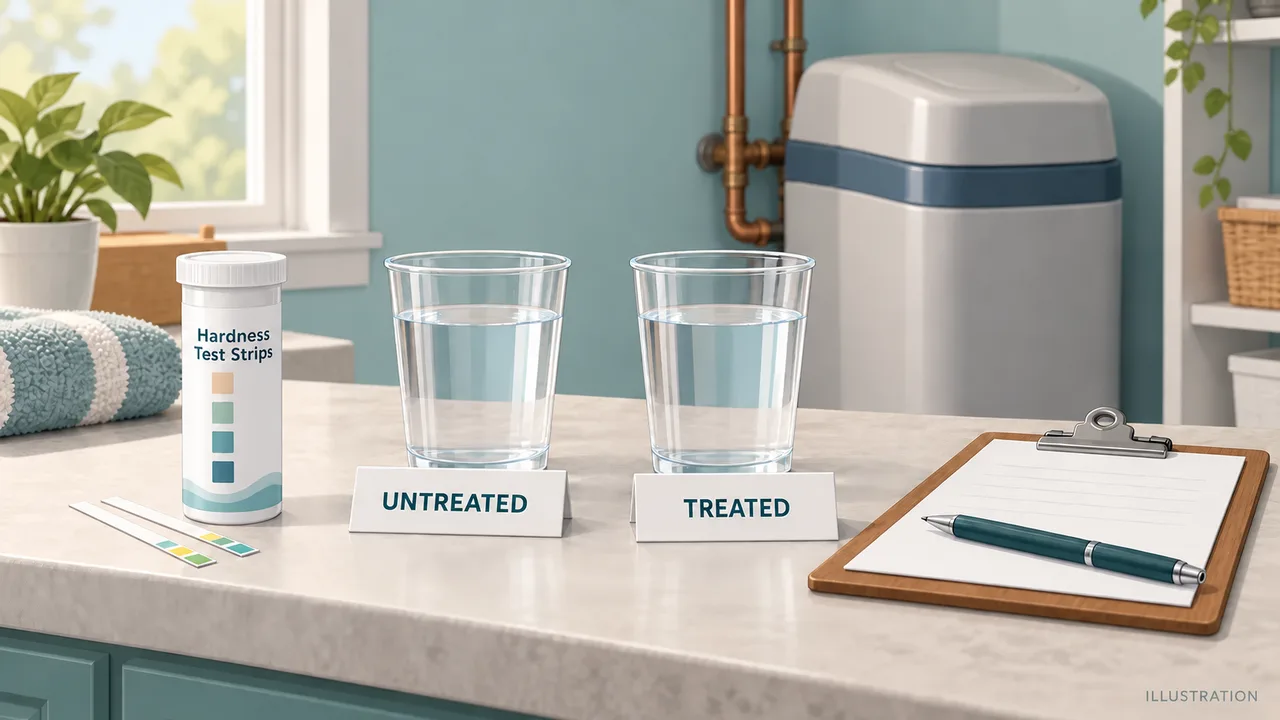
If water is still hard after regeneration, confirm that the cycle has finished, then test cold water from faucets you know are supplied by the softener. Compare those results with untreated water using a hardness test. The useful distinction is whether treated water never becomes soft, only certain outlets test hard, or hardness returns before the next cycle. Each pattern calls for a different next check.
This guide covers household salt-based ion-exchange softeners. It provides a sampling record and a way to organize observations; operating buttons, bypass positions, recovery procedures, and acceptable treated-water results still come from your complete system's manual.
A high reading on a handheld TDS meter does not establish that regeneration failed. TDS measures total dissolved solids, while softening exchanges hardness minerals for sodium or potassium. The reading can remain similar after treatment. Rheem's guide to testing hard and soft water explains this distinction and why the sampled faucet must actually receive treated water.
Use a test intended to measure total hardness. Follow that kit's directions for collection, sample volume, reagents, timing, and interpretation. Check its expiration and storage instructions. A color strip with a broad lowest band cannot establish an exact zero result; record the band it shows. If the result is unclear or consequential, ask the manufacturer or a water-testing service to confirm it with an appropriate method.
Keep units visible. GPG means grains per gallon; some tests instead report mg/L as calcium carbonate. Do not compare bare numbers from different scales. The Hach HA-71A instructions illustrate why technique matters: even one kit has separate low- and high-range procedures. Its drop values belong to those procedures, not to every hardness kit.
Find the model label and note when regeneration actually ended. A scheduled start time or the sound of a motor is not a completion record. If the display is stuck in a stage or shows an error, record that condition and use the matching troubleshooting instructions before treating the cycle as complete.
Identify an accessible untreated sampling point and several cold faucets on confirmed treated branches. An outdoor faucet or kitchen cold tap may bypass the softener, but location alone does not prove its plumbing connection. Ask the installer when the route is uncertain. Avoid using water downstream of another treatment device as your only sample of softener output.
Follow the system's post-regeneration flushing directions, if provided, so the sample represents newly delivered water rather than water left in the line. There is no fixed flushing time that fits every pipe layout. Use the test's own sampling and labware-cleaning instructions, and repeat questionable results under the same conditions.
Use Print this page to keep this worksheet beside the manual. Complete a separate result row for each outlet rather than recording only “whole house hard.”
| Record | Your observation |
|---|---|
| Complete system model and manual | ____________________ |
| Cycle end time; completed or uncertain | ____________________ |
| Test kit, range, units, and date | ____________________ |
| Untreated sample: point, time, result | ____________________ |
| Treated cold sample A: point, time, result | ____________________ |
| Treated cold sample B: point, time, result | ____________________ |
| Hot-water result, if relevant; sampling method | ____________________ |
| Display, salt condition, bypass position | ____________________ |
| Recent water use or setting changes | ____________________ |
Record what you observed separately from what you suspect. “Salt surface has not moved since the marked date” is useful; “resin is worn out” needs additional evidence.
If other confirmed treated cold outlets meet the expected result, investigate the affected plumbing branch before declaring the softener ineffective. Confirm whether that outlet is bypassed and whether a mixing arrangement changes the water it receives. Give a plumber the outlet-by-outlet results if the route is unclear.
Hot water can also reflect water already stored in the heater. The Whirlpool WHES18 manual explains that a connected water heater initially contains hard water and refills with conditioned water as hot water is used. Its troubleshooting section also identifies hot-water use during regeneration as a possible source of hard water in the heater. That is a model-specific example, not a promise that every hot-only problem will disappear after a set number of hours. Start with the cold-water comparison; do not drain a heater simply to troubleshoot the softener.
Review accessible observations against your manual: power and error display, service versus bypass position, available salt, evidence of a salt bridge, and the documented incoming-hardness setting. Photograph the current settings before changing them. A full-looking salt tank does not by itself prove that brine, the salty regeneration solution, reached the resin.
Whirlpool's no-soft-water diagnostic guide checks metering, bypass, hardness programming, salt, and tank filling before directing owners toward further diagnosis. Follow it only when it matches your equipment. Do not copy its button holds, numbered salt marks, or bypass-handle direction onto another system.
If those checks do not explain the result, send the record to the manufacturer or service provider. Brine draw, drain restrictions, valve operation, and internal sealing require more specific investigation. Avoid opening pressurized parts or using generic cleaning doses as an experiment. A cycle that visibly ran can still leave the cause unresolved.
Record when the change happens and the water use between tests. Compare the programmed incoming hardness with a current untreated-water test. Note unusual laundry, guests, leaks, or a setting change. These observations help separate a demand or scheduling question from a failure to recover immediately after regeneration.
Use the regeneration interval guide and cycle log to compare demand, documented working capacity, reserve, and observed cycles. Its estimate explains capacity use; it does not replace the controller's algorithm. Keep manual cycles separate in the log so they do not disguise the automatic pattern. Change a setting only with the model's instructions or support advice, then repeat the comparison.
A repair proposal should explain how the suggested work accounts for your pattern. Ask the technician which observation distinguishes a brine problem from bypassed or mixed water, and what treated-water result they expect after the work. Request a follow-up check at the same sampling points using the same units.
If water initially recovers but fails later, ask how the proposed capacity and scheduling settings will handle your recorded demand. If it never recovers, ask what test identified the failed component. Equipment age alone does not answer either question. Keeping the before-and-after record makes a service recommendation easier to assess and gives you something concrete to revisit if the problem returns.
Wait until the documented cycle has finished, then follow the system's flushing instructions and the hardness kit's sampling procedure. Start with a confirmed treated cold-water outlet. Water remaining in plumbing, and especially water stored in a heater, can complicate an immediate sample. Record the actual completion and sampling times instead of relying on a universal waiting period that may not fit your system.
A TDS result measures dissolved solids rather than hardness alone. An ion-exchange softener replaces hardness minerals with sodium or potassium, so a similar TDS reading before and after treatment does not establish failure. Use a total-hardness test on known untreated and treated samples, follow the same method, and retain the units and test range when you compare the results.
Check the sampling conditions and your model's recovery instructions before starting another cycle. Record whether the previous cycle actually completed and whether the water ever tested soft afterward. Repeating a cycle without resolving bypass, unavailable salt, or another underlying problem may leave the explanation unchanged. Manufacturer-directed recovery can include regeneration, but the required procedure should come from the instructions for your equipment.
Yes. The visible salt level does not prove that the system made and drew usable brine. Salt condition, the actual water path, and cycle operation also matter. Document the salt surface and any unusual tank-water observation, then use the matching manual's checks. Do not infer that adding more salt or pouring in water will correct an unexplained post-regeneration result.
The symptom alone cannot identify resin as the cause. First establish valid hardness readings, confirm the treated plumbing path, and distinguish immediate failure from hardness that returns later. Give the service provider those records and ask what test supports a resin diagnosis. A proposed repair should include an expected treated-water result and a way to verify it after the work.
Maintenance
Check your softener clock, retained programming and interrupted-cycle status after an outage, with model-specific examples and a printable recovery record.
Maintenance
Choose a model-appropriate vacation plan, record power and valve positions, separate freezing-weather preparation, and check the return to service.
Salt & regeneration
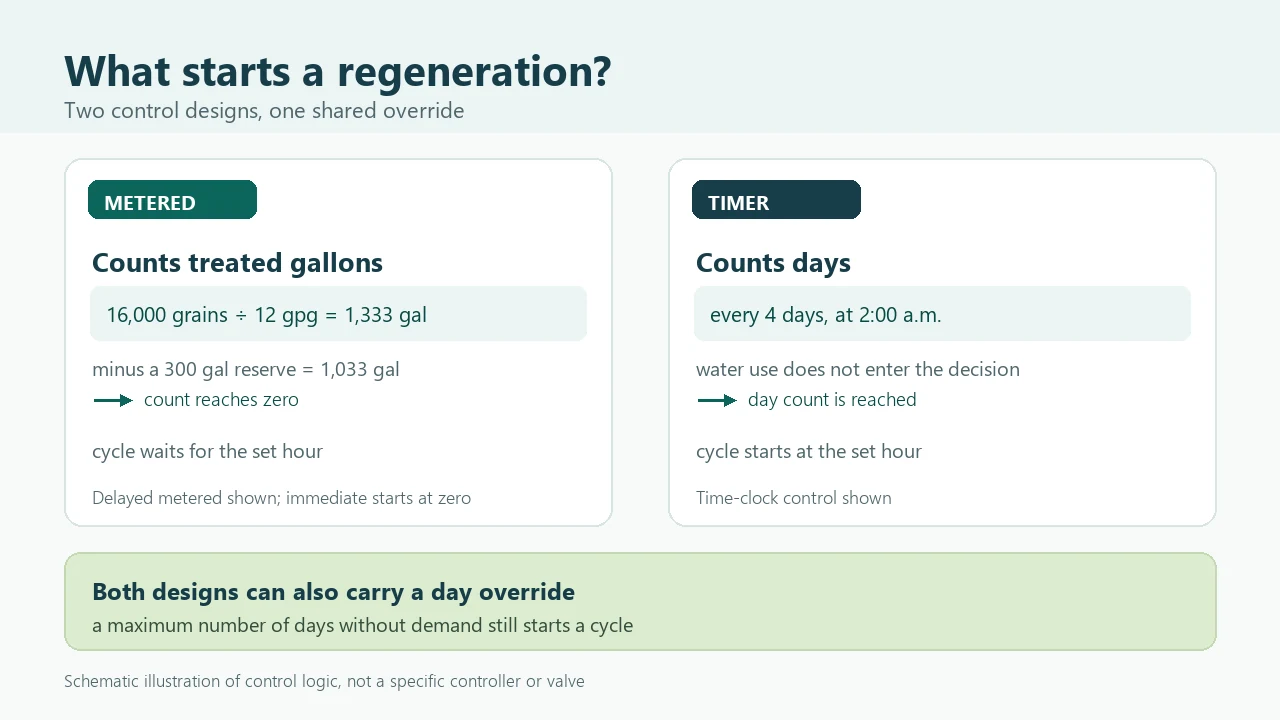
Compare how metered and time-clock softener controls decide when to regenerate, with the immediate and delayed trigger paths, a shared day override, and worked gallons arithmetic for two usage patterns.
Salt & regeneration
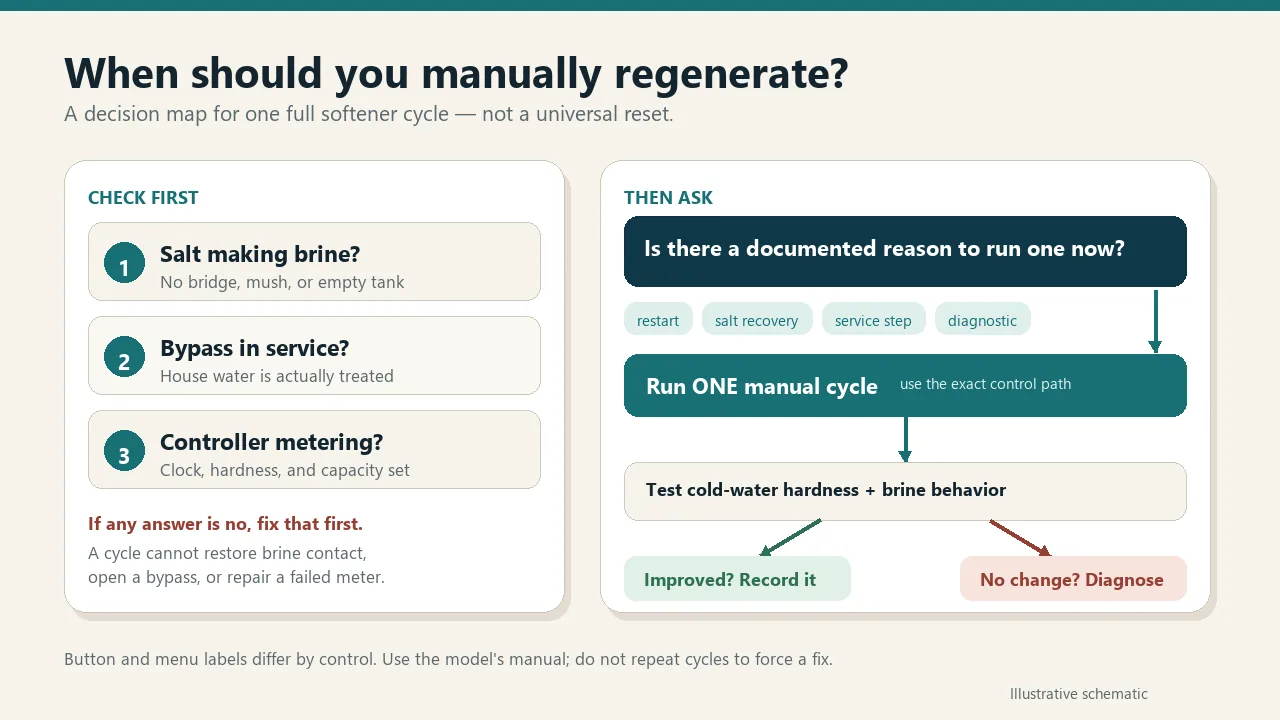
Decide when a manual softener regeneration is justified, compare Whirlpool, EcoWater, and Fleck control paths, and know when to stop and diagnose instead.
Sizing & costs
Estimate simultaneous household flow, compare it with a model-specific service-flow rating and pressure drop, and record the evidence before choosing a water softener.
Troubleshooting
Use an observation-first checklist to find why a water softener is not using salt, then separate salt bridges, metering, bypass, fill, and brine-draw questions.