Maintenance
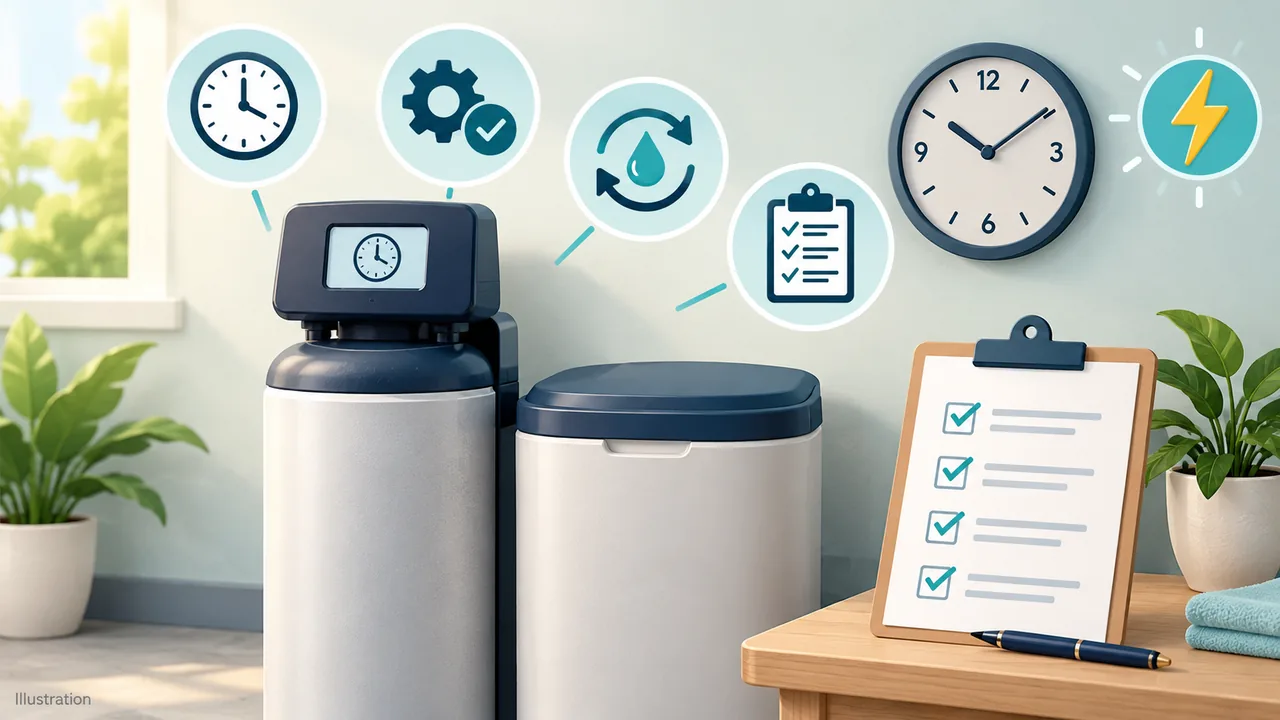
Water Softener After a Power Outage: What Settings Should You Check?
Check your softener clock, retained programming and interrupted-cycle status after an outage, with model-specific examples and a printable recovery record.
Sizing & costs
Use a hardness reading, recurring symptoms, and a printable decision record to decide whether a water softener makes sense for your home.
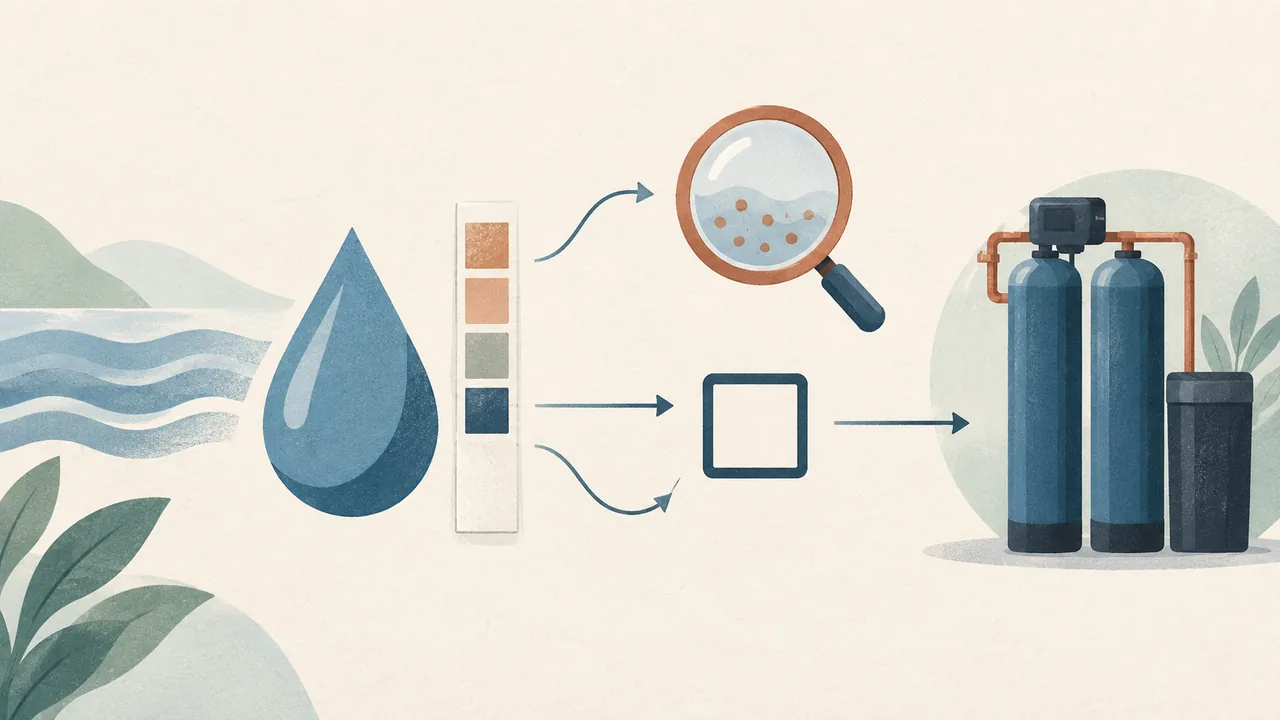
You do not automatically need a water softener because a test says your water is “hard.” Consider one when a current reading from the water entering your home shows substantial hardness and scale, soap film, or another hardness-related problem matters enough to justify the equipment, salt, water, and upkeep. If the real concern is whether your water is safe to drink, test for that concern separately; a standard softener is a hardness treatment, not a general drinking-water safeguard.
This checklist gives you three practical outcomes: wait and observe, investigate a different cause, or compare softeners using your own water and household data.
Ask your public water supplier for a recent hardness result, or use a test intended for total hardness at an untreated tap that represents the water entering the home. If a softener is already installed, confirm which tap is upstream before collecting a sample. For a private well, a suitable laboratory can help establish hardness and other water-quality questions. Record the date, sample location, result, and unit; a broad test-strip color band is a range, not a precise number.
Hardness commonly appears as milligrams per liter (mg/L) as calcium carbonate or grains per US gallon (GPG). The USGS hardness guide describes 0–60 mg/L as soft, 61–120 as moderately hard, 121–180 as hard, and above 180 as very hard. These bands describe a measurement; they do not set a national buying rule. A regional hardness map cannot tell you the result at your own tap.
If your home uses a private well, keep the hardness decision separate from drinking-water safety. EPA advises annual well testing for total coliform bacteria, nitrates, total dissolved solids, and pH, with other tests when local conditions or symptoms warrant them; its private-well testing guidance explains when to use a certified drinking-water laboratory. A hardness strip does not answer those safety questions.
White scale on a faucet, repeated mineral deposits in a kettle, and persistent soap film are reasons to check hardness. The useful question is whether these effects recur at fixtures receiving the tested water and whether the measured hardness is high enough to make treatment worthwhile for you. A single spot on a glass, a stiff towel, or a sales demonstration is too weak to settle that decision by itself.
Some complaints point elsewhere. An unusual odor, colored water, or a specific contaminant worry calls for the appropriate water test and utility, health-department, or qualified treatment advice. A softener exchanges calcium and magnesium; it should not be chosen as a blanket remedy for an unknown water problem. If only one fixture is affected, record that location before pricing whole-house equipment.
Fill in what you know. Leave a field blank if it has not been measured; that blank is a useful next action, not a reason to guess.
| Decision field | Your record |
|---|---|
| Water source and supplier, or private well | ____________ |
| Incoming-water sample point and date | ____________ |
| Total hardness result and unit | ____________ |
| Source of reading: utility, lab, or test kit | ____________ |
| Recurring problem, location, and frequency | ____________ |
| Other possible cause or test still needed | ____________ |
| Local installation rule or septic question to check | ____________ |
| Salt, water, maintenance, and budget limits | ____________ |
| Next step and date to revisit | ____________ |
Use the completed record this way:
| If your evidence looks like this | Reasonable next step |
|---|---|
| Low or moderate hardness, little recurring scale or soap trouble | Wait and observe. Keep the reading and revisit if the water supply or symptoms change. |
| Hardness is uncertain, complaints are isolated, or the concern is odor, color, or drinking-water safety | Investigate. Confirm the sample point and request the test that matches the complaint before buying a softener. |
| Substantial measured hardness and recurring nuisance, with installation permitted and ownership costs acceptable | Compare systems. Ask for the complete model's capacity, service flow, salt dose, water use, and maintenance requirements under your conditions. |
These are decision branches, not diagnostic thresholds. EPA's 2026 water-efficient softener guide says softeners are not needed in every home and generally puts consideration at substantial hardness or a relevant professional, utility, or local-code recommendation. It also notes that some jurisdictions restrict these systems and that septic owners should check with their system provider before installation.
Do not start with the biggest grain number on a box. A quote should show how the particular model handles your hardness, softened-water demand, and expected flow, along with its salt and regeneration-water use. Ask whether the proposed layout treats the fixtures you care about and leaves irrigation or other uses untreated when appropriate. Check local rules and, if applicable, septic compatibility before signing.
An ion-exchange softener uses regeneration salt and discharges brine; it also needs monitoring and maintenance. If someone in your household has a sodium restriction, ask their clinician about drinking-water choices and discuss whether a tap should remain unsoftened. Efficiency and certification claims should be tied to the exact model and stated operating point.
Once you have an incoming hardness result and an estimate of the daily gallons that would actually be softened, use the SoftenerWise size calculator and guide to prepare a working-capacity question for suppliers. Its calculation is a comparison aid, not an instruction to buy a particular nominal-size unit. Bring the completed record above to the installer or supplier and ask them to explain any assumption they change.
A decision to wait can make sense today and still deserve another look if the utility changes its water source, your well test changes, scale becomes a repeated burden, or household water use grows. Conversely, a higher hardness number alone may not justify a system if the effects are minor and the upkeep or local discharge rules are a poor fit. Keep the dated reading and one observable problem in your record, then reassess on that evidence. The remaining choice is how much nuisance and ongoing work you are willing to trade for softer water in this particular home.
Yes. Get a total-hardness result for the water that would enter the proposed system, and record the unit, date, and sample point. A utility reading can be a starting point for public water; a suitable lab or hardness test can help with a private supply. Also write down the nuisance you hope to solve. Without both pieces, a seller can size a unit around assumptions that do not describe your home. A water-safety concern needs its own relevant tests.
No. Public guidance says water above about 7 GPG, or 120 mg/L as calcium carbonate, may benefit from softening; that is not a national requirement. Your choice also depends on recurring scale or soap problems, which fixtures would be treated, cost, maintenance, and local restrictions. Confirm the reading and its units first. If the household has little trouble despite that reading, keeping a record and monitoring the situation can be more sensible than making an immediate purchase.
Only if hardness is the specific problem you are addressing and the model suits the tested water. A private-well owner also needs a separate water-quality testing plan; hardness does not tell you whether bacteria, nitrate, or another contaminant is present. The sample should represent the water reaching the proposed treatment equipment. If staining, odor, or a health concern prompted your search, ask a certified drinking-water lab or local health department what to test before selecting treatment.
No. Spots and scale can be clues, but one surface does not identify the exact cause or show that every fixture needs treatment. Check whether deposits recur, which taps and appliances are affected, and what a total-hardness test says for the same supply. If the problem is limited to one location, investigate that location before paying for whole-house equipment. The decision is stronger when a credible reading and repeated, meaningful nuisance point in the same direction.
A conventional ion-exchange softener is designed to reduce hardness minerals, mainly calcium and magnesium. Do not treat that as a promise to remove bacteria, nitrate, lead, or every other contaminant. If a health-related concern exists, obtain the appropriate water-quality information and choose treatment only after matching a verified product claim to the identified problem. For private wells, follow a broader testing plan; for public water, ask the supplier about the relevant report and any current advisory.
First find the model and its manual, then establish whether the system is connected, in service, and treating the taps you care about. Measure incoming hardness and, if you want to judge performance, sample an appropriate treated tap under comparable conditions. Do not interpret a default setting, a partly filled salt tank, or a regional map as proof that the unit is needed or functioning. Keep its operating cost and maintenance in the same decision record you would use for a new purchase.
Maintenance
Check your softener clock, retained programming and interrupted-cycle status after an outage, with model-specific examples and a printable recovery record.
Maintenance
Choose a model-appropriate vacation plan, record power and valve positions, separate freezing-weather preparation, and check the return to service.
Salt & regeneration
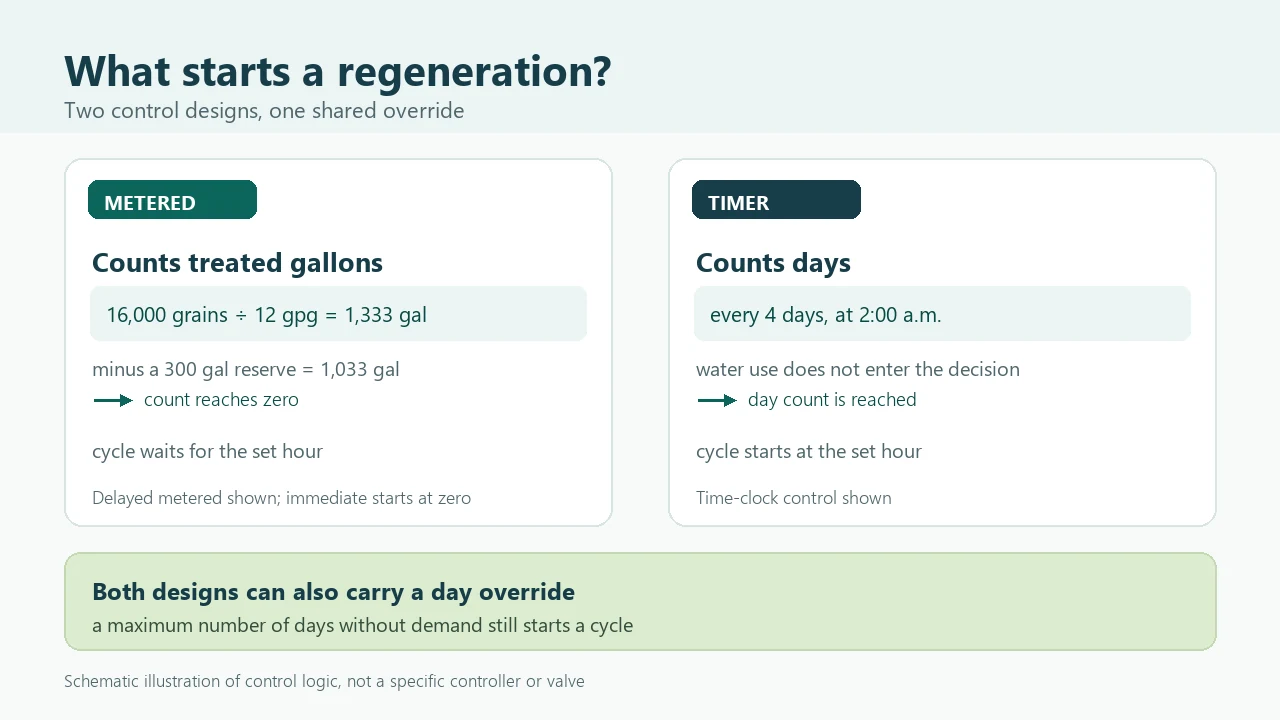
Compare how metered and time-clock softener controls decide when to regenerate, with the immediate and delayed trigger paths, a shared day override, and worked gallons arithmetic for two usage patterns.
Salt & regeneration
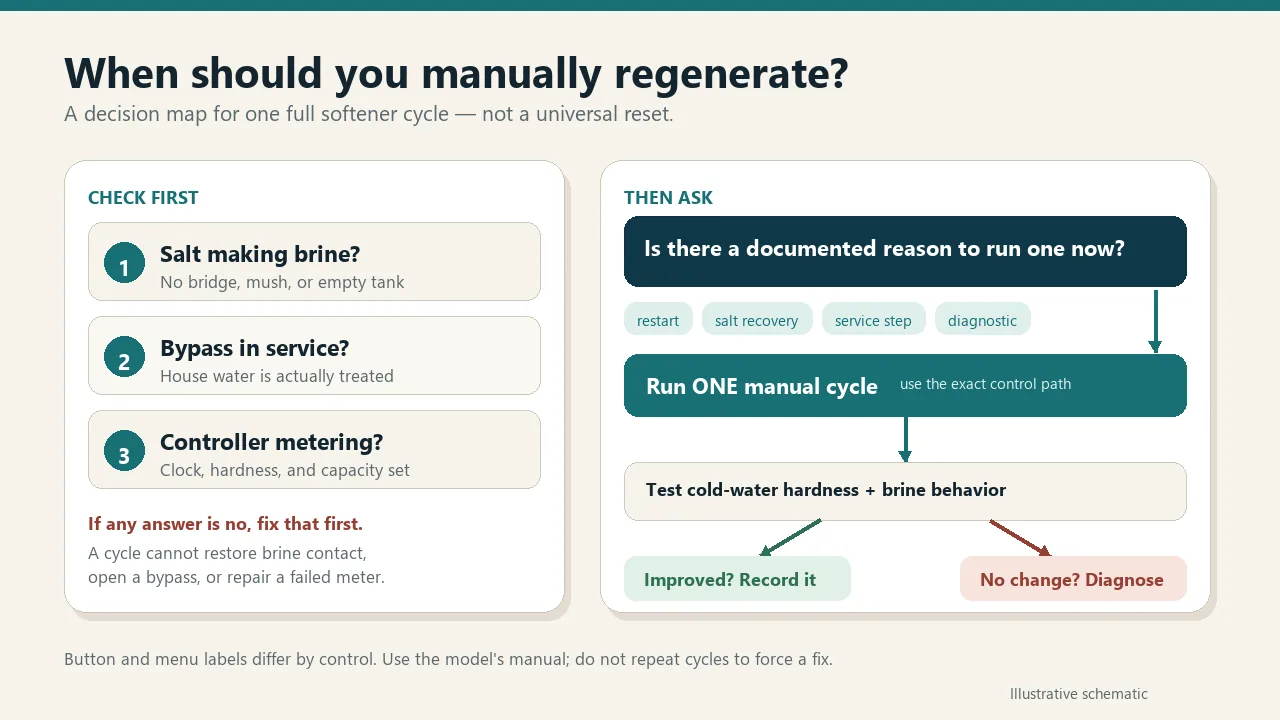
Decide when a manual softener regeneration is justified, compare Whirlpool, EcoWater, and Fleck control paths, and know when to stop and diagnose instead.
Sizing & costs
Estimate simultaneous household flow, compare it with a model-specific service-flow rating and pressure drop, and record the evidence before choosing a water softener.
Troubleshooting
Use an observation-first checklist to find why a water softener is not using salt, then separate salt bridges, metering, bypass, fill, and brine-draw questions.