Maintenance
Water Softener After a Power Outage: What Settings Should You Check?
Check your softener clock, retained programming and interrupted-cycle status after an outage, with model-specific examples and a printable recovery record.
PLANNING TOOL & EXPLANATION
Calculate the working capacity your water use and hardness require, including one reserve allowance. Compare that target with capacity at a documented salt dose, then check service flow separately before choosing equipment.
Use the calculator ↓Example values are a starting point for the arithmetic. Replace them with your own measurements.

Keep the calculated grains, salt dose and service flow in separate columns when you compare models. A supplier should be able to show which documented operating point meets your target without counting the reserve twice.
| Rated capacity | Salt dose | Against the 21,600-grain example target |
|---|---|---|
| 11,900 grains | 2.4 lb | Below the example target |
| 31,600 grains | 9.0 lb | Above the capacity target; flow and other checks still required |
| 40,000 grains | 15.5 lb | Above the target at a different salt dose |
The WHES40/WHES44 manual, document 7335139, page 3 lists these WHES40 ratings and a separate 8.5 GPM rated service flow at 11 psi pressure drop. They illustrate how to read a specification, not a recommendation to buy or program this model.
Hypothetical simultaneous demand of 2.0 + 2.5 + 1.0 = 5.5 GPM is a separate flow calculation. Replace those assumed fixture rates with actual flow information. Being below a service-flow rating does not by itself confirm acceptable household pressure or treatment suitability; an intermittent maximum is not a sustained service rating.
Use a controller meter or dedicated treated-water meter if available. Otherwise subtract dated whole-house meter readings, convert to gallons and divide by elapsed days, then remove documented bypassed outdoor use. As the EPA water-bill guide explains, 1 CCF or HCF is about 748 US gallons. A hypothetical 8 CCF over 30 days is about 199.5 gallons/day before subtracting bypassed water.
If you cannot separate bypassed water, label the value a whole-house upper-bound scenario. Check several representative periods and account for leaks, travel or guests. A local hardness map also cannot replace your incoming-water test.
Already have a documented working capacity? Use the regeneration interval calculator for the reverse question: how long capacity minus reserve lasts at your daily load.
Your result is a target for working capacity under the assumptions you entered. It is a number to take to a supplier alongside your flow requirements and water analysis. It does not identify a nominal “grain size” you should buy.
Units matter: GPG describes the concentration of hardness, while grains describes the amount of hardness represented by the calculation.
Using 180 gallons/day at 15 GPG gives 2,700 grains/day. Evaluating seven days with one additional day as a reserve gives:
180 × 15 × (7 + 1) = 21,600 grains
These inputs demonstrate the arithmetic. Seven days is not a universal recommended interval, and 180 gallons is not an assumed household average.
Use water consumption that passes through the softener, separating bypassed outdoor water. Get a current incoming hardness reading in GPG. A result in mg/L or ppm must be total hardness as CaCO3; divide by 17.12 to obtain GPG, using the factor in the USGS unit-conversion table (Table 8, page 55).
Next, estimate running costs using the salt dose and regeneration-water amount for the equipment you are considering.
The water softener size you need depends on how much water you soften, its incoming hardness, and the working capacity needed between regenerations. The equipment also needs a suitable service flow rate for fixtures running together. Use the calculator above to estimate a capacity target, then take that result and its assumptions to the supplier for a model-specific check.
This guide applies to salt-regenerated ion-exchange softeners. The target is a planning estimate; it does not identify a product from its advertised grain number. The worksheet below helps you document the information that turns a calculator result into a purchase decision.
Start with the water that will actually pass through the softener. A whole-house bill can include irrigation supplied through a separate, unsoftened line. Subtract that use only when you can document it. If you cannot separate it, label the result a whole-house scenario rather than presenting it as measured softened demand.
Record where the hardness number came from, when it was measured, and its units. Use incoming water, before treatment. A reading from an already-softened faucet answers a different question. The calculator accepts GPG or hardness expressed as ppm/mg/L as calcium carbonate; keep the unit selection attached to the number when you save the result.
The EPA's water-softener selection guide, published in May 2026, recommends checking hardness and household consumption, considering uses such as irrigation that do not need softening, and avoiding oversizing. It also favors demand-initiated regeneration when selecting efficient equipment. These checks help make the inputs relevant to your home.
Two other inputs need labels of their own:
Use the calculator with your own readings, save the input summary, and leave uncertain entries marked “estimated.” A precise-looking output does not make a guessed input more reliable.
If two recommendations disagree, compare their inputs before comparing their equipment labels. This hypothetical worksheet holds a six-day evaluation interval and one extra reserve day constant. These are arithmetic examples, not household averages or recommended regeneration settings.
| Scenario | Softened use | Incoming hardness | Capacity target, including the separate reserve |
|---|---|---|---|
| Starting assumption | 150 US gal/day | 12 GPG | 150 × 12 × (6 + 1) = 12,600 grains |
| More water through the softener | 200 US gal/day | 12 GPG | 200 × 12 × (6 + 1) = 16,800 grains |
| Harder incoming water | 150 US gal/day | 18 GPG | 150 × 18 × (6 + 1) = 18,900 grains |
The second scenario adds 4,200 grains to the target; the third adds 6,300. Neither change tells you which retail model to buy. They identify a practical question: is the disagreement caused by water use, hardness, the evaluated interval, or the reserve?
Run a separate scenario for an expected change, such as another full-time resident. Keep an occasional guest period separate from normal demand, and ask how the proposed controller would respond to each. Do not quietly combine every high estimate and then call the result your typical requirement.
The model name alone may not identify the right ratings. For example, the older WHES40 illustration above is labeled LL40. A newer Whirlpool WHES40/WHES44 manual, revision G dated January 30, 2025, identifies WHES40 model code L40P on page 3. Its ratings include 31,600 grains at 9.0 lb of salt and 40,000 grains at 15.5 lb, with a rated service flow of 7.6 GPM at a 14.7 psi pressure drop.
Those figures belong together in that specification. Do not combine capacity from one generation with flow from another. The same manual says the electronic controls select a variable salt dose at regeneration; the listed rating points are not instructions to enter a particular dose yourself.
A supplier should explain which documented operating conditions support the proposed capacity. Keep that answer beside the calculation instead of simply rounding the result up to a number printed on the box.
Use the page's Print this page button to keep the following record with the quote. Fill in the evidence you have and ask the supplier to complete the equipment-specific fields.
| Item to confirm | Your record or supplier's answer |
|---|---|
| Incoming hardness, unit, sample location, and test date | ____________________ |
| Softened US gallons/day and measurement period | ____________________ |
| Bypassed water excluded; remaining uncertainty | ____________________ |
| Normal-demand calculation and separate high-use scenario | ____________________ |
| Complete system model, model code, and manual revision | ____________________ |
| Proposed working capacity and corresponding salt dose | ____________________ |
| Reserve definition; whether it is already included | ____________________ |
| Regeneration control method and expected operating interval | ____________________ |
| Simultaneous softened-water demand in GPM | ____________________ |
| Rated service flow, associated pressure drop, and suitability | ____________________ |
| Water-analysis limits and any additional treatment needed | ____________________ |
| Available space, connections, drain, power, and installation review | ____________________ |
For the flow row, list fixtures that could run together. As a separate hypothetical example, two fixtures using 2 GPM each plus another using 1.5 GPM create 5.5 GPM of simultaneous demand. Replace those assumptions with information for your fixtures. Daily gallons cannot show that brief peak, and a favorable capacity calculation does not settle the pressure question.
Ask the supplier to interpret the complete water analysis and installation conditions. This worksheet does not calculate a generic allowance for iron, manganese, or other treatment issues. Keep an unanswered suitability question visible instead of hiding it inside a larger grain-capacity estimate.
Once a working capacity and reserve are documented, the regeneration interval guide and observation log provide the reverse calculation and a way to compare expected behavior with actual cycles. Save the supplier's assumptions so that a later change in demand can be investigated against the original proposal.
Future occupancy, a change in which fixtures receive softened water, or revised water-use habits can change the capacity you want to evaluate. Treat each as an explicit scenario with a reason and a date. A planned permanent change deserves a different discussion from one unusually busy weekend.
A larger quoted system also needs an operating plan for ordinary demand. Ask what capacity, salt dose, regeneration behavior, and flow performance the supplier expects under both scenarios. Fewer cycles alone do not establish lower operating expense; the amount used per cycle matters too. The useful comparison is whether each proposal can meet the documented household demand under conditions you can later check.
Four people do not determine a single grain size. Record the household's softened water use and incoming hardness, then evaluate an interval and one reserve allowance. Two households with the same occupancy can have different inputs. Take the resulting capacity target to a supplier along with simultaneous flow needs, the water analysis, and any expected change in occupancy.
The advertised number alone cannot answer that. Compare your calculated target with the model's documented capacity at the proposed operating conditions and salt dose. Ask how reserve is handled, and check service flow separately. If the supplier cannot connect the label to the relevant specification, keep the comparison incomplete rather than assuming the full advertised number is always available.
The calculator already includes the reserve you enter. Adding it again would change the scenario and can inflate the target. When a supplier provides a capacity figure, clarify whether it is before or after their reserve allowance. Keep the unit and definition with each number; extra days, reserve grains, and an already-adjusted capacity are not interchangeable entries.
Capacity describes the hardness load represented by your use over time. Flow describes how quickly water must pass through the equipment when fixtures operate together. A daily total cannot reveal that peak. Give the supplier your simultaneous fixture scenario and ask them to check rated service flow and its associated pressure drop against the proposed installation and treatment needs.
Evaluate the extra demand explicitly before choosing more capacity. Record whether it reflects a permanent household change or an occasional event, and ask how the proposed system would operate during normal use as well. Compare the documented capacity, salt dose, and flow conditions for each proposal. A bigger label or a promise of fewer cycles does not complete that comparison.
Maintenance
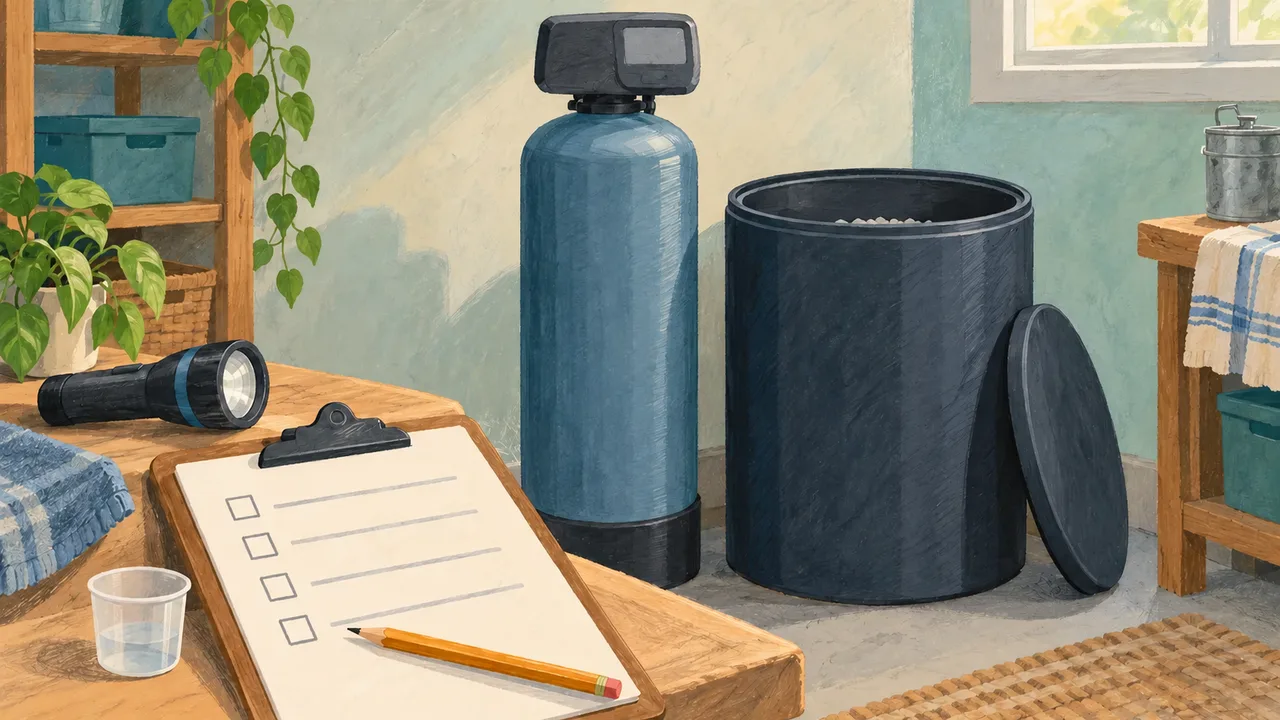
Check your softener clock, retained programming and interrupted-cycle status after an outage, with model-specific examples and a printable recovery record.
Maintenance
Choose a model-appropriate vacation plan, record power and valve positions, separate freezing-weather preparation, and check the return to service.
Salt & regeneration
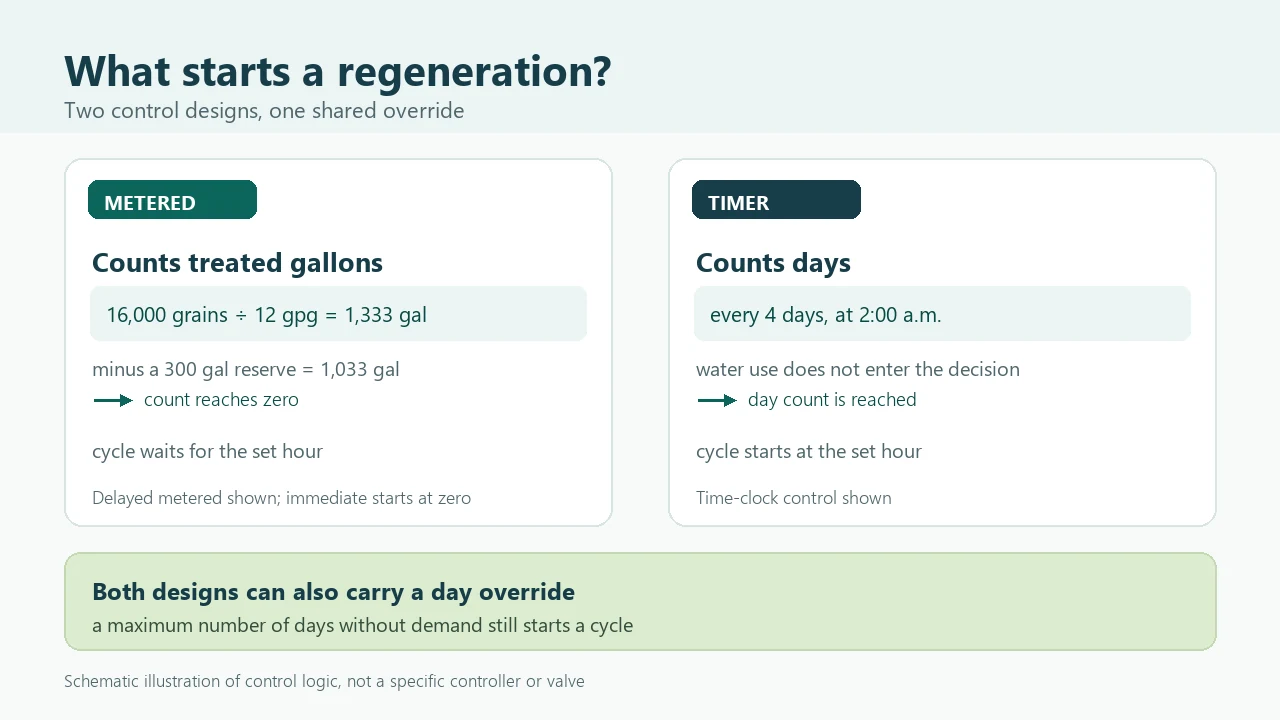
Compare how metered and time-clock softener controls decide when to regenerate, with the immediate and delayed trigger paths, a shared day override, and worked gallons arithmetic for two usage patterns.
Salt & regeneration
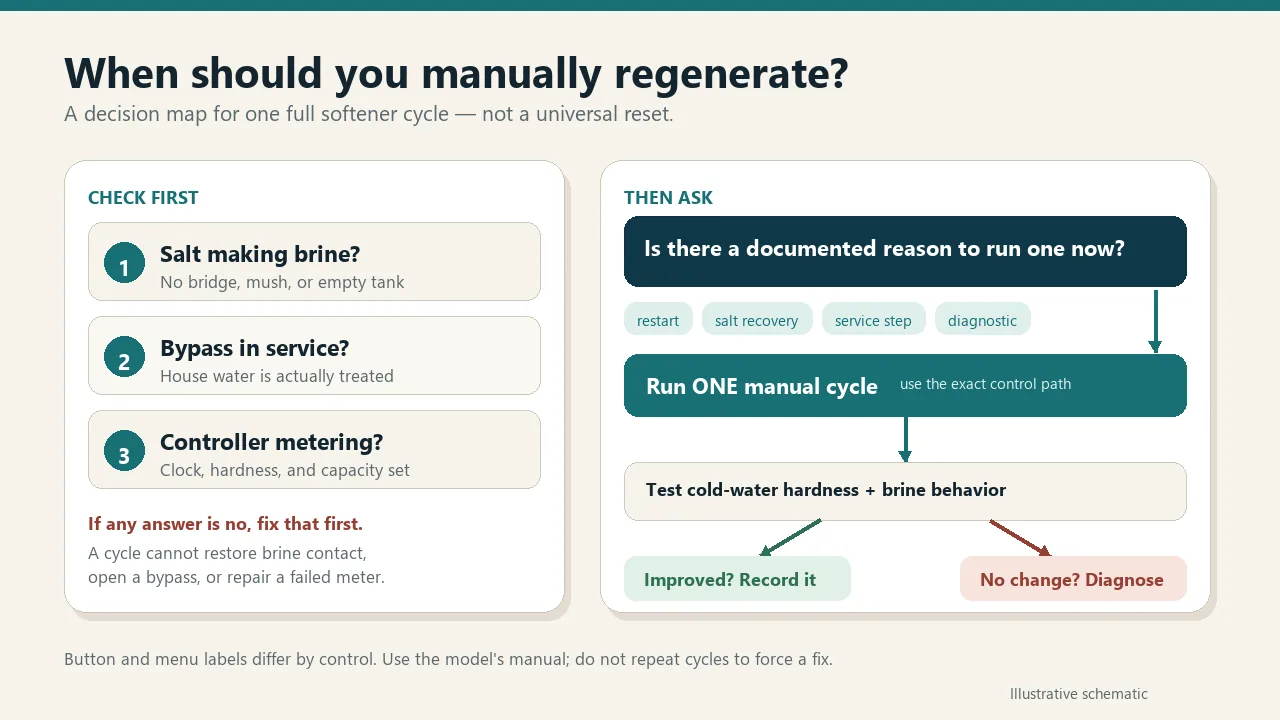
Decide when a manual softener regeneration is justified, compare Whirlpool, EcoWater, and Fleck control paths, and know when to stop and diagnose instead.
Sizing & costs
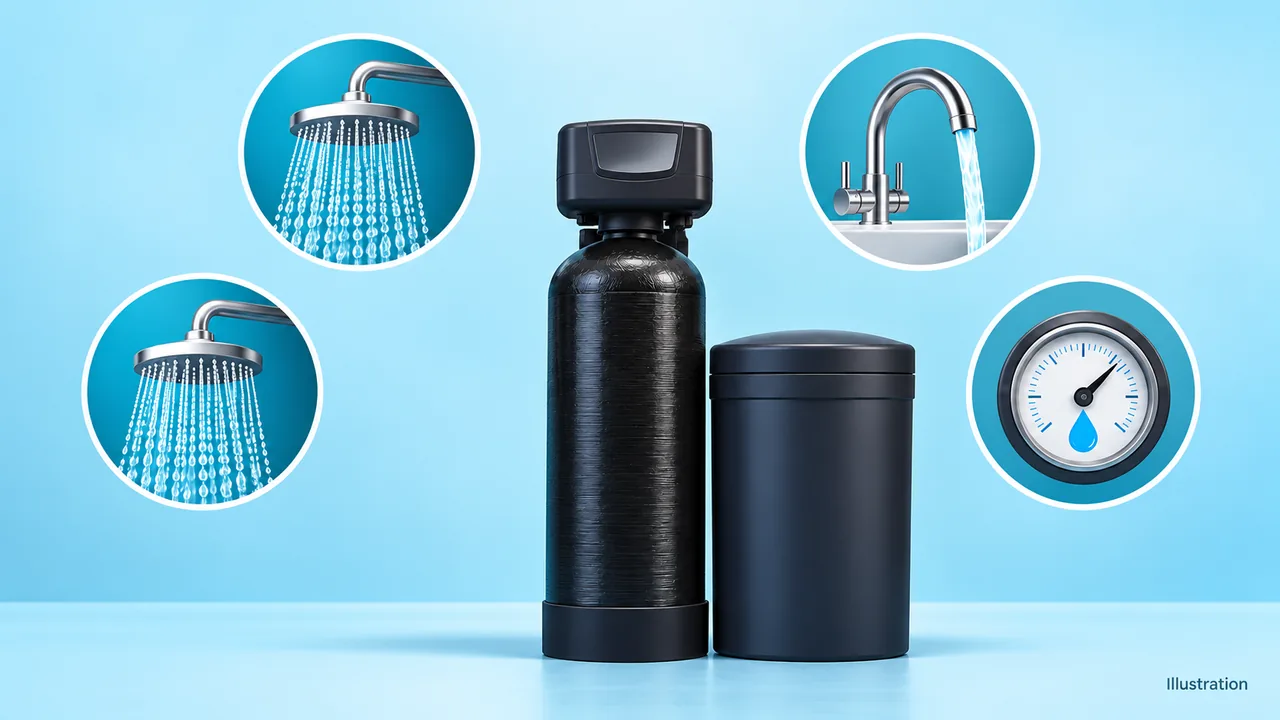
Estimate simultaneous household flow, compare it with a model-specific service-flow rating and pressure drop, and record the evidence before choosing a water softener.
Troubleshooting
Use an observation-first checklist to find why a water softener is not using salt, then separate salt bridges, metering, bypass, fill, and brine-draw questions.