Maintenance
Water Softener After a Power Outage: What Settings Should You Check?
Check your softener clock, retained programming and interrupted-cycle status after an outage, with model-specific examples and a printable recovery record.
Maintenance
Find the manual, record settings and salt condition, distinguish an operating softener from an idle one, and verify the result with a new-owner checklist.
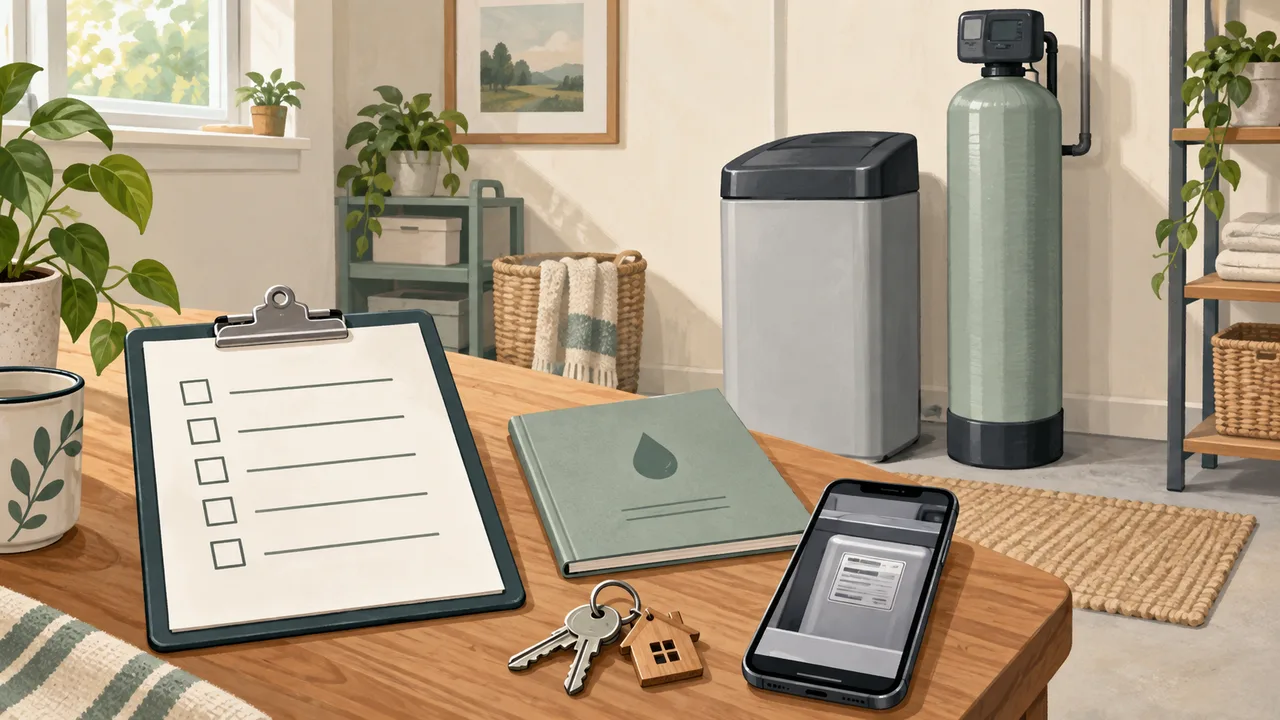
If you bought a house with a water softener, start by identifying the complete system, finding its manual, and recording its condition before changing settings. Then establish whether it has been operating normally or sitting unused. A working unit needs a verified starting point and a care routine; an idle or unfamiliar unit may need a model-specific restart or service visit.
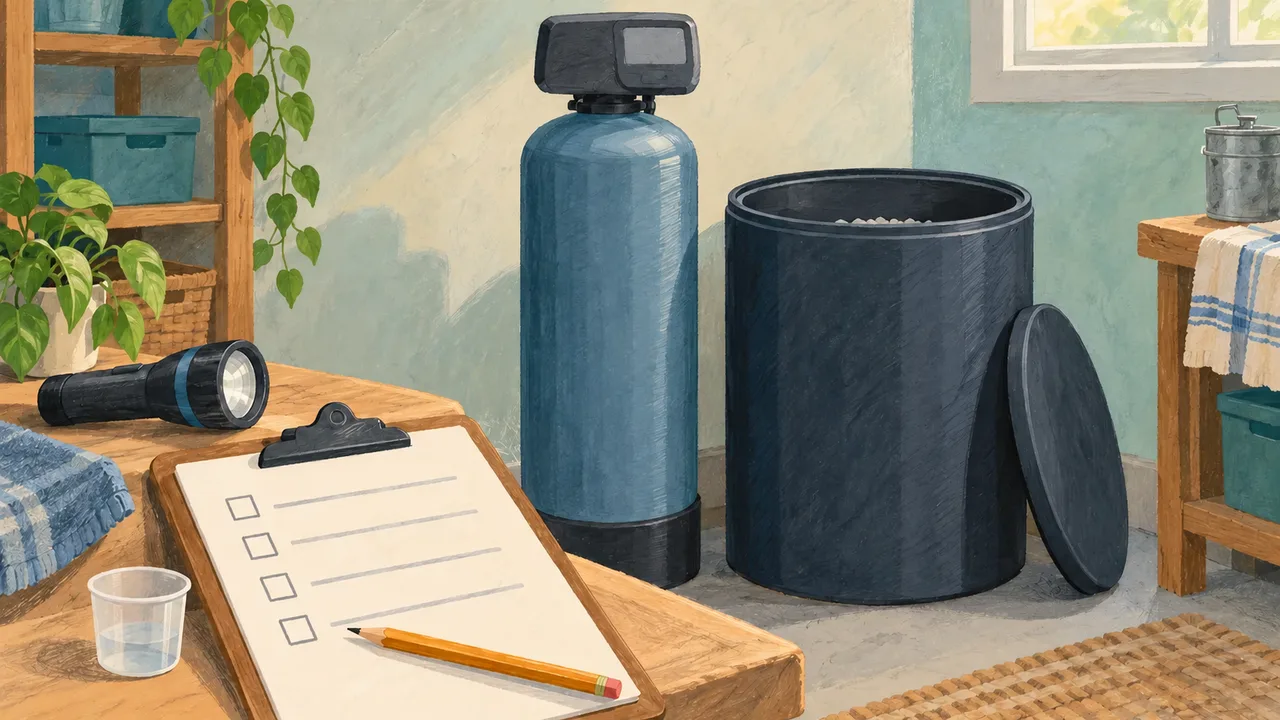
This checklist covers household softeners that regenerate with salt. A filter, salt-free conditioner, or another tank beside the softener may have different requirements. The cover is a conceptual illustration, not a photograph of an inspected installation.
Photograph the system label, controller, tanks, and visible plumbing layout. Record the complete system's manufacturer, model, and serial number. A name printed on the control valve can be useful, but it may identify only that component. Ask the manufacturer or installer to confirm which manual covers the assembled system if the labels do not make that clear.
Label locations vary. For example, Rheem's model and serial number guide points owners to the underside of the salt lid. Its date-code guidance can help identify manufacturing age; that is not the same as a documented installation date. Save a readable label photo so support does not have to work from an uncertain transcription.
Gather what the seller or previous service company can provide:
Keep a previous owner's statement separate from something you have verified. “Serviced last spring” is useful context, but ask what work was done and whether there is a record. An unknown entry is more useful than an assumed date.
Take a photo of the display while it is readable. Note the displayed time, any error or cycle message, and accessible settings you can view without changing them. The existing hardness number is a setting to investigate, not proof of the incoming water's current hardness.
Look at the salt compartment and the floor around the equipment. Record the visible salt level and condition, any visible water, and whether a regeneration cycle is underway. Do not add or drain water just to make the tank resemble another owner's photo. Water level must be interpreted using the system's fill sequence and the observation time.
Locate the documented bypass and household shutoff arrangements, but do not guess which way an unfamiliar handle should move. If you find an active leak, overflowing water, or an unexplained error, make resolving that condition the immediate task. Use the matching emergency or isolation instructions if you can identify them confidently; otherwise get help from the installer or a plumber. Avoid opening pressurized connections to investigate.
Use Print this page to keep this worksheet with the manual. Fill in observations now and add confirmed information as you obtain it. You do not need to force a cycle or dismantle anything to complete the initial record.
| Item to establish | Your record |
|---|---|
| System manufacturer, model, serial number | ____________________ |
| Separate valve model, if present | ____________________ |
| Matching manual and revision | ____________________ |
| Installation date and supporting document | ____________________ |
| Operating recently, idle, or unknown; source of information | ____________________ |
| Display, clock, error or cycle message | ____________________ |
| Existing settings and photo reference | ____________________ |
| Salt product, visible level, last known refill | ____________________ |
| Visible water, cycle stage, exterior condition | ____________________ |
| Water source and confirmed treated sampling point | ____________________ |
| Untreated and treated hardness: date, result, unit, method | ____________________ |
| Last service, paperwork, and provider | ____________________ |
| Action agreed, unresolved question, next check | ____________________ |
For example, write “manual not located; label photo sent to manufacturer” instead of marking the manual task complete. For an untested outlet, write “not tested,” rather than “soft.” Those distinctions keep the record useful when someone else evaluates the equipment.
When there is no unresolved leak or error, preserve the recorded setup while you confirm the manual, salt requirements, and treated-water result. Read the manufacturer's instructions before adjusting the clock, hardness, recharge schedule, or salt settings. A new homeowner is not, by itself, a reason to perform a factory reset.
If salt is near the model's refill point, use the specified product and refill guidance. Record how much you actually add, rather than how much salt you buy. A bag left partly in storage is not all in the tank. Keep the starting photo so later observations show whether the level changes.
Find out why it stopped being used before putting it back into service. A bypassed system could have been intentionally isolated pending a repair. Ask the manufacturer or service provider which inspection and restart procedure applies to its present condition.
Rheem's guidance for a softener left out of service includes salt-tank cleaning, a programming check, and a manual recharge. That is a useful example of why restarting involves more than plugging in a cord; its water quantities and button sequence should not be copied onto another system.
Cleaning the salt tank, sanitizing the unit, and servicing internal parts are separate decisions. Use the exact procedure and product instructions that apply, or arrange service when the equipment or history cannot be established. Do not improvise a bleach dose, add an installation quantity of water to an already filled tank, or use repeated regeneration as a substitute for identifying the problem.
A lit display and a tank containing salt do not establish the treated-water result. Identify a suitable untreated sampling point and a cold-water outlet confirmed to be downstream of the softener. An outdoor faucet or kitchen cold tap may have a different plumbing route; its location alone does not settle that question.
Use a test intended for total hardness and follow its sample, timing, and interpretation instructions. Record the result and unit, such as grains per gallon or mg/L as calcium carbonate. Do not substitute a TDS-meter reading for a hardness test. Compare results under documented conditions, and follow any applicable post-service or post-regeneration flushing directions.
If treated water still tests unexpectedly hard, use the hardness sampling record and diagnostic branches to distinguish an outlet-specific issue from a system-wide pattern. It provides a more useful service request than “the water feels different.”
If the home uses a private well, keep drinking-water testing as a separate task. EPA's private-well testing guidance recommends annual tests for total coliform bacteria, nitrates, total dissolved solids, and pH, with other tests as conditions require. Use a certified drinking-water laboratory and ask the local health department about local concerns. A satisfactory hardness result does not establish that the water is safe to drink.
Once the equipment and operating state are understood, use the water softener maintenance checklist and printable log to set reminders from the manual and your observations. Start with salt inventory, display messages, exterior condition, and a recorded treated-water result. Put cleaning or service on the calendar by naming the actual procedure, not simply “clean softener.”
Retain receipts and written findings. After a setting change or service visit, record what changed and the follow-up result. Ask a technician to explain any proposed work in terms of the symptom and evidence, then state how successful operation will be checked. That makes the next visit easier to evaluate if the original problem returns.
Working equipment may still need its documented settings reviewed when occupancy or water use changes. The previous owner's refill habits are a starting clue, not a schedule your household must copy. Compare observations over time before treating a different salt-use pattern as proof of failure.
If repair or replacement is proposed, ask which finding supports it, whether the required parts and instructions are available, and what the quotation includes. An unknown installation date does not settle that decision. Neither does a single successful hardness test establish future reliability. A documented starting condition lets you weigh the cost of resolving a specific problem against the uncertainty of keeping equipment whose history remains incomplete.
Check the current level and identify the product and refill guidance for your model first. Add salt when the documented refill point calls for it, and record the amount actually poured in. If the system was idle, has an unresolved error, or contains unfamiliar material, establish its condition before treating a refill as the solution. A full-looking tank alone does not prove normal operation.
Take clear photographs of the complete equipment, labels, controller, and visible connections, then ask the installer, service company, or identifiable component manufacturer for help. Keep the system model and valve model separate when you record them. Do not select a manual solely because its cabinet looks similar. Until identification is reliable, preserve the settings and use qualified help for restart or service decisions.
Do not reset it merely because ownership changed. First photograph the existing settings, establish the incoming-water hardness, and find the correct programming instructions. Your household's usage may justify a review, but a factory reset can discard information needed to understand the current setup. If a setting is changed under the manual or support guidance, record the reason and verify the result afterward.
Visible water alone does not establish neglect or a fault. Its meaning depends on the model, fill sequence, salt level, and cycle stage when you look. Record those details and compare them with the matching manual. An overflow or active leak needs prompt attention, but adding or draining water simply to match another system's appearance can obscure the starting condition.
You need to establish why it was idle and which recovery procedure applies before returning it to service. The manufacturer may call for cleaning, programming checks, or other steps based on the system's condition. If its identity or history is unclear, arrange an assessment. Avoid applying a generic water-fill amount, chemical dose, or button sequence to equipment that has not been identified.
Check a documented total-hardness result from a confirmed treated cold-water outlet and compare it with an appropriate untreated sample. Follow the test's directions and record the units, location, timing, and any recent cycle or service. Display lights, salt in the tank, and how water feels are incomplete evidence. For a private well, keep this performance check separate from the laboratory testing needed to assess drinking-water quality.
Maintenance
Check your softener clock, retained programming and interrupted-cycle status after an outage, with model-specific examples and a printable recovery record.
Maintenance
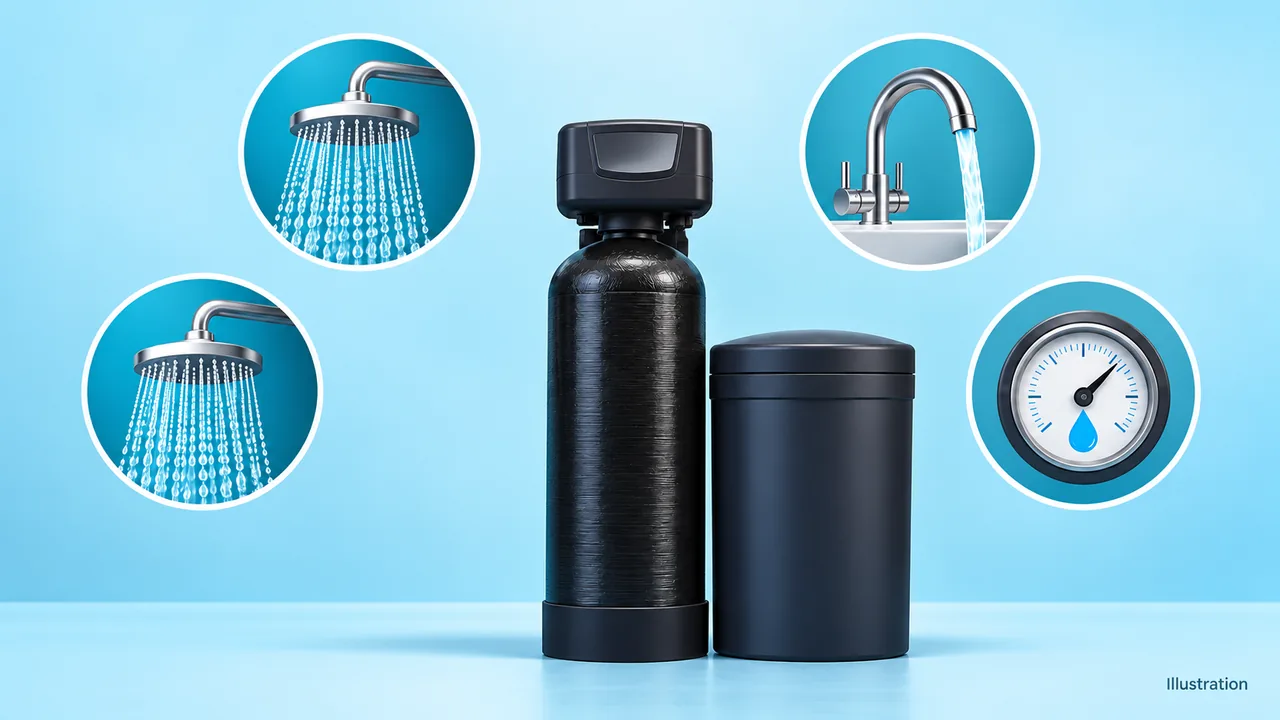
Choose a model-appropriate vacation plan, record power and valve positions, separate freezing-weather preparation, and check the return to service.
Salt & regeneration
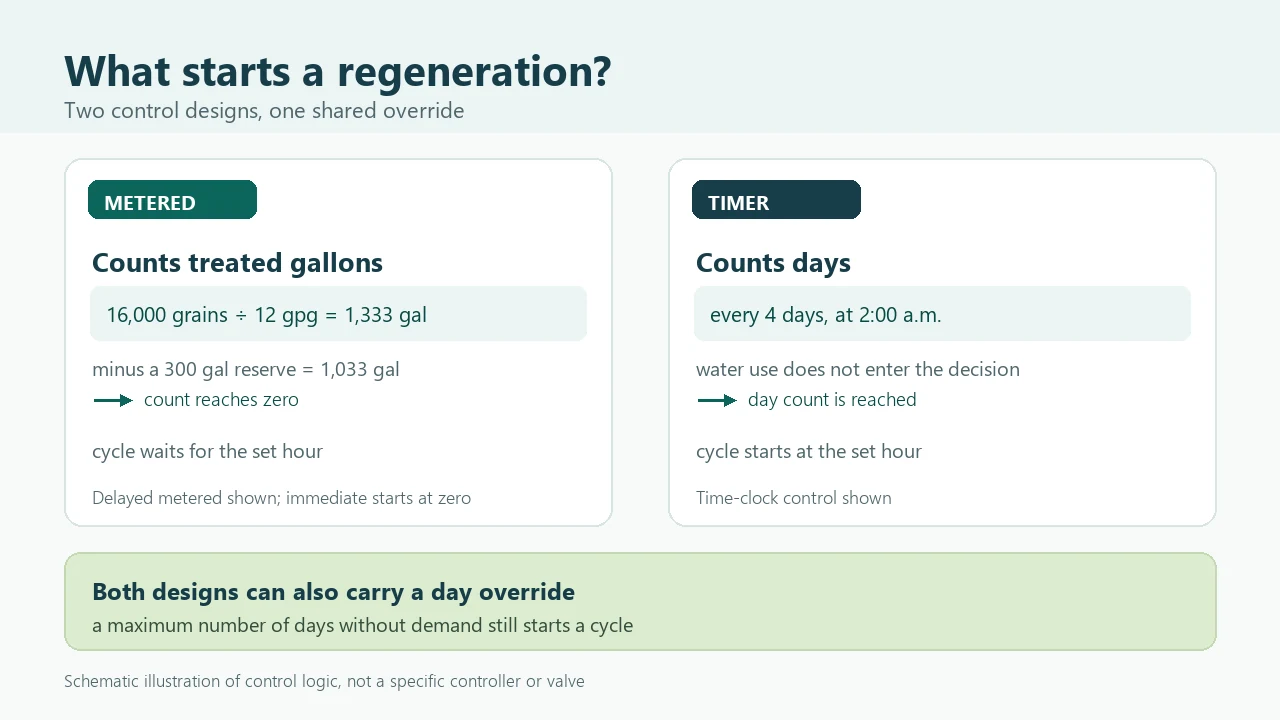
Compare how metered and time-clock softener controls decide when to regenerate, with the immediate and delayed trigger paths, a shared day override, and worked gallons arithmetic for two usage patterns.
Salt & regeneration
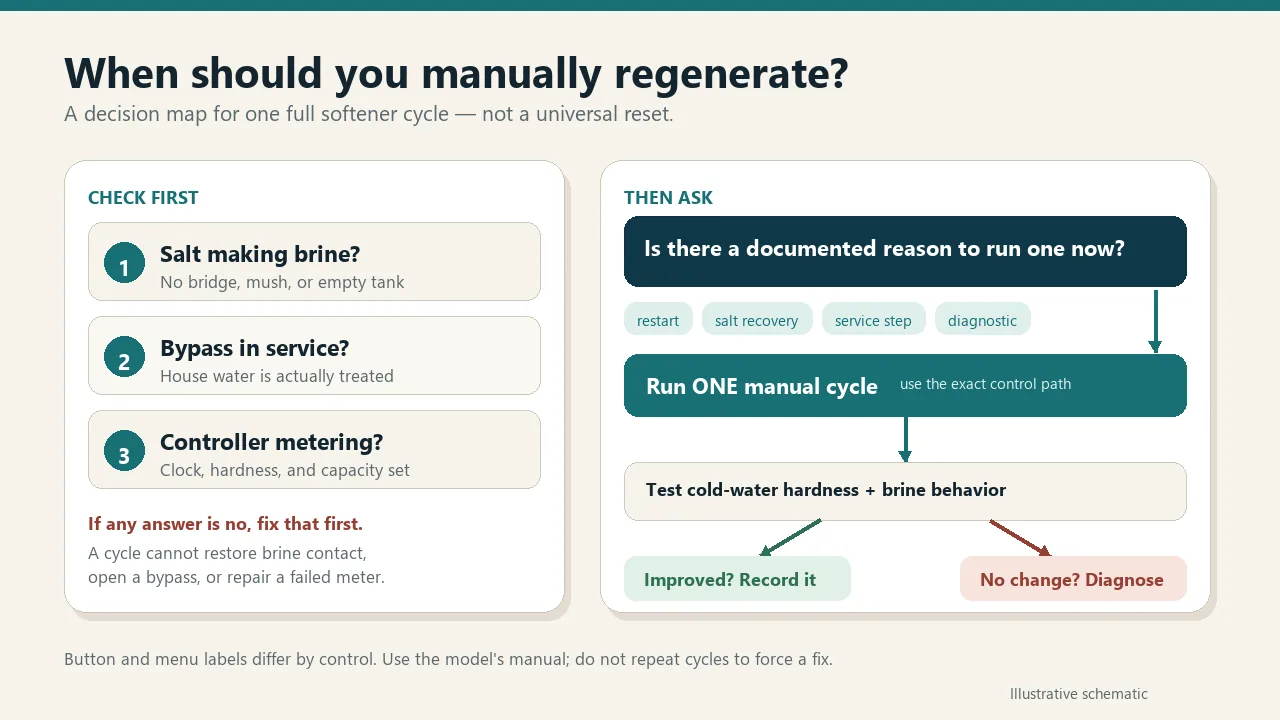
Decide when a manual softener regeneration is justified, compare Whirlpool, EcoWater, and Fleck control paths, and know when to stop and diagnose instead.
Sizing & costs
Estimate simultaneous household flow, compare it with a model-specific service-flow rating and pressure drop, and record the evidence before choosing a water softener.
Troubleshooting
Use an observation-first checklist to find why a water softener is not using salt, then separate salt bridges, metering, bypass, fill, and brine-draw questions.