Maintenance
Water Softener After a Power Outage: What Settings Should You Check?
Check your softener clock, retained programming and interrupted-cycle status after an outage, with model-specific examples and a printable recovery record.
Salt & regeneration
Learn when recharge supplies hard water, how twin resin tanks differ, and which showers or appliance loads to postpone. Includes a printable household record.

You may still have water while your softener regenerates, but whether that water is softened depends on the system. A unit with automatic hard-water bypass can supply unsoftened water during recharge; an alternating twin-resin-tank system can keep another tank softening water. Check your model's manual before starting a shower or appliance load. If you have not identified the arrangement, postpone optional water-heavy tasks until the cycle finishes.
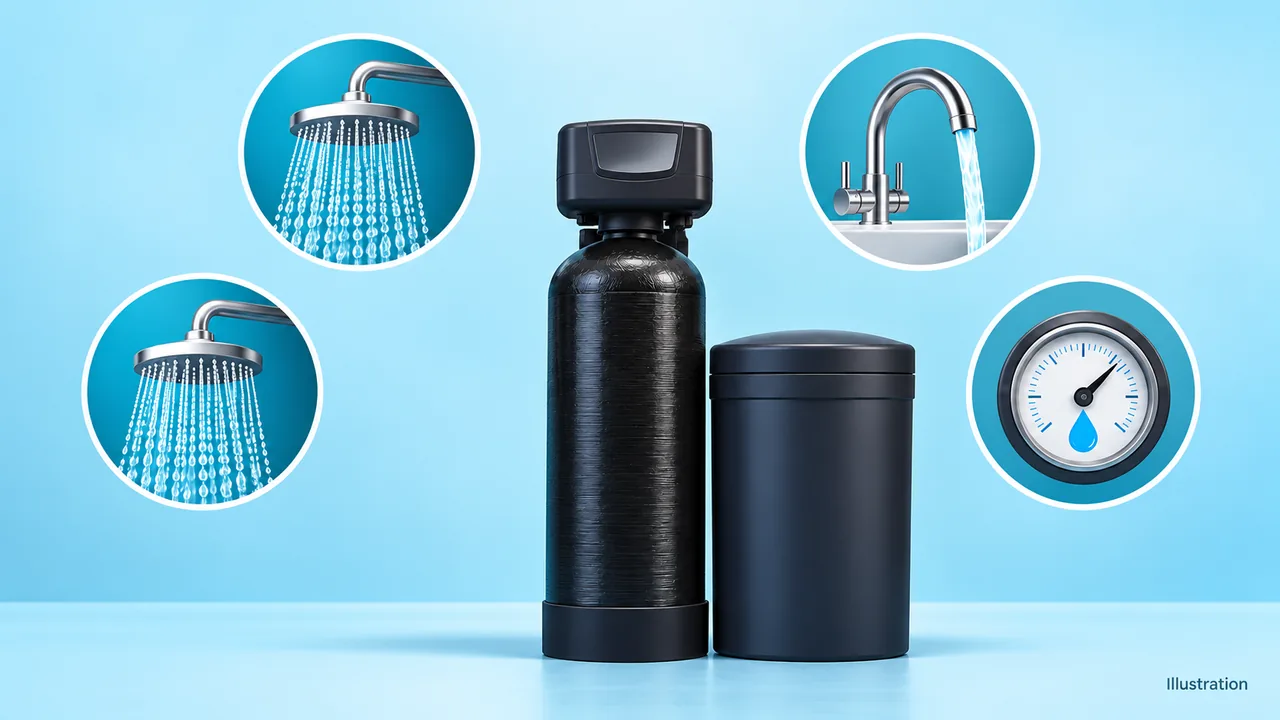
Cover illustration: a generic home softener and bathroom, created for this guide; it does not show a particular model or installation.
The useful question is not just whether water comes out of the faucet. It is which path that water takes while the resin is being regenerated.
For a documented hard-water-bypass example, the GE GXSF30V owner's manual, page 4, explains that recharge automatically allows hard water to reach the home. Once recharge ends, water goes through the softener again. GE specifically advises avoiding hot-water use during this period because the heater will refill with hard water.
The Kinetico Signature Series owner's manual, pages 5 and 11, describes another arrangement: when one resin tank regenerates, service switches to the other. The system can therefore keep providing softened water during regeneration. That is a feature of the documented design, subject to the equipment's operating limits, rather than a promise about every system with two visible vessels.
| What the matching manual describes | What that means for household use |
|---|---|
| Automatic hard-water bypass during recharge | Water remains available through that bypass, but it is not being softened by the regenerating resin. Plan around the manual's restrictions and your need for softened water. |
| One resin tank stays in service while the other regenerates | The working tank can continue supplying softened water. Follow the complete system's operating instructions and limits. |
| Supply behavior is not identified | Do not assume that running water is softened or that every fixture has the same supply. Ask the manufacturer or installer to identify the arrangement. |
A brine tank stores salt and water for regeneration. It is not a second tank of softening resin. A separate salt container beside a resin tank does not, by itself, establish that the system can keep softening water during a cycle. Use the full model number and its manual, not the number of cabinets you can see.
For equipment documented to supply hard water during recharge, the following choices help keep water-heavy tasks out of that period. They are practical applications of that supply arrangement, not instructions for every brand or a claim that one use damages the softener.
| Household task | A practical choice during documented hard-water bypass |
|---|---|
| A necessary toilet flush or brief cold-water draw | Water can still be available, but a normally softened fixture may receive hard water. Check whether that fixture is actually on the softened branch. |
| Shower or bath | Wait if you want softened water. On the GE example, the hot-water draw also brings hard replacement water into the heater. |
| Dishwasher or warm/hot laundry | Defer the load until service resumes when softened water is the aim, especially where the load draws from the water heater. |
| Cold-only laundry or another optional large cold-water use | It avoids drawing hot water, but does not make the bypassed water soft. Defer it if the result depends on softened water. |
Some homes intentionally leave selected fixtures on an unsoftened branch. The GE manual's plumbing and troubleshooting sections note that outside faucets and some other fixtures may be arranged this way. A toilet flush at one home therefore does not prove what reaches the shower at another. Record the fixture's supply instead of assuming the entire house is connected identically.
A storage water heater may already contain softened water when regeneration starts. That does not mean a long hot-water draw preserves the same supply: as hot water leaves, replacement water enters. If the softener is providing hard water through bypass, that replacement is hard water. GE's warning addresses this situation.
Returning the softener to service does not instantly replace water already stored in the heater. Do not infer a failed regeneration from the hot tap alone, or use a universal waiting time for the heater. Its stored water and subsequent use matter. This guide does not call for draining the heater or interrupting the softener's cycle.
Find the complete model and the manual section about water use during recharge. If it does not explain the supply arrangement, ask the manufacturer or installer: “While this unit regenerates, does my house receive bypassed hard water, water from another resin tank, or no supply through this path?” Include the fixture you are concerned about.
Use Print this page and complete this record before the next planned cycle. Leave an unknown item marked unknown; filling it with a guess defeats the purpose.
| Record | Your notes |
|---|---|
| Complete softener model and manual page | ____________________ |
| Supply during recharge, as documented | ____________________ |
| Fixture or appliance and whether it is on the softened branch | ____________________ |
| Job that needs softened water; hot or cold draw | ____________________ |
| Cycle start and observed return to service | ____________________ |
| Task postponed or completed; question for support | ____________________ |
If the uncertainty is how long to wait, the regeneration stage guide and observation log explains how to record the start and return to service for your model. A controller's countdown may describe only the current step. Do not treat a quiet period as proof that the cycle is over.
Let the equipment complete its normal sequence. Moving a bypass valve, advancing a stage, or borrowing another model's settings is not part of this household-use check. If the actual supply differs from what the manual describes, note the cycle state and affected fixture and ask for model-specific support.
Repeated conflicts raise two different questions: can the equipment's permitted recharge schedule better fit the household, and does the household need softened water during regeneration itself? A change in routine may matter more than a single unexpected shower. Keep a few dated records of the actual overlap before deciding what needs to change.
For a controller that allows a recharge start-time adjustment, use its own instructions and confirm what the setting controls. An alternating system such as the documented Kinetico example addresses continuity in a different way. Neither observation alone establishes that you need new equipment. Bring your model, supply arrangement and overlap record to the installer so the conversation stays focused on the service you need.
Check how your model supplies the house during recharge. On the GE hard-water-bypass example, water remains available, but it is unsoftened and a hot shower draws replacement hard water into the heater. Waiting preserves your preference for softened water. A documented alternating twin-resin system can keep supplying soft water through its other tank. That distinction is more useful than a blanket yes or no for every softener.
If the manual confirms an automatic hard-water bypass, a toilet can still receive water through that arrangement. It may also be on a branch that was never softened. Identify the actual plumbing rather than using a flush as a test of water quality at other fixtures. The availability of water for a short cold use does not establish that a shower or appliance load will receive softened water.
On a system that bypasses hard water during recharge, the draw may have introduced hard replacement water into the heater. Note what you used and let the softener finish its normal cycle. Its return to service does not immediately replace the heater's contents. Do not diagnose a failed regeneration from the hot tap alone, and do not start another recharge or drain the heater just to undo that one use.
Only identifying the components and control arrangement answers that. A resin tank plus a salt-storage tank is different from two resin tanks with service switching between them. The Kinetico Signature manual describes the latter and explains how the other tank supplies soft water during regeneration. Check your complete model's instructions and operating limits; counting vessels or recognizing a similar cabinet is not enough to establish the same behavior.
For a hard-water-bypass system, wait for the documented return to service if you want the load supplied with softened water. Use your model's completion indication rather than a generic number of minutes. A display may count down one stage, with others still to follow. If hard water has already entered a storage heater, restarting softening does not instantly change that stored water, so keep the hot-water history in mind.
Maintenance
Check your softener clock, retained programming and interrupted-cycle status after an outage, with model-specific examples and a printable recovery record.
Maintenance
Choose a model-appropriate vacation plan, record power and valve positions, separate freezing-weather preparation, and check the return to service.
Salt & regeneration
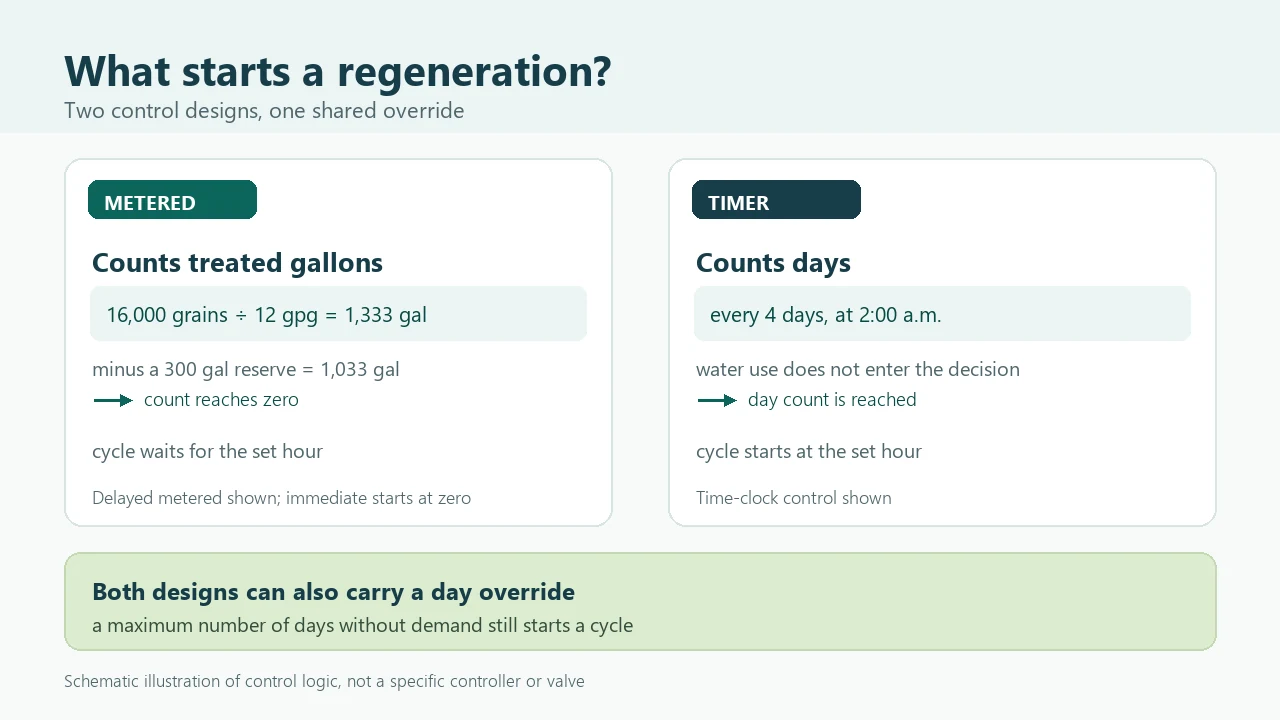
Compare how metered and time-clock softener controls decide when to regenerate, with the immediate and delayed trigger paths, a shared day override, and worked gallons arithmetic for two usage patterns.
Salt & regeneration
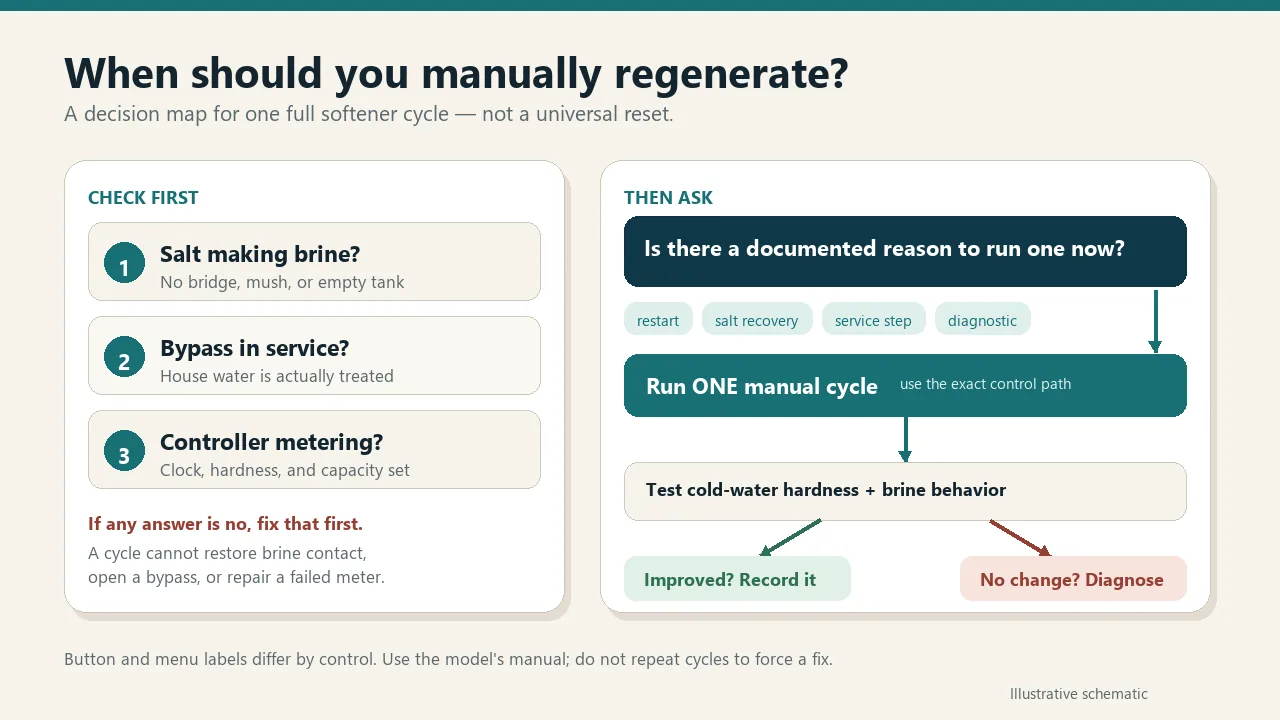
Decide when a manual softener regeneration is justified, compare Whirlpool, EcoWater, and Fleck control paths, and know when to stop and diagnose instead.
Sizing & costs
Estimate simultaneous household flow, compare it with a model-specific service-flow rating and pressure drop, and record the evidence before choosing a water softener.
Troubleshooting
Use an observation-first checklist to find why a water softener is not using salt, then separate salt bridges, metering, bypass, fill, and brine-draw questions.