Maintenance
Water Softener After a Power Outage: What Settings Should You Check?
Check your softener clock, retained programming and interrupted-cycle status after an outage, with model-specific examples and a printable recovery record.
Sizing & costs
Understand water softener grain capacity with manufacturer salt-dose examples, a specification audit card, and a simple check for conflicting efficiency claims.

Water softener grain capacity describes the amount of hardness a softener can remove between regenerations under stated conditions. To judge usable capacity, keep the capacity and its salt dose together. A large advertised grain number and a high salt-efficiency number may describe different operating points, so they cannot automatically be used in the same calculation.
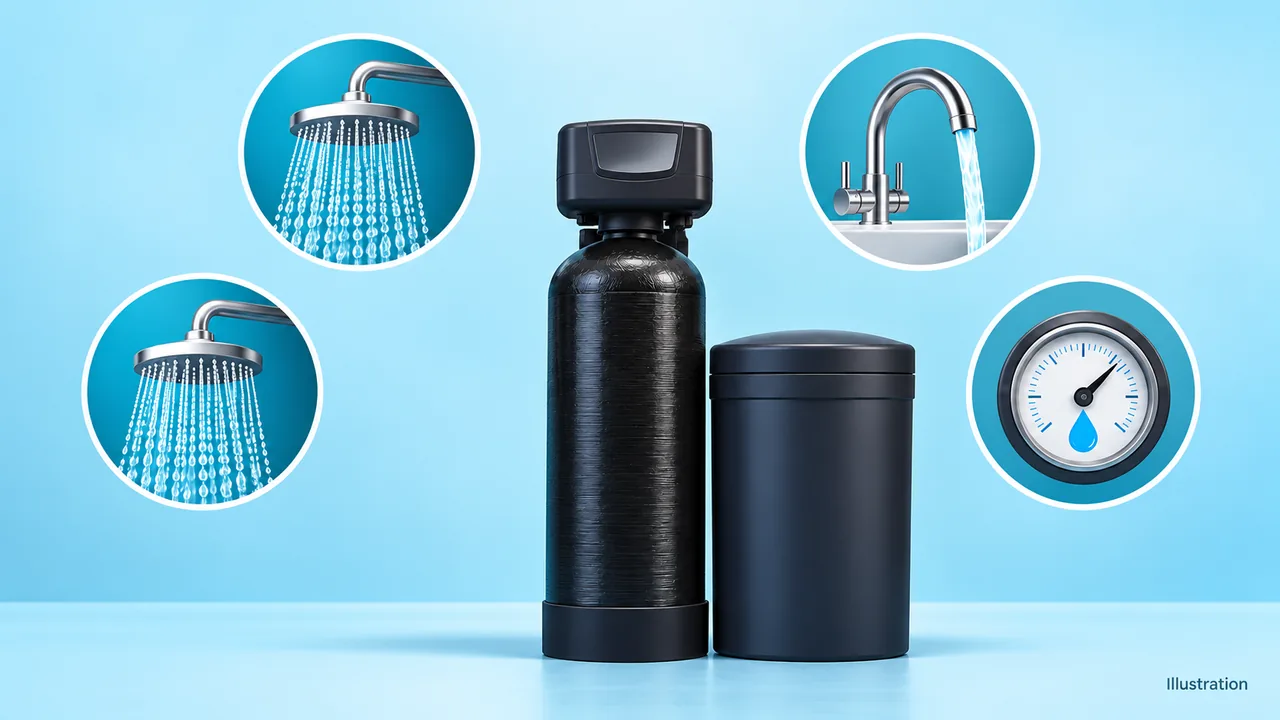
This guide concerns salt-regenerated ion-exchange softeners. Use the examples to read a specification or question a proposal, then confirm the operating capacity with the manufacturer or installer for your complete system. The cover is an illustrative rendering, not a product test or installation photograph.
A specification sheet can place several impressive-looking numbers together. Write the unit beside each one before deciding what it tells you.
| Specification | What you can use it to answer |
|---|---|
| Capacity, in grains | How much hardness removal is represented by the stated operating point? |
| Incoming hardness, in grains per gallon (GPG) | How concentrated is the hardness in the incoming water? |
| Salt efficiency, in grains per pound of salt | How much hardness removal corresponds to each pound at the stated conditions? |
| Service flow, in gallons per minute (GPM) | What flow can the equipment handle under its documented conditions? |
| Salt amount, in pounds | Is this a regeneration dose, or merely the amount the storage tank can hold? |
These units describe different parts of the decision. In particular, a tank's salt-storage amount does not tell you the salt used in one regeneration. Keep the time period or cycle attached to any consumption figure.
The treatment itself also has a defined scope: EPA's explanation of cation-exchange softeners describes calcium and magnesium exchange and the salt and water used during regeneration. EPA also states that WaterSense does not label water softeners. A grain-capacity figure alone should never be read as a drinking-water safety claim or a WaterSense label.
“Rated” does not always mean “the largest number on the box.” A manufacturer can publish several rated capacity-and-dose pairs for the same model.
For example, the GE GXSH40V/GXSH45V manual, revision 1 dated April 2026 lists these GXSH40V values on printed page 3:
| Rated capacity | Corresponding salt dose |
|---|---|
| 11,700 grains | 2.3 lb |
| 31,500 grains | 8.7 lb |
| 40,000 grains | 15.1 lb |
The same page gives a rated efficiency of 5,090 grains per pound at the minimum 2.3 lb dose. That efficiency does not belong to the 40,000-grain point. The manual's testing used sodium chloride; these are documented ratings, not instructions to enter a salt dose into a controller.
Keep the page number and revision with the figures you copy. If a sales sheet presents only the maximum capacity, ask for the dose that goes with it and the operating point proposed for your home.
The Water-Right Impression Plus specification sheet, SPE-IMP CERT RevA0720, provides a second example. Its IMP-948 column lists 18,200 grains at 4.5 lb, 23,500 grains at 9.0 lb, and 28,000 grains at 15.0 lb. The sheet identifies these as minimum, medium, and maximum salting, and says Impression Plus softeners leave the factory at minimum salting.
Those figures show why “usable capacity” needs a definition. It might mean capacity at a proposed salt setting, or a figure already reduced by a reserve allowance. Ask which meaning the supplier is using. Do not reduce every advertised capacity by the same percentage, and do not treat a factory-setting statement in an older specification as proof of an installed unit's current settings.
For an assembled system, record the complete equipment specification. A valve name alone is not a complete capacity record. Leave a claimed working capacity unconfirmed until the supplier connects it to the relevant system and operating conditions.
Here is a deliberately fictional example for checking arithmetic, not a manufacturer's rating or a recommended setup. Suppose a proposal claims all three of these at the same operating point:
The first two imply 30,000 ÷ 5 = 6,000 grains per pound. The last two imply 5 × 4,000 = 20,000 grains per cycle. They cannot all describe the same point as written. Alternatively, 30,000 grains divided by 4,000 grains per pound would require 7.5 lb in this arithmetic example.
This check identifies an unanswered question; it does not establish which number is wrong. A figure might come from a different salt setting, a different definition of available capacity, or a transcription error. Ask the supplier to label each number and provide the matching source row before using the proposal to compare equipment.
The same discipline applies when you calculate efficiency yourself. Label the result “capacity divided by dose at this point.” Do not call your division a separately certified efficiency rating, and do not combine it with a reserve-adjusted capacity without explaining the adjustment.
Use the page's Print this page button and complete this record beside the actual specification. “Not supplied” is a useful answer: it identifies the next piece of evidence to request.
| Item to trace | Your record |
|---|---|
| Complete model and identifying code | ____________________ |
| Manual or data sheet, revision, and page | ____________________ |
| Advertised capacity and its stated salt dose | ____________________ |
| Proposed operating capacity and paired dose | ____________________ |
| Salt type and stated test conditions | ____________________ |
| Efficiency figure and the operating point it belongs to | ____________________ |
| Meaning of “usable”; reserve included or separate | ____________________ |
| Controller method and who confirmed its settings | ____________________ |
| Service flow and associated pressure drop | ____________________ |
| Missing evidence or conflicting figures to resolve | ____________________ |
Once the equipment figures are clear, use the household water-softener capacity calculator to develop your demand target from softened water use, incoming hardness, an interval to evaluate, and one reserve allowance. Compare like definitions: a target that already includes reserve should not quietly acquire the same reserve again.
The calculator answers how much working capacity your assumptions require. This audit card answers whether the equipment figure you intend to compare against it is documented. Keep both records so that a later disagreement can be traced to demand, settings, or the specification itself.
A clean specification comparison still leaves the question of performance in your home. The Water-Right sheet distinguishes laboratory efficiency from operational efficiency and notes that hardness, water use, and other contaminants can affect the latter. Treat the documented operating point as a basis for discussion, not a promise of an identical result in every installation.
Ask how the proposed system will be checked after commissioning and what evidence would trigger a settings review. A useful handover record would connect the agreed capacity assumptions with the actual settings, incoming-water test, and subsequent hardness observations. If household use or the water supply changes, that record gives the next discussion a starting point. A bigger grain number cannot resolve an unexplained mismatch between the original assumptions and current conditions.
The label alone does not establish that. Find the complete model's capacity-and-salt-dose table, then ask which operating point applies to the proposed setup. Also clarify whether the supplier's “usable” figure includes a reserve deduction. Keep those definitions attached to the numbers before comparing them with a household demand target or another piece of equipment.
They describe different quantities. Grain capacity is an amount of hardness removal associated with stated operating conditions. Incoming hardness in grains per gallon describes a concentration in the water. A specification may also show salt efficiency in grains per pound and flow in gallons per minute. Copying the full unit prevents those neighboring figures from becoming interchangeable in a comparison.
You can use that division to check whether figures are internally consistent, provided both numbers belong to the same operating point. Record the capacity, dose, units, and any reserve adjustment alongside the result. Your arithmetic is not a new certification claim. When the result conflicts with a published efficiency figure, check the source rows and definitions before drawing a performance conclusion.
Do not use an advertised number as a programming instruction. A capacity rating belongs to a documented dose and set of conditions, while the installed controller needs the settings specified for the complete system. Ask the manufacturer or installer to identify the applicable instructions and explain the reserve handling. Keep that answer with the specification record before making a change.
Request the complete system model, the manufacturer's specification and revision, and the operating capacity paired with its salt dose. Ask whether the quoted usable capacity already accounts for reserve, and request the service-flow and pressure-drop information separately. Mark unresolved fields on the audit card. A short written explanation tied to the actual specification is more useful than another unsupported capacity label.
Maintenance
Check your softener clock, retained programming and interrupted-cycle status after an outage, with model-specific examples and a printable recovery record.
Maintenance
Choose a model-appropriate vacation plan, record power and valve positions, separate freezing-weather preparation, and check the return to service.
Salt & regeneration
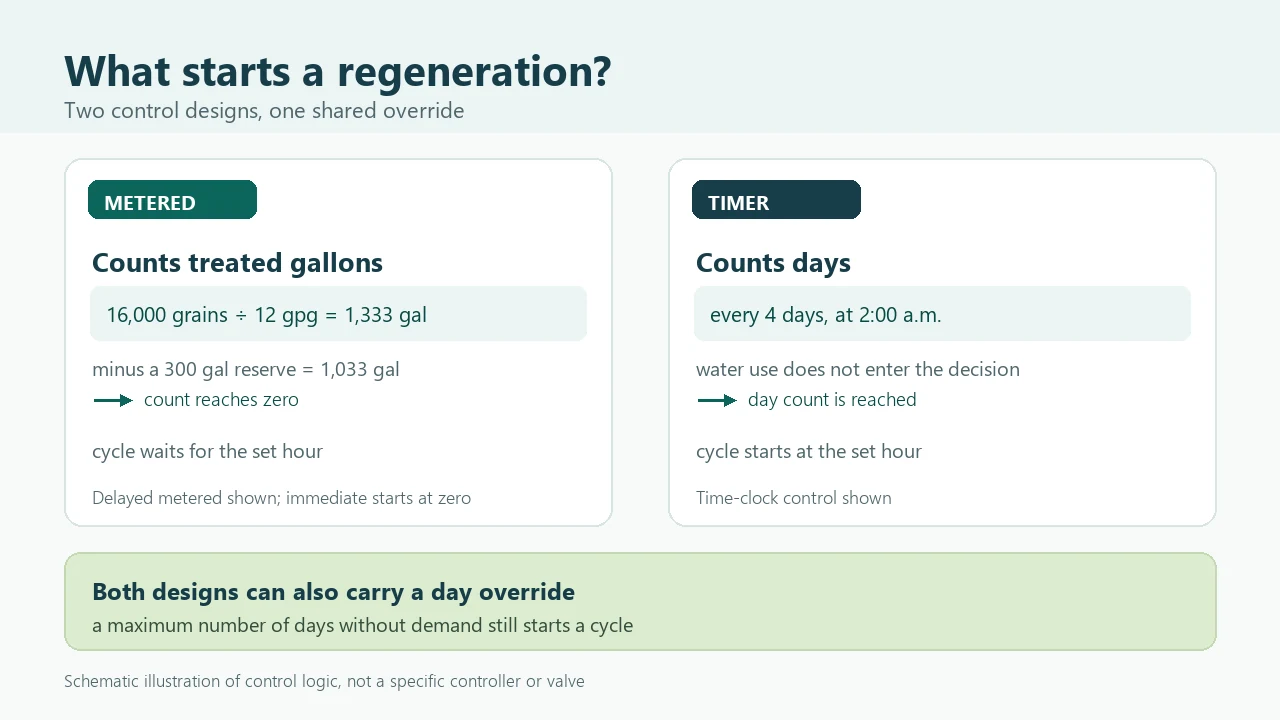
Compare how metered and time-clock softener controls decide when to regenerate, with the immediate and delayed trigger paths, a shared day override, and worked gallons arithmetic for two usage patterns.
Salt & regeneration
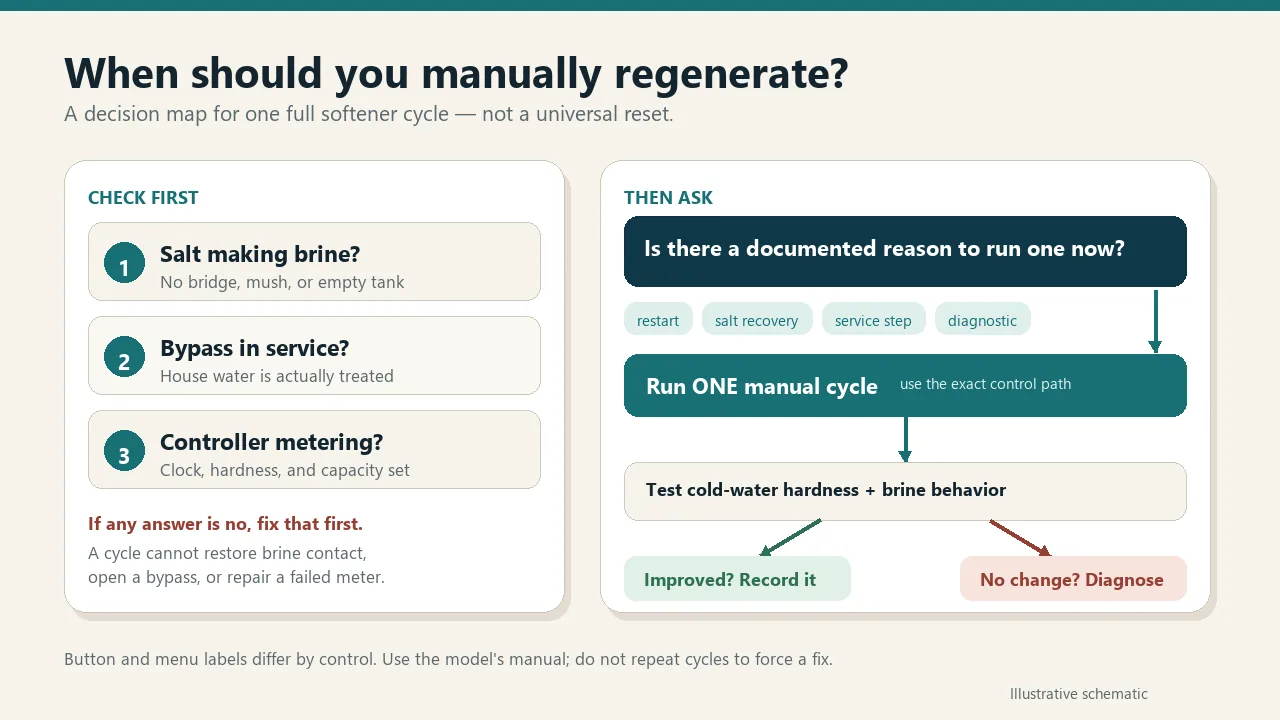
Decide when a manual softener regeneration is justified, compare Whirlpool, EcoWater, and Fleck control paths, and know when to stop and diagnose instead.
Sizing & costs
Estimate simultaneous household flow, compare it with a model-specific service-flow rating and pressure drop, and record the evidence before choosing a water softener.
Troubleshooting
Use an observation-first checklist to find why a water softener is not using salt, then separate salt bridges, metering, bypass, fill, and brine-draw questions.