Maintenance
Water Softener After a Power Outage: What Settings Should You Check?
Check your softener clock, retained programming and interrupted-cycle status after an outage, with model-specific examples and a printable recovery record.
Sizing & costs
Use your water test and model manual to choose a hardness setting. Check GPG versus ppm, iron compensation, and follow-up results with a printable worksheet.
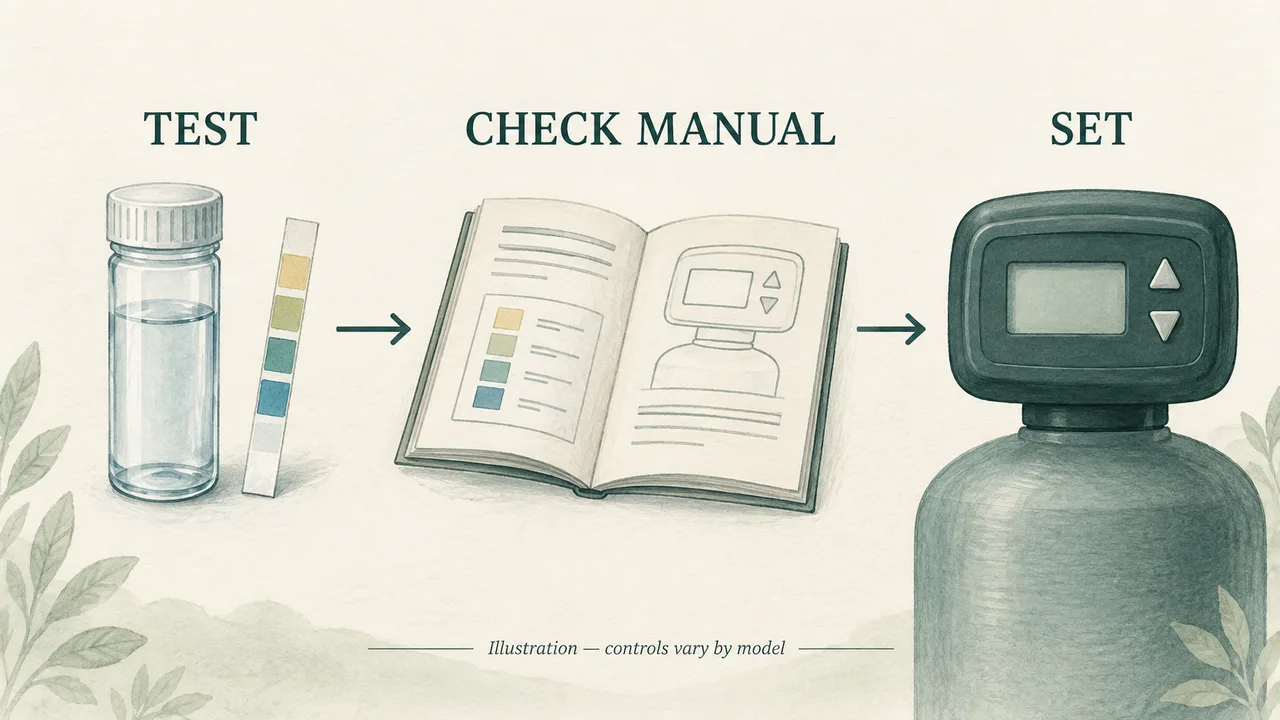
Set your water softener's hardness to the hardness of the water entering the unit, expressed in the units its controller expects, with only the adjustments required by your model's instructions. The number is usually an input used to plan regeneration, not a target for how hard you want the treated water to be. A factory default or a neighbor's setting is not a measurement of your supply.
For a salt-based ion-exchange softener, the useful starting point is a current incoming-water test and the matching owner's manual. Keep the measured result separate from the programmed value: iron compensation and controller features can make those numbers different.
Identify a sampling point before the softener. If other treatment equipment sits upstream, the sample should represent the water that actually reaches the softener. Do not assume an outdoor faucet is untreated or a kitchen tap is softened just because of its location; confirm the plumbing route with the installer when necessary.
Use a test intended to measure total hardness, following its collection, timing, and interpretation instructions. Record the result, unit, date, and sample point. A municipal supplier can help identify the hardness information for your service area; a well-water testing service can help establish hardness and iron levels. If a report gives only a range, ask how it applies to your supply before choosing a programming value.
A handheld TDS reading cannot replace the hardness result. A softener exchanges hardness minerals for sodium or potassium, so similar TDS readings before and after treatment do not establish failure. Rheem's explanation of hardness testing also emphasizes checking which water the sampled faucet receives.
If a strip gives a broad color band, write down that band. Do not invent a precise value from an uncertain color match. Ask for a suitable follow-up test when that uncertainty prevents you from choosing the setting specified by the manual.
Check both the test report and the controller. GPG means grains per US gallon. For a total-hardness result reported in mg/L or ppm as calcium carbonate, the usual practical conversion is:
Hardness in GPG = hardness in mg/L as CaCO3 ÷ 17.1
Rheem's hardness programming guide uses that conversion for its GPG setting. Do not apply it to TDS, iron, alkalinity, or an isolated calcium result.
These are arithmetic examples, not test results from a home. The possible entries assume a GPG controller and no required compensation.
| Example total hardness | Conversion | Possible GPG entry |
|---|---|---|
| 171 mg/L as CaCO3 | 171 ÷ 17.1 = 10 | 10 |
| 256.5 mg/L as CaCO3 | 256.5 ÷ 17.1 = 15 | 15 |
| 342 mg/L as CaCO3 | 342 ÷ 17.1 = 20 | 20 |
If the controller is configured to accept ppm, follow that unit setting instead of automatically entering the converted GPG number. For a result between available increments, use the manufacturer's rounding instructions or ask support. The table does not establish a universal rounding rule.
Also distinguish hardness in grains per gallon from softener capacity in grains. The capacity printed on the equipment is not the number to type into a hardness field.
Iron handling is model specific. Rheem's linked programming guidance adds a hardness allowance of five for each ppm of clear-water iron. Under that rule, an example with 15 GPG hardness and 1 ppm clear-water iron produces a programmed value of 20. That allowance does not mean the laboratory measured 20 GPG of hardness, and it is not a coefficient to copy to every controller.
For a contrasting design, the Whirlpool WHES48 E-Z Touch manual, 7310359 Rev L has a separate iron entry. Its controller instructions on printed page 17 explicitly say not to increase the hardness setting for iron because the control compensates after the iron level is entered. Page 21 also allows grains or ppm as hardness units.
There is a documentation wrinkle: that same manual's general discussion on page 5 says to add five grains for each ppm of ferrous iron. Owners matching this revision should use the controller-specific instructions and ask Whirlpool to resolve any remaining conflict before programming. Do not combine both approaches. This example shows why the complete model and manual revision matter more than a generic online formula.
Photograph the current display and find the manual section for your control. If your unit has a separate salt-type setting, include it in the review. Potassium chloride instructions can differ from sodium chloride instructions; do not apply a generic adjustment on top of an automatic feature without model-specific direction.
Use Print this page to keep this record with the manual. Fill unresolved fields with “unknown” so they become questions for the manufacturer, rather than hidden assumptions.
| Item to record | Your equipment and result |
|---|---|
| Complete model; manual number and revision | ____________________ |
| Incoming sample point; test date and method | ____________________ |
| Measured total hardness; original unit | ____________________ |
| Controller's selected hardness unit | ____________________ |
| Conversion, if required | ____________________ |
| Clear-water iron result; separate field or adjustment | ____________________ |
| Salt type; applicable manual instruction | ____________________ |
| Previous setting; proposed setting and reason | ____________________ |
| Manual page or support instruction used | ____________________ |
| Follow-up treated-water result and date | ____________________ |
Enter the supported value using your manual's programming procedure, save it, and return to the normal display as instructed. Check that the value was retained. Avoid changing capacity, reserve, cycle durations, and hardness together as an experiment: you would lose the ability to tell which change affected the result.
Follow your system's directions for any recovery or regeneration needed after correcting the setting. Then test a confirmed treated cold-water outlet using the hardness kit's instructions and any model-specific flushing procedure. Record the cycle completion and sampling times. A saved display value alone does not prove that the resin has regenerated or that the sampled outlet receives treated water.
Rheem explains that raising the hardness setting unnecessarily can increase recharge frequency, using more salt and water without making already softened water progressively softer. Treat the input as a documented operating value, not a “more softness” control.
If the setting is supported but the result remains wrong, use the hard-water-after-regeneration sample log and diagnostic branches. That guide helps distinguish a problem at one outlet, hardness immediately after a completed cycle, and hardness that returns later. Those observations are more useful to support than repeated unexplained increases to the setting.
A change in supply, upstream treatment, or a new test result is a reason to review the record. It does not automatically justify a larger number. Ask the utility whether a reported range reflects different service areas or changing supply conditions, then ask the equipment manufacturer how to program for the information that applies to your home.
Manual conflicts deserve the same care. Send support the model label, manual revision, relevant pages, water-test results, and current entries. Ask which instruction applies to that controller and how to verify the outcome. Keeping that answer alongside the worksheet gives the next owner or technician a basis for the setting, rather than another unexplained number to inherit.
Only if you verify that it matches the incoming-water result, controller units, and any model-required adjustment. A default makes initial setup possible; it does not establish the hardness at your address. Record the current value before editing it, obtain a usable total-hardness result, and compare the two using the programming instructions for the complete system.
First confirm that 171 ppm refers to total hardness as calcium carbonate, not TDS or another measurement. Dividing that hardness result by 17.1 gives 10 GPG. A controller expecting GPG would use that converted value before any required model-specific adjustment. A controller set to ppm needs its own matching input; inspect the selected units rather than choosing by the size of the number.
It is not a general outlet-softness adjustment. In the Rheem systems discussed here, the hardness entry helps determine when recharge is needed, and an unnecessarily high entry can use extra salt and water. If treated water tests hard, verify the sample, input value, and model's recovery procedure. If it already meets the expected result, increasing the setting has no established benefit from that observation alone.
Do not assume that both are required. The WHES48 Rev L controller instructions explicitly use a separate iron entry and tell the owner not to raise the hardness value for iron. Other systems use a compensated hardness number. Match the exact manual and controller, and ask the manufacturer to resolve conflicting instructions before adding another allowance to the measured hardness.
Correct programming is only one part of treatment. Confirm that any required recovery cycle finished and that the sampled cold tap receives softened water. Keep the new entry and follow-up test in your record. If the result is still unexpected, document whether every treated outlet is affected and whether hardness appears immediately or later, then follow the model's troubleshooting or support path.
Maintenance
Check your softener clock, retained programming and interrupted-cycle status after an outage, with model-specific examples and a printable recovery record.
Maintenance
Choose a model-appropriate vacation plan, record power and valve positions, separate freezing-weather preparation, and check the return to service.
Salt & regeneration
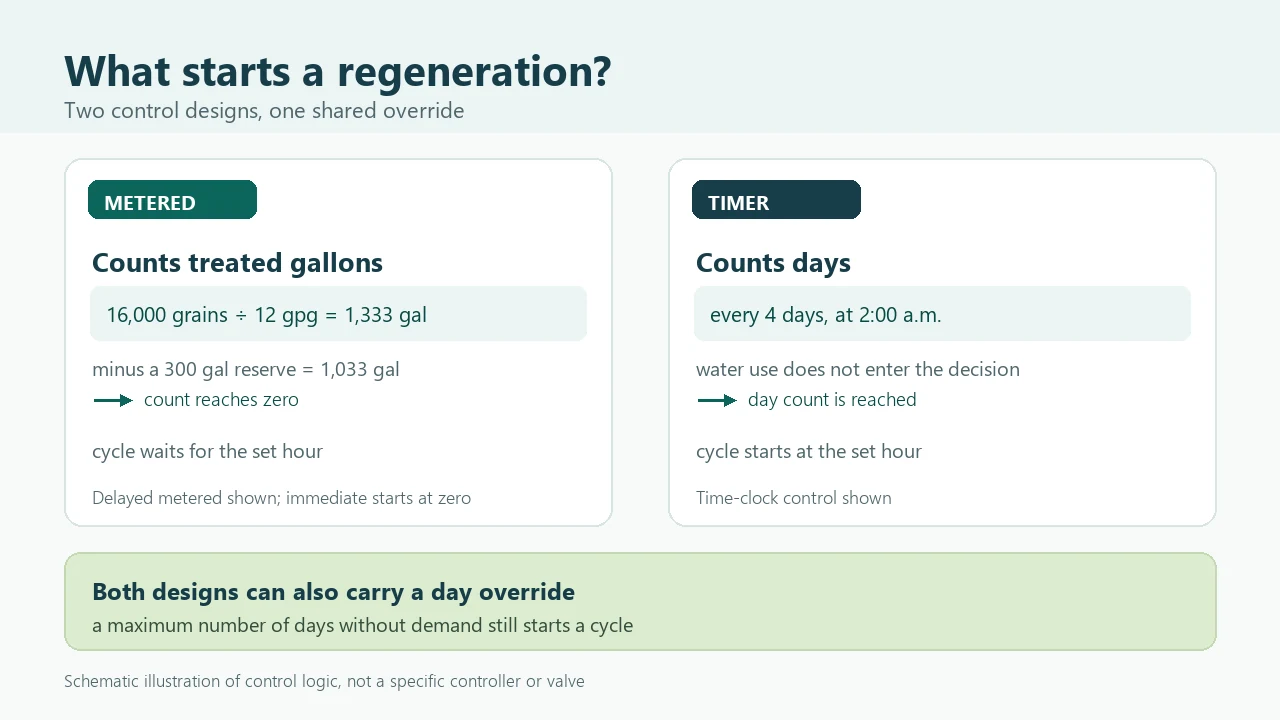
Compare how metered and time-clock softener controls decide when to regenerate, with the immediate and delayed trigger paths, a shared day override, and worked gallons arithmetic for two usage patterns.
Salt & regeneration
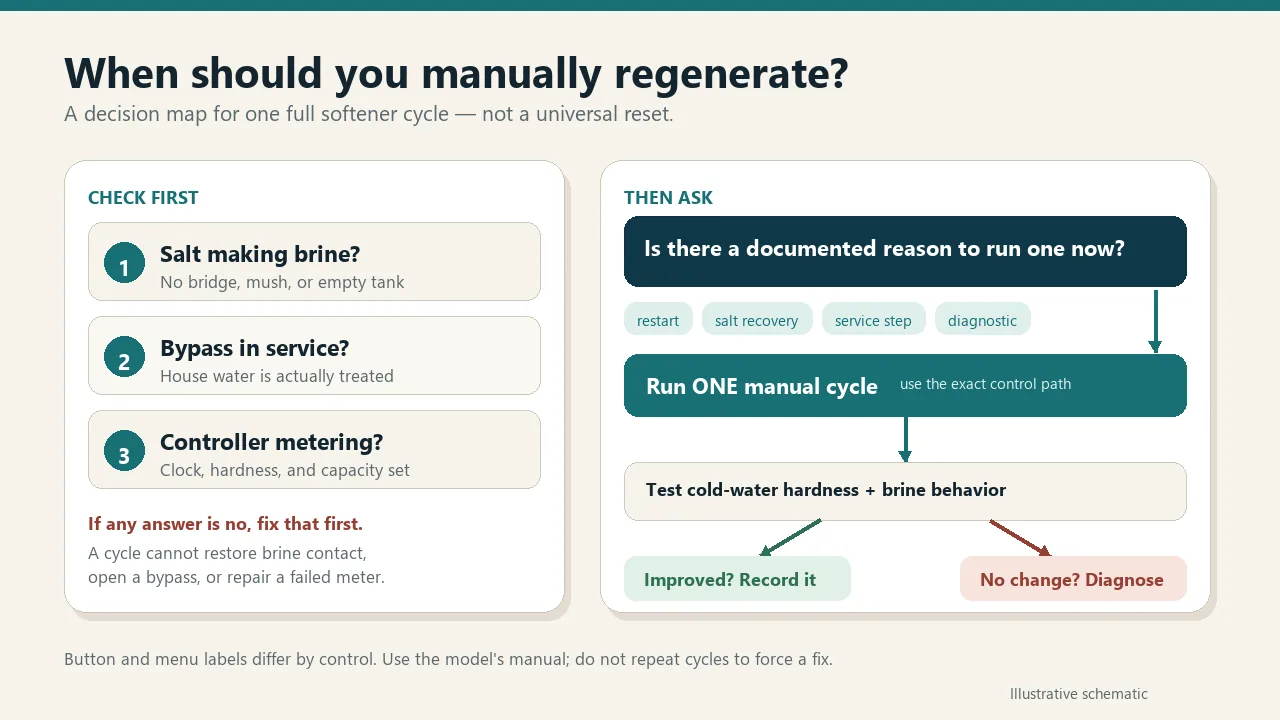
Decide when a manual softener regeneration is justified, compare Whirlpool, EcoWater, and Fleck control paths, and know when to stop and diagnose instead.
Sizing & costs
Estimate simultaneous household flow, compare it with a model-specific service-flow rating and pressure drop, and record the evidence before choosing a water softener.
Troubleshooting
Use an observation-first checklist to find why a water softener is not using salt, then separate salt bridges, metering, bypass, fill, and brine-draw questions.