Maintenance
Water Softener After a Power Outage: What Settings Should You Check?
Check your softener clock, retained programming and interrupted-cycle status after an outage, with model-specific examples and a printable recovery record.
Salt & regeneration
Choose pellets or coarse solar crystals by checking your model manual, bag specifications, and tank condition. Includes a printable salt-selection card.
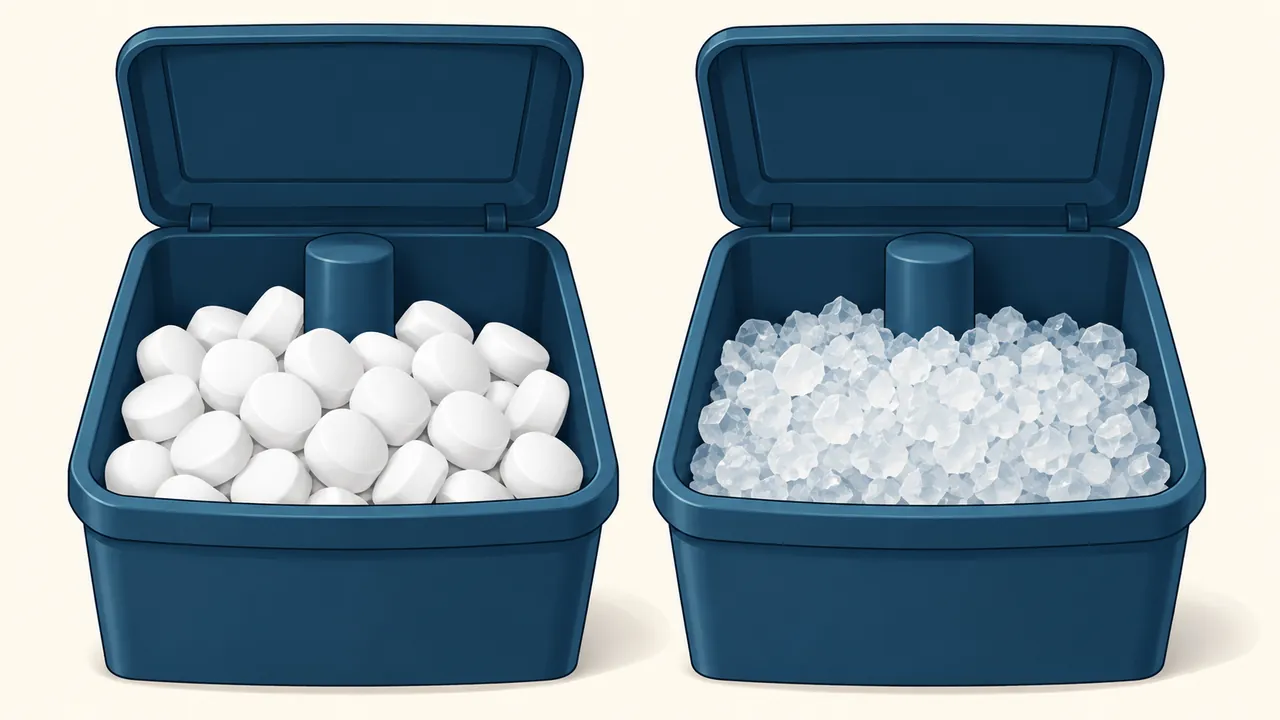
If your softener's manual permits both pellet salt and coarse solar crystals, either can be a reasonable choice. Check the specified salt type and impurity limit first, then compare the actual bags available to you. Shape alone does not establish that one salt will soften water better in every machine. The decision card below separates a model requirement from a manufacturer's general advice so you can buy a compatible product without guessing.
This guide concerns household ion-exchange softeners with a salt storage or brine tank. It does not cover salt-free conditioners. The cover is an illustration of salt shapes, not a photograph of a tested installation or a diagram of a particular tank.
Find the full model number on the unit and read its salt instructions. One concrete example is the Whirlpool WHES30/33/40/44 installation booklet, which names nugget, pellet, and coarse solar salt with less than 1% impurities. That is permission for the listed models, not a specification for every water softener. The same booklet excludes rock, block, table, and ice-melting salts from its recommended choices. If your own manual names a narrower set, use that narrower set.
Read the bag as carefully as the manual: identify the chemical (usually sodium chloride), the intended use (“water softener”), the shape, any stated purity or insoluble-material figure, and any additives. “Crystal” can describe a physical form; it does not tell you whether the bag is coarse solar salt approved by your equipment maker. Likewise, a pellet label does not override a model-specific prohibition. If the label does not provide the information your manual requires, ask the maker or choose a bag with a clear specification.
Pellets are compressed salt particles; coarse solar salt is made as crystals through evaporation. Rheem's salt-type guide lists both as suitable for its softeners and emphasizes high purity and low contaminants. It says pellets can help reduce bridging. That statement is useful when choosing for a Rheem unit, but it is not a measured guarantee that pellets prevent bridges in every tank.
The resin is regenerated by brine made from the salt. In a compatible, functioning system, the relevant purchasing question is whether the product provides the salt and quality the unit calls for; the visible shape is only one part of that question. Humidity, overfilling, long periods between regenerations, and an unsuitable product can also be involved when salt forms a hard layer. Switching shapes while ignoring those conditions may leave the problem unchanged.
Use four checks to compare the actual bags:
For refill quantity and timing, use the model-based salt-level and refill record. It helps you document the level before and after adding salt; a bag's weight does not set the fill line for every tank. Print this page as a shopping card if you want to compare labels beside the appliance manual.
Write these five fields before the next purchase. Leaving an item blank is a reason to check, not an invitation to fill it with a generic recommendation.
| Field | Your entry |
|---|---|
| Complete softener model and manual version | __________ |
| Manual's approved salt forms and impurity limit | __________ |
| Current bag: name, chemical, form, additives, label specification | __________ |
| Candidate bag: same label details | __________ |
| Existing salt condition and next inspection date | __________ |
If both candidate bags meet the manual, choose using a practical factor you can verify, such as availability, the bag's disclosed specifications, or whether your manufacturer offers model-specific advice for a recurring bridge. Record the choice and the tank's condition. If softened-water performance changes later, that record gives you a starting point without assuming the salt shape caused it.
Do not bury a solid salt layer under a new bag and call that a product comparison. First identify whether the salt remains loose and the tank can make brine. A bridge can leave an apparently full tank while salt stops reaching the water beneath it. The appropriate check and remedy depend on the equipment. For loose residue or a brinewell problem, the salt-tank and brinewell cleaning guide explains how to identify the model and keep cleaning separate from sanitizing or valve service. It is the next step when there is an observable tank condition, not a routine requirement for every change of brand.
Rheem's support advice for its own units says to keep one shape at a time rather than mixing pellets and crystals because mixing may increase bridging or blockage. If you have a Rheem unit, follow that instruction. For a different brand, read its manual or ask its support team how to use remaining salt during a changeover. Do not transfer a Rheem fill scale, changeover rule, or bridge procedure to a different tank.
The best choice can change when you identify a different model, discover a tighter manual specification, or see a persistent tank symptom. A bag formula can change, too, so retain the product label rather than relying on an old name. If two approved products are available, there is no need to claim an unmeasured performance difference. Keep the model, bag, fill level, and observed condition together; that evidence makes a later conversation with the manufacturer more useful than a blanket pellets-versus-crystals rule.
No. Check the complete model's approved salt list and any purity or impurity requirement before comparing shapes. The Whirlpool booklet cited above accepts pellets and coarse solar salt for its listed models, while Rheem also discusses both forms for its equipment. Those examples do not create a universal rule. If both forms are approved for your unit, compare the actual bag labels and keep a record of tank condition rather than expecting a particular shape to fix every softening problem.
The word “crystals” is not enough to establish compatibility. Read whether the bag is intended for water softeners, what chemical it contains, and what the label says about purity, insoluble material, or additives. Then compare those details with your own model's manual. A manual that approves coarse solar salt does not necessarily approve every crystalline product sold for another purpose. If the label lacks a required specification, choose a clearly documented product or ask the equipment maker before buying.
Follow your manufacturer's changeover directions instead of assuming every tank must be emptied. Rheem advises owners of its softeners to stay with one shape rather than mixing pellets and crystals, but other brands may give different instructions. Identify the model, note the amount and condition of salt already in the tank, and ask support how to handle usable stock if the manual is silent. A hardened layer or heavy residue is a separate tank problem that should be addressed under the applicable service guidance.
Do not count on a new bag to remove a bridge that is already present. The hard layer can prevent salt from reaching the water beneath it even when the tank looks full. Record what you can observe, then use your model's bridge instructions or contact its support team. Rheem says pellets can help reduce bridging for its units, but also names humidity, excess salt, and long intervals between recharges as possible contributors. A product switch cannot diagnose those conditions by itself.
The manual's specification is the deciding requirement. In the cited Whirlpool booklet, approved forms include pellets and coarse solar salt, with less than 1% impurities. Rheem likewise emphasizes high purity and low contaminants in its salt guidance. That supports checking the quality information on a bag as well as its shape; it does not establish one universal purity threshold for all softeners. If your manual is more specific, follow it and keep the label details in your purchasing record.
Maintenance
Check your softener clock, retained programming and interrupted-cycle status after an outage, with model-specific examples and a printable recovery record.
Maintenance
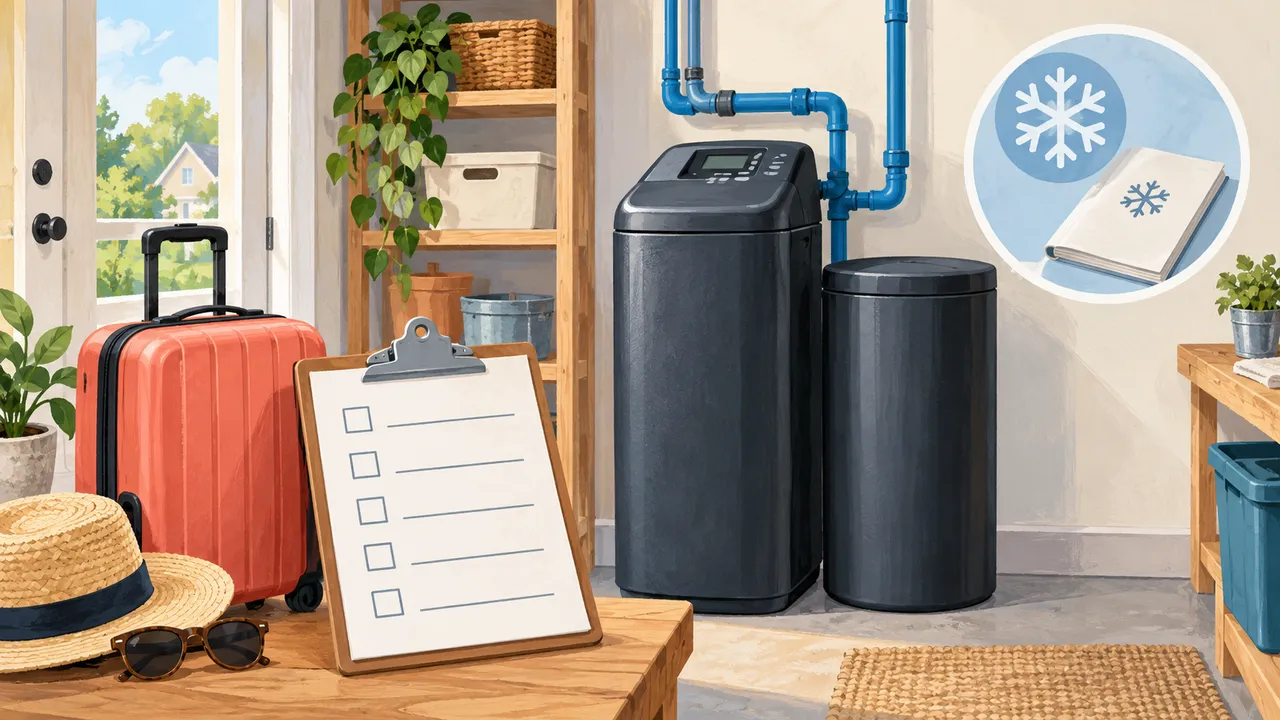
Choose a model-appropriate vacation plan, record power and valve positions, separate freezing-weather preparation, and check the return to service.
Salt & regeneration
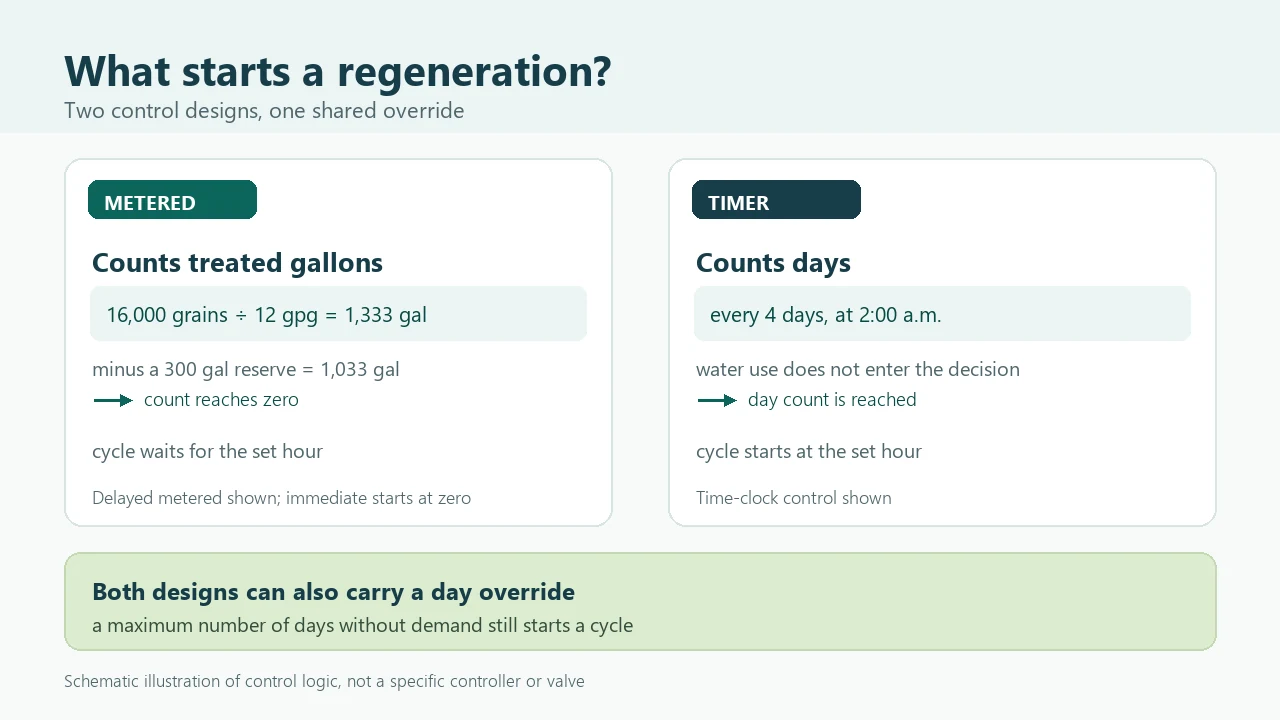
Compare how metered and time-clock softener controls decide when to regenerate, with the immediate and delayed trigger paths, a shared day override, and worked gallons arithmetic for two usage patterns.
Salt & regeneration
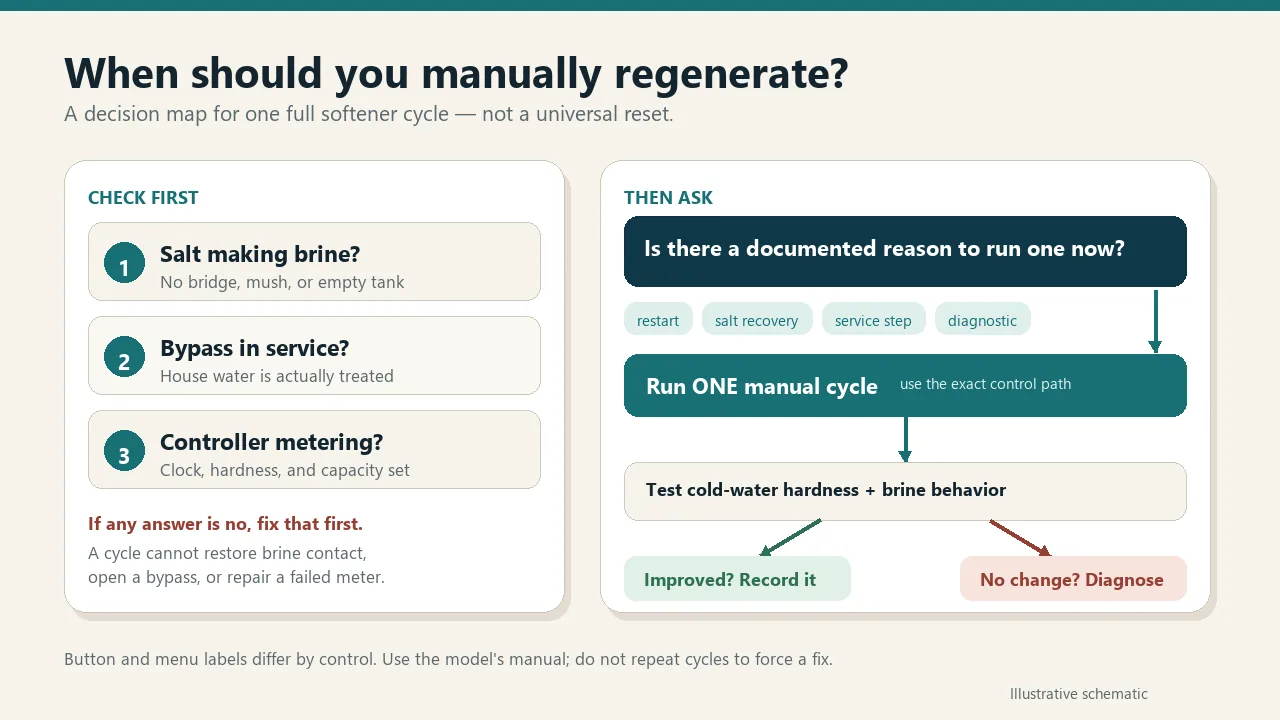
Decide when a manual softener regeneration is justified, compare Whirlpool, EcoWater, and Fleck control paths, and know when to stop and diagnose instead.
Sizing & costs
Estimate simultaneous household flow, compare it with a model-specific service-flow rating and pressure drop, and record the evidence before choosing a water softener.
Troubleshooting
Use an observation-first checklist to find why a water softener is not using salt, then separate salt bridges, metering, bypass, fill, and brine-draw questions.