Maintenance
Water Softener After a Power Outage: What Settings Should You Check?
Check your softener clock, retained programming and interrupted-cycle status after an outage, with model-specific examples and a printable recovery record.
Sizing & costs
Check manufacturer lifespan estimates, diagnosis, parts, and warranty before replacing a water softener. Print a repair-versus-replacement worksheet.
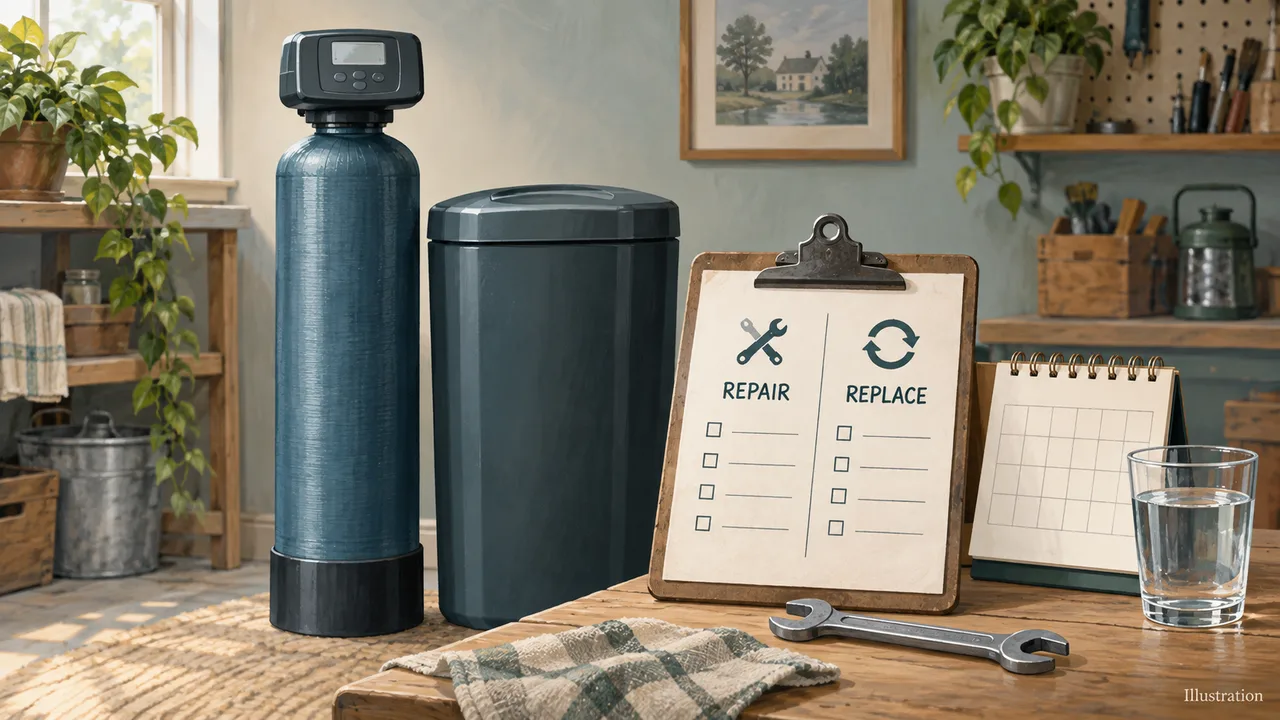
Water softeners can provide years of useful service, but there is no single replacement age that fits every system. Rheem estimates about 8–10 years for its softeners, depending on incoming water quality and use. Culligan describes 10–15 years or more for a well-maintained, high-quality system. Use those estimates to plan ahead, then base a repair or replacement decision on the equipment's condition, the diagnosed problem, available parts, and the scope of the quote.
This guide covers residential salt-regenerated ion-exchange softeners. The Rheem lifespan answer and Culligan's replacement guidance are manufacturer advice, not a shared independent study of when all softeners fail. Neither tells you how many years remain in the unit in your home.
Keep the installation invoice, model and serial number, and service history together. If the installation date is unknown, ask the manufacturer to help interpret the serial number. Record a manufacturing date as a manufacturing date; the equipment may have been installed later. An old receipt for a replacement control also does not establish the age of the entire system.
Write down what prompted the question. A functioning older unit, a repeated repair, and a sudden loss of soft water are different decisions. Record the symptom, when it started, recent maintenance, and any change in household water use. Leave the cause unassigned until it has been checked.
If the complaint is hard water, use the post-regeneration hardness diagnostic and sampling record before accepting a resin-replacement recommendation. It helps distinguish water that never becomes soft from hardness that returns later or affects only particular outlets. A change in feel or a TDS reading alone is not a diagnosis of worn-out resin.
Ask the service provider to connect the proposed repair to an observation: which test identified the problem, which component is involved, and what result should improve afterward? Keep that answer with the quote. “The unit is old” supplies context but leaves those questions unanswered.
A softener contains several components, and a parts list can help you ask a more precise question. For example, the Rheem RHW42 manual, revision K lists resin, tanks, electronic controls, and valve parts separately on pages 29 and 31. That supports asking about a component repair; it does not prove that a listed part is currently stocked or that replacing it is economical.
Ask for the complete part identification, availability, labor, and any additional work required to restore service. A resin-only proposal should also explain the condition of the tank and valve. Replacing one component does not renew everything left in place.
Read warranty scope alongside the quote. Page 32 of that RHW42 manual illustrates different coverage for different components, with conditions and a separate extension provision. Check the warranty supplied with your own unit, purchase eligibility, coverage dates, and who pays labor or other charges. Have the provider confirm the applicable coverage before treating an advertised warranty as a reduction in your bill.
Use this table to organize the decision, rather than assigning a retirement date from the equipment's age.
| What you have established | Reasonable next step | What still needs an answer |
|---|---|---|
| The system meets the expected treated-water result and has no known fault | Continue the model's maintenance and keep a service record | What change would trigger another assessment? |
| A specific fault has been identified and a suitable part is available | Compare a complete repair offer with replacement | What will be verified after repair, and what remains old? |
| The proposed repair leaves another known problem unresolved | Request a combined scope before deciding | What would the additional work cost and involve? |
| Faults recur or needed parts cannot be obtained | Obtain a replacement proposal and clarify any viable repair alternative | Does replacement address the cause and current household needs? |
| There is an active leak, visible damage, or an unresolved pressure problem | Arrange prompt model-appropriate service | What must be made safe or isolated before normal use continues? |
Follow your own system's instructions for any isolation or bypass action. This decision table does not provide a universal valve position or instructions for opening pressurized equipment.
Use Print this page to keep this worksheet with the service paperwork. Put “unknown” in unanswered fields. A blank assumption should not quietly become a promise of reliable service.
| Comparison item | Your record and provider's answer |
|---|---|
| Model, serial number, installation date or documented age estimate | ____________________ |
| Current symptom and test that supports the diagnosis | ____________________ |
| Repair: named parts, availability, labor, and total quoted amount | ____________________ |
| Repair: other known problems included or excluded | ____________________ |
| Repair: applicable coverage and your remaining charges | ____________________ |
| Replacement: complete model and installation scope | ____________________ |
| Replacement: removal, connections, setup, and other quoted charges | ____________________ |
| Each option: promised result and how it will be checked | ____________________ |
| Each option: ongoing maintenance obligations and expected expenses | ____________________ |
| Quote date, expiry, service contact, and unresolved questions | ____________________ |
Compare amounts for work that reaches the same stated outcome. A parts-only repair figure and a fully installed replacement price are incomplete comparators until the missing work is priced. Ask whether each total includes the items listed in the worksheet, and retain exclusions in writing.
Avoid a universal rule that repair must cost less than a particular fraction of replacement. That shortcut can hide missing labor, another known fault, or a coverage difference. A modest repair with no supported diagnosis deserves more questions; a substantial repair with a clear scope can still be worth comparing. The worksheet makes those differences visible without pretending to predict the next failure.
After work is completed, retain the service report and the agreed verification result. If the original complaint was intermittent, ask how and when that pattern will be checked rather than accepting a single reassuring observation as the whole follow-up plan.
Your planned time in the home changes the questions to ask, even though it cannot establish the remaining life of either option. A short-term repair decision may emphasize the immediate outcome and unresolved faults. A longer-term comparison also needs accessible service, replacement-part support, and ongoing care requirements. Ask what evidence supports any claimed remaining service life, and leave an unsupported estimate labeled uncertain.
Household demand may also have changed since the original installation. Before ordering the same advertised capacity, use the water-softener sizing calculator and supplier worksheet with current softened-water use and incoming hardness. Have the supplier check flow needs separately. Replacing an old unit gives you a chance to revisit the original assumptions; choosing a newer label alone does not show that the proposed system fits them.
Age is a reason to review condition and plan for future expense, but it does not identify a failed component. If the system delivers the expected treated-water result and has no known fault, keep its maintenance and service record current. If a problem appears, ask for a documented diagnosis and compare complete repair and replacement proposals before deciding.
Start with the installation invoice and any paperwork left by a previous owner. Photograph the model and serial label, then ask the manufacturer how to interpret it when the date is unclear. Keep manufacturing, installation, and component-replacement dates separate. If the installation date remains unknown, record that uncertainty instead of treating a control's replacement date as the system's age.
Ask whether resin replacement is supported for your complete model and what evidence identifies resin as the problem. A parts list is a starting point, not confirmation of stock or a diagnosis. The proposal should address the tank and valve's condition, include the work needed to restore service, and explain how the result will be checked after the repair.
A warranty describes specified coverage under stated conditions; it does not give your particular unit a remaining-life forecast. Read which components are covered and how eligibility, labor, and other charges are handled. Use the documentation for your own model and purchase, then have the provider confirm what applies to the proposed work before deducting anything from your expected bill.
A fixed percentage cannot account for differences in diagnosis, included work, unresolved problems, or coverage. Request a total repair quote and a complete replacement proposal, then compare the outcome each promises. If one leaves a known fault or a necessary charge outside its scope, resolve that gap first. Keep uncertain future repairs separate from expenses that are already documented.
Maintenance
Check your softener clock, retained programming and interrupted-cycle status after an outage, with model-specific examples and a printable recovery record.
Maintenance
Choose a model-appropriate vacation plan, record power and valve positions, separate freezing-weather preparation, and check the return to service.
Salt & regeneration
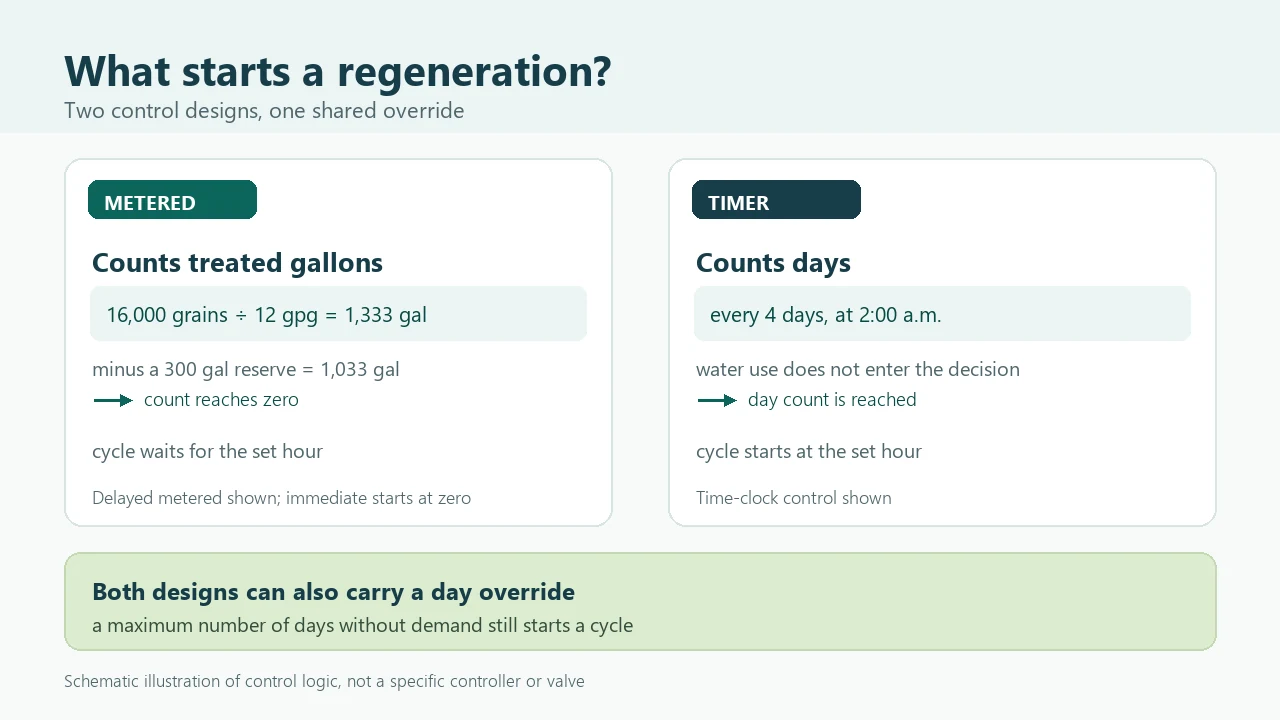
Compare how metered and time-clock softener controls decide when to regenerate, with the immediate and delayed trigger paths, a shared day override, and worked gallons arithmetic for two usage patterns.
Salt & regeneration
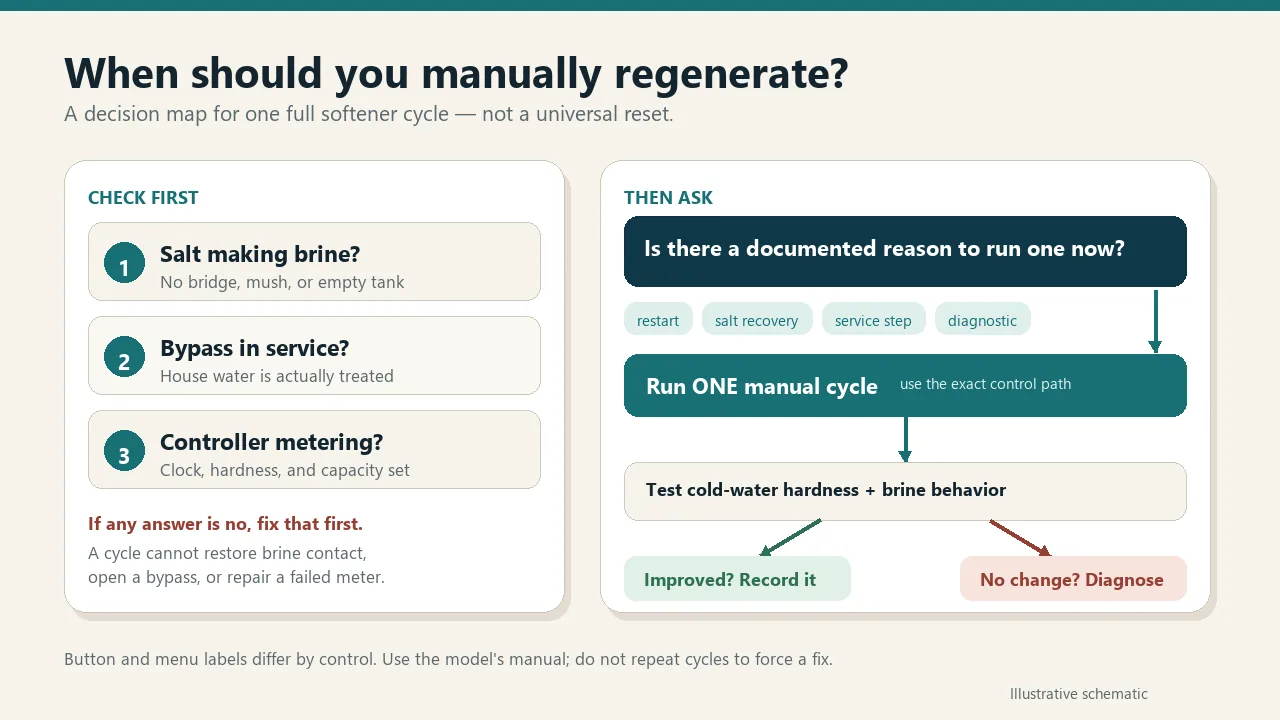
Decide when a manual softener regeneration is justified, compare Whirlpool, EcoWater, and Fleck control paths, and know when to stop and diagnose instead.
Sizing & costs
Estimate simultaneous household flow, compare it with a model-specific service-flow rating and pressure drop, and record the evidence before choosing a water softener.
Troubleshooting
Use an observation-first checklist to find why a water softener is not using salt, then separate salt bridges, metering, bypass, fill, and brine-draw questions.