Maintenance
Water Softener After a Power Outage: What Settings Should You Check?
Check your softener clock, retained programming and interrupted-cycle status after an outage, with model-specific examples and a printable recovery record.
Sizing & costs
Compare dated US equipment prices, identify installation extras, and print a project budget before approving your water softener purchase.
A water softener's equipment price can be several hundred dollars before installation. For a concrete reference, three Aquasure models listed on its US store cost $539.99, $629.99, and $749.99 when checked September 15, 2026. Those are equipment examples from one manufacturer. Your installed cost also depends on the connections, site work, and services included in your local proposal.
Build the budget in separate lines: equipment + installation and materials + any extra site work + removal + applicable taxes and fees. Mark an unpriced item as unknown until someone confirms its scope. A blank installation line does not mean installation is free.
The following prices appeared in Aquasure's US Harmony catalog on September 15, 2026. They are displayed online prices in US dollars, not ZIP-specific checkout totals, installed quotes, or a survey of the entire market.
| Model listed | Advertised grain label | Displayed equipment price |
|---|---|---|
| Harmony AS-HS32D | 32,000 grains | $539.99 |
| Harmony AS-HS48D | 48,000 grains | $629.99 |
| Harmony AS-HS64D | 64,000 grains | $749.99 |
The comparison excludes installation labor, site modifications, removal, and any taxes or shipping that apply to your purchase. Confirm current price, availability, package contents, and checkout charges before ordering. These examples establish what a particular seller listed on a particular date; they do not establish the cheapest available system or the right model for your home.
Keep the exact model on the budget. A quote with a softener, prefilter, drinking-water system, and service package covers a different purchase from a softener alone. Ask for each component's purpose and price so that an optional addition does not disappear into the equipment total.
A replacement can reuse some existing infrastructure, but the installer still needs to check whether it fits the new equipment. A first installation may require a new connection to the water supply and a suitable drain or electrical provision. A different location can change the work even when the equipment stays the same.
Culligan's explanation of installation costs, updated September 1, 2026, identifies labor, extra parts, plumbing, local permit or inspection requirements, and old-system removal as items that can change the proposal. It also notes that quotes may combine equipment and installation. Ask the provider to identify the included scope in writing; local requirements and the actual property determine what applies.
Before choosing equipment, use the water softener sizing calculator and supplier record. Take the resulting working-capacity target, its inputs, and a separate flow requirement to the supplier. An advertised grain label is not enough to choose a system, and the largest number in a product family is not a reason to spend more.
Use Print this page above the article and fill out the record below. This is a single-project budget: its purpose is to expose omissions before you approve the work. Enter an amount only when you have a quote, a current checkout total, or a clearly labeled planning allowance.
Project location: ____________________ Quote date: ____________________
Proposed model: ____________________ Price valid through: ____________________
| Budget line | Amount / included / unknown | What to confirm |
|---|---|---|
| Softener equipment | __________ | Exact model and supplied components |
| Installation labor and connection materials | __________ | Written work description and exclusions |
| Additional site work | __________ | Each required change and who prices it |
| Old equipment removal | __________ | Disconnecting, carrying away, and disposal scope |
| Delivery and starting supplies | __________ | Charges and items already in the package |
| Applicable taxes and fees | __________ | Final amounts and who pays them |
| Other treatment equipment | __________ | Separate purpose and approval |
| Total priced upfront work | __________ | Sum without duplicate bundled items |
| Unpriced work still outstanding | __________ | Owner of the question and next response date |
For bundled lines, write “included in equipment package” or identify the other line that covers the charge. Do not enter the same labor allowance twice simply because both the retailer and installer mention installation.
Send the incomplete record back with a specific request: “Please confirm which of these items are included, price the required extras, and identify anything you cannot determine until the site visit.” That answer is more useful than asking whether a total is generally expensive.
Keep recurring service separate. If a provider offers maintenance, salt delivery, or a payment plan, request the recurring amount, duration, inclusions, and cancellation or end-of-term conditions. An initial payment alone does not describe the cost of the arrangement.
Here is an invented US-dollar planning example, prepared September 15, 2026. These amounts are arithmetic inputs, not local labor rates, market averages, or the installation price for any model above.
| Assumed item | Illustrative amount |
|---|---|
| Equipment | $650 |
| Installation labor and connection materials | $550 |
| Additional drain or power work | $180 |
| Old equipment removal | $90 |
| Applicable taxes and fees | $80 |
| Illustrative upfront total | $1,550 |
The calculation is $650 + $550 + $180 + $90 + $80 = $1,550. If the site review identifies another $300 of required work, the scenario becomes $1,850. The arithmetic shows why the equipment price alone cannot settle the budget; it does not predict what your installer should charge.
Replace every assumed amount with your own evidence. If an extra is still unpriced, keep the priced subtotal and the unresolved item side by side instead of presenting the subtotal as a complete quote. This also makes it easier to tell whether a later price change reflects new work or a change in the original price.
A higher upfront price is worth examining when it buys something you can identify: a different installation scope, documented equipment suitability, an included service commitment, or another feature you actually want. Ask what changes for your household and how the provider supports that claim. A larger package deserves a clearer explanation, not an automatic preference.
Operating expense is another part of that decision. Use the running-cost calculator with the proposed system's documented salt and regeneration-water inputs and your own rates. Include applicable sewer charges, maintenance, and known electricity costs. Keep purchase and installation outside that operating subtotal, then compare both figures over a period you choose.
Uncertain savings should remain uncertain. If a seller cannot document an operating-cost difference, a higher initial price may still offer useful service or convenience, but the budget should name that benefit rather than assume the purchase will pay for itself. The question to leave open is which costs and responsibilities you want to take on after installation, and what evidence would change that choice.
Start with the exact equipment and the work required at your property. The listed manufacturer prices in this guide cover equipment examples only. An installed proposal needs to state the labor, materials, site changes, removal, and applicable charges it includes. Ask for unpriced required work to be resolved before treating the total as complete; this guide does not establish a nationwide installed average.
Do not assume it does. Read the package description and identify who will perform the work. A listing may offer installation separately, while a local provider may combine it with equipment. Write the inclusion beside the price in your budget, along with delivery and applicable checkout charges. This prevents both missing a charge and counting a bundled service twice.
Existing connections may reduce the work, but their presence does not establish a lower final price. The proposed model and location still need review, and removal adds a separate question. Ask the installer what can be reused, what must change, and whether disposal is included. Compare the stated project scope rather than assuming every replacement is a straightforward equipment swap.
Choose around documented household requirements. Use softened water demand and incoming hardness to develop a working-capacity target, then check the proposed model's relevant operating conditions and service flow. The grain number in a product name does not complete those checks. Ask the supplier to explain why the chosen configuration fits before paying for a larger model or additional equipment.
Budget separately for salt, regeneration water, applicable sewer charges, maintenance, and known electricity. Optional delivery or service arrangements may add recurring commitments, so keep their written terms. The running-cost calculator helps organize those inputs, but its example values are not your household's forecast. Use your own rates and model-specific information, and keep unknown expenses visible instead of entering zero by default.
Maintenance
Check your softener clock, retained programming and interrupted-cycle status after an outage, with model-specific examples and a printable recovery record.
Maintenance
Choose a model-appropriate vacation plan, record power and valve positions, separate freezing-weather preparation, and check the return to service.
Salt & regeneration
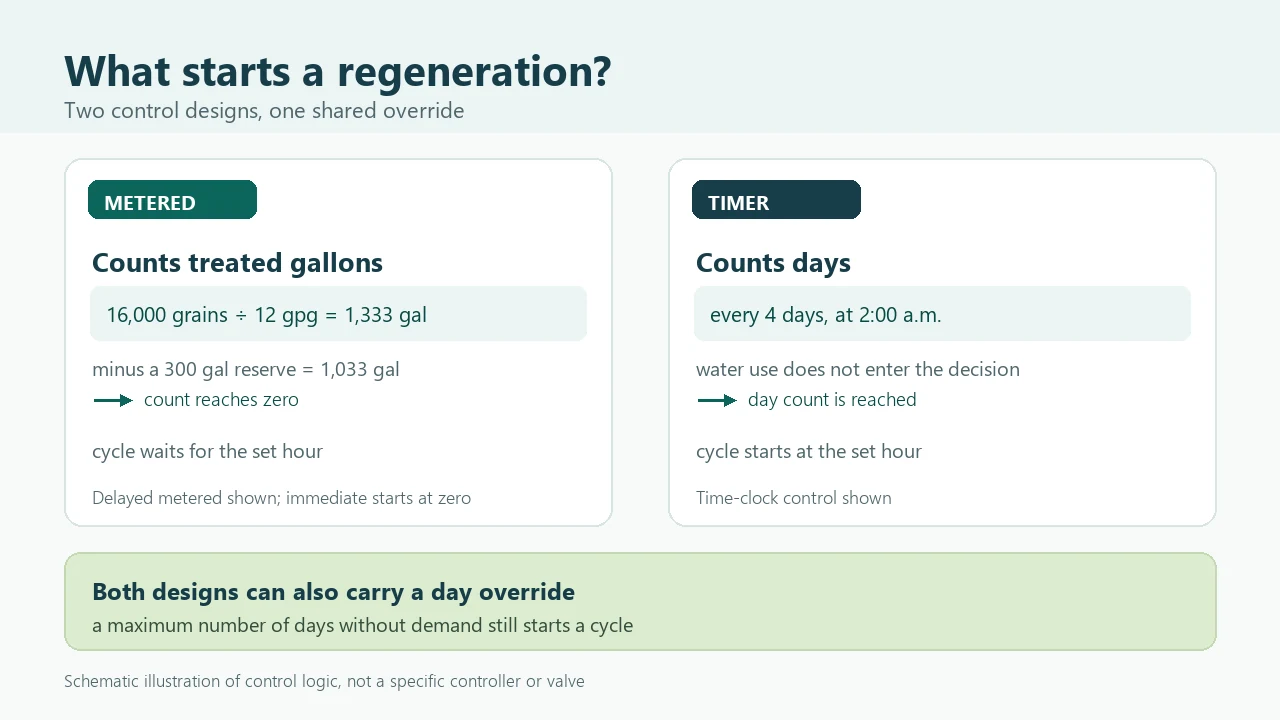
Compare how metered and time-clock softener controls decide when to regenerate, with the immediate and delayed trigger paths, a shared day override, and worked gallons arithmetic for two usage patterns.
Salt & regeneration
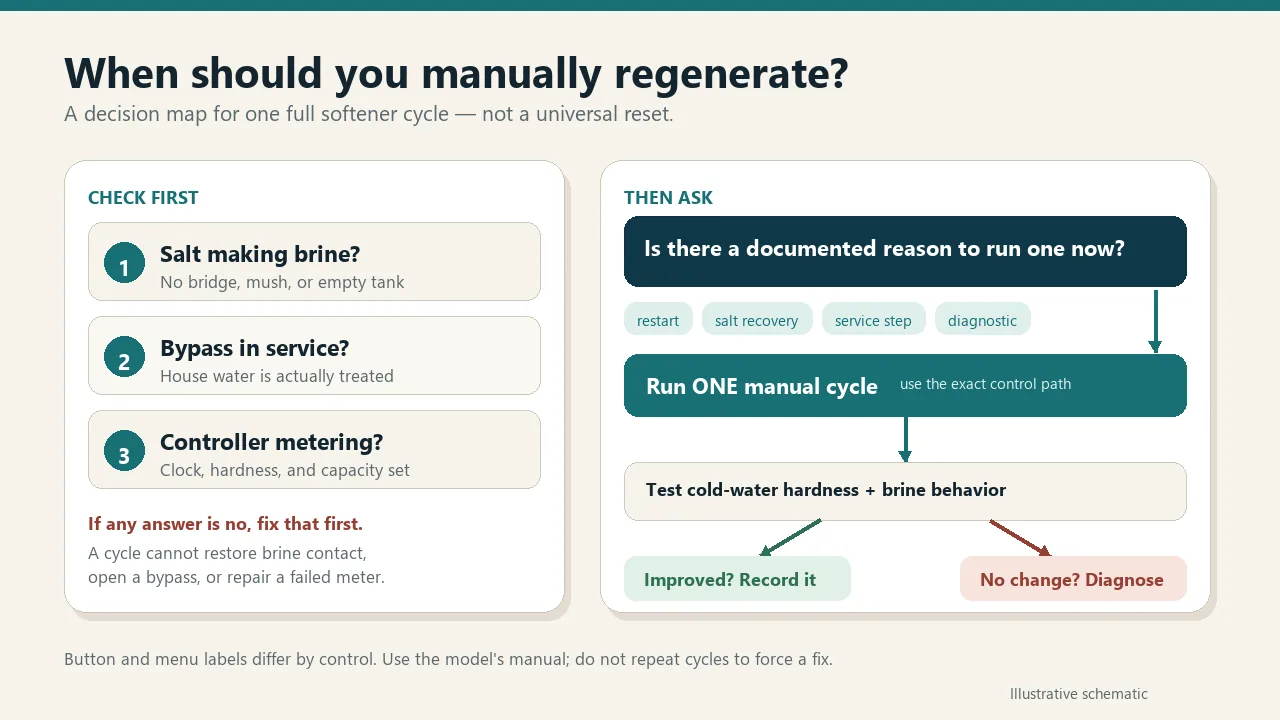
Decide when a manual softener regeneration is justified, compare Whirlpool, EcoWater, and Fleck control paths, and know when to stop and diagnose instead.
Sizing & costs
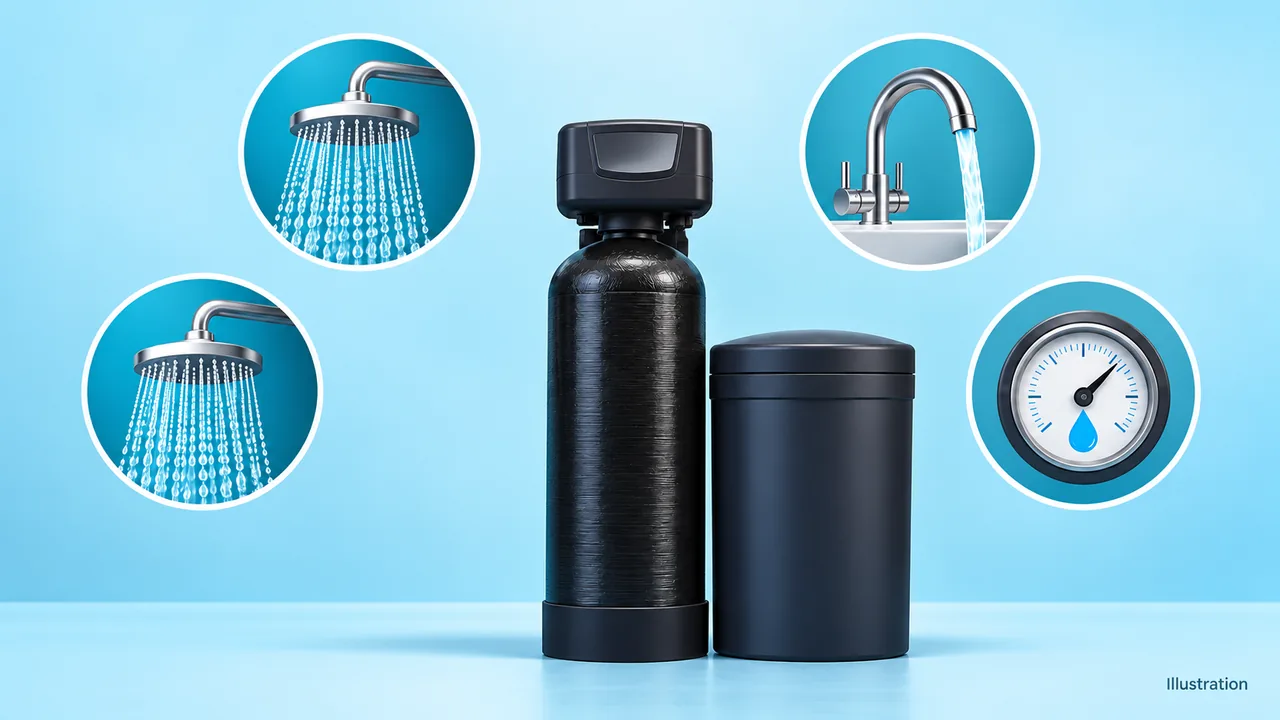
Estimate simultaneous household flow, compare it with a model-specific service-flow rating and pressure drop, and record the evidence before choosing a water softener.
Troubleshooting
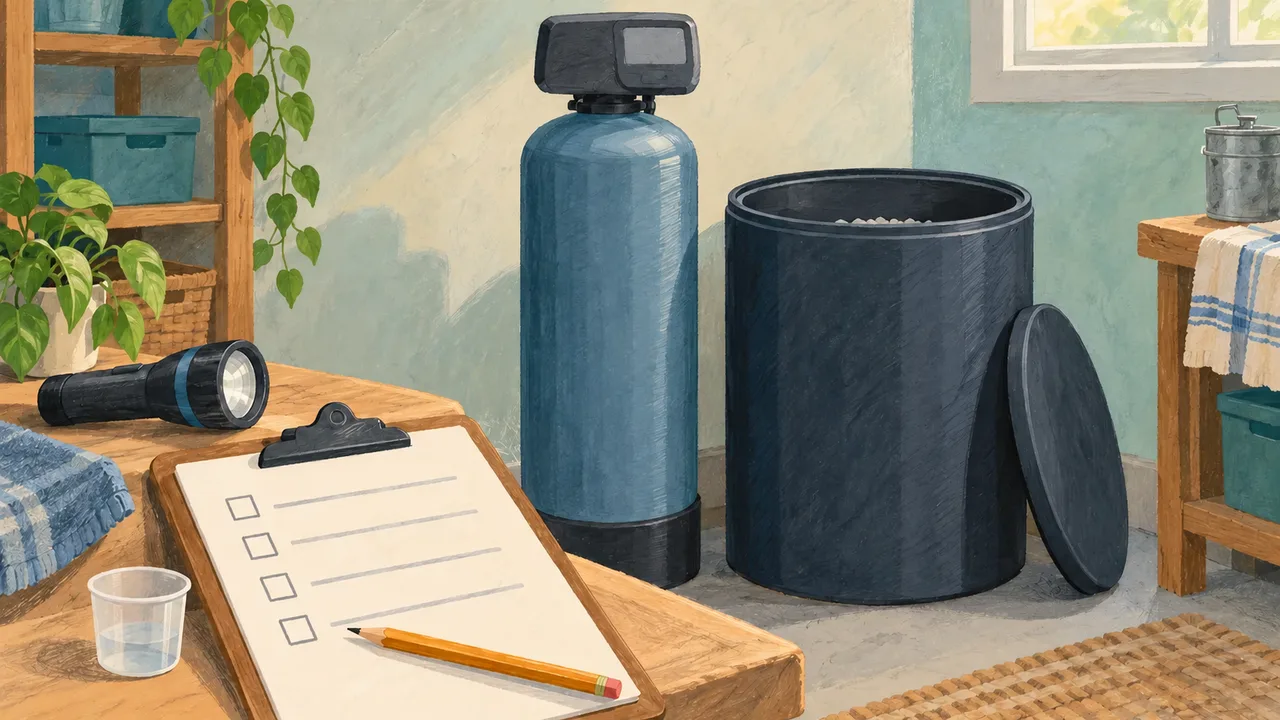
Use an observation-first checklist to find why a water softener is not using salt, then separate salt bridges, metering, bypass, fill, and brine-draw questions.